Prove It, Tea Partiers. Prove It.

Steven Taylor posed several questions about the Republicans to OTB readers:

What will have to happen in the House in the next Congress for you to say that the Tea Party is having an effect on the GOP? That is to say:  what would constitute a true shift in GOP behavior to you? A related question might be: what has to happen in your opinion for the GOP to demonstrate that they are taking the mantle of fiscal responsibility seriously?

The responses are interesting. Says one reader:

Passing a farm bill that cuts farm subsidies? They’ve got until 2012 for that one, right?

Another offers this:

Meaningful cuts to one of:

1.) Social Security
2.) Medicare
3.) Defense

Anything else is just rearranging the deck chairs on the Titantic.

A third writes:

We will know the Republicans are serious when they repeal Medicare Part D. If they own up to passing a huge bill without funding as being a mistake and repealing it, they will gain the credibility to cut other spending.

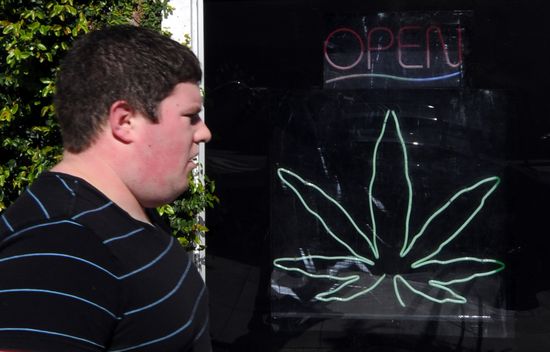
“Thanks, Growers. And Screw You”: Prop 19 Reax II

DISPENSARYMarkRalston:Getty

Some thoughts from Dish readers. One writes:

I knew Prop 19 was going down weeks ago when a friend of mine and his wife voted against. They are parents of two small kids, and did so with the reasoning ''I don't care if other people do it but I don't want it to be illegal.” Another father, whose 21-year-old son has had a drug problem, grew emotionally angry when we discussed it. “At least you can tell your kids it's illegal.” I didn't want to engage him by pointing out his son had the problem when drugs were ILLEGAL.

Parents voted their fears.

Another writes:

I think proponents made the same mistake as that made a few years ago with Prop 8, i.e. not actually making the clear case and hammering away at it.

The correct vote on these props seemed self-evident to some of us, but apparently not to the majority. A lot of people in my generation (60s) who should have voted yes on 19 were swayed by the "gateway drug" rhetoric. We've all lived long enough to know people whose kids have lost their way on the drug road, that argument needed a clear response. The Mexico cartel connection had great potential but then the Rand study sort of put it away, without a cogent, repeated counter from proponents.

Another:

Last night I asked my girlfriend's 18 year-old son if he was going to vote for Prop 19, in what is his first opprtunity to vote. He surprised me with a no. His reasoning? It's more exciting if it's illegal.

Another:

I am a long-time San Francisco resident.  I just saw that Proposition 19 lost – big time.  Then I checked some of the county results.  The measure was approved by about 65% of San Francisco voters.  In Humboldt County, on the other hand – one of the points on the Emerald Triangle – only about 47% of voters approved the measure.

I know some growers up north, and there is no doubt in my mind that this measure lost (or at least lost by as much as it did) because of greedy growers in northern California who are making bags of money selling cannabis to medical dispensaries, and who know that their bottom line would suffer were cannabis legalized across the board.  That puts those growers in league with big alcohol, tobacco, and other unsavories for whom personal monetary gain is worth a few young kids getting thrown in some hell-hole prison for the rest of their lives as the result of a pot bust.  I really should cease to be amazed by the power of money to corrupt people.

Thanks growers.  And screw you.

(Photo: Mark Ralston/Getty.)
Hello To All This

Brownstein takes a look at voter demographics:

The stampede toward the GOP among blue-collar whites was powerful almost everywhere.

In response, Adam Serwer predicts:

I would say that this makes comprehensive immigration reform super-dead for the next two years, since Democrats won't want to do anything that exacerbates the loss of working class white voters.

Ezra Klein studies the age gap. Many obvious factors explain this: the economy primarily, the turn-out (older and whiter than 2008), health insurance reform … but what really impresses me is that the GOP ran perhaps the oldest, simplest, most hackneyed campaign ever: he's a big government liberal! And that message worked with enough white people to give us this wave. If Obama represented a chance to say "Goodbye To All That," the GOP has now proven that, for one cycle anyway, this hoary old red-blue, right-left, big-small-government abstraction still has amazing traction. Even for an electorate 54 percent of whom said they want more government-borrowed stimulus!

That it offers no actual solution to any actual problem we face seems irrelevant. The only hope I have is that Obama keeps pushing the pragmatic center forward, reveals the bluff behind the Tea Party's fake fiscal conservatism and somehow crafts a narrative to defeat this exhausted but potent meme.

Are We Now Japan?

Judis:

If you want to imagine what American politics will be like, think about Japan…. Japan had a remarkably stable leadership from the end of World War II until their bubble burst in the 1990s. As the country has stumbled over the last two decades, unable finally to extricate from its slump, it has suffered through a rapid of succession of leaders, several of whom, like Obama, have stirred hopes of renewal and reform, only to create disillusionment and despair within the electorate…. That kind of political instability is both cause and effect of Japan’s inability to transform its economy and international relations to meet the challenges of a new century.

Will The GOP Push For A US Default On The Debt?

Tim Rutten predicts what I suspect could be the first real crisis ahead – both within the GOP and for the country and world:

One of the first tests of [Boehner's] ability to discipline populist revolutionaries fresh from the electoral barricades will come when the new Congress is asked to raise the federal debt limit from $12.4 trillion to $14.3 trillion. No Congress has ever refused to approve such an increase and, if such a refusal were to occur, the consequences for the global financial system would be apocalyptic.

Many of the new senators and House members have pledged to vote against an increase in the debt. Tim Phillips, president of Americans for Prosperity — one of the more active national tea party groups — told Politico this week that the Republicans' new House majority "cannot fold on the debt."

A Keynesian Majority

Serwer bangs the nail on the head:

The "Republican country" conservatives can look forward to waking up to tomorrow morning is one in which Republicans rail against government spending while promising to do more of it.

I keep asking myself: what does this mean in terms of actual policy? And I really don't know. For me, this part of the exit poll is easily the most revealing:

On spending priorities, 40 percent favored deficit-reduction, 35 percent "spending to create jobs," and 19 percent cutting taxes.

So this election found a 54 – 40 majority for more economic stimulus, via more tax cuts and more government spending. And yet on the surface, this was allegedly about restraining the power of government. Go figure.