As of this writing, the GOP has been declared the winner in or is winning in 243 House districts. If this number holds, it would exceed any Republican majority since 1946.
Nate Silver is in the same ballpark:
Our current projection is that Republicans will finish with a total of 243 house seats: this would reflect a net gain of 65 from Democrats. The range of plausible outcomes is fairly small: our model thinks there is roughly a 90 percent chance that the G.O.P.’s total will eventually be somewhere between 64 seats and 66.
Ilya Somin cheers divided government:
I should also note that nearly all of the major government-restraining legislation of the the last thirty years (e.g. — the 1981 and 1986 tax reforms, the 1996 welfare reform, the deregulations and spending restrictions of the late 1990s) were passed under divided government, whereas nearly all the major expansions of government during that period (e.g. — Bush’s massive prescription drug bill, Obama’s stimulus and health care bills) were enacted under united control (the TARP bailout in late 2008 is the one big exception). This is probably not an accident and is consistent with historical experience. I’m not exactly optimistic about what either Obama or the new Republican House majority will do. But I do think that prospects for limiting government are far better today than they were just a few months ago. And the return of divided government is a crucial reason why. At the very least, we are unlikely to see any massive new government programs enacted, as happened under both united Republican control in the Bush era and united Democratic control under Obama.
Josh Marshall thinks Palin has taken a hit:
It makes sense to be pretty careful in judging how things will affect Sarah Palin. But there's a decent argument that this is not a great night for her. Think about if Sharron Angle and Christine O'Donnell hadn't won their primaries. There's a decent chance Dems would have lost the Senate tonight. That's a pretty big deal. She also made a late endorsement of John Raese in West Virginia. He got crushed. And perhaps most importantly, she went to war in a big way with her state's senior senator, Lisa Murkowski. She got her beat in the Republican primary. But now it's looking like Murkowski's quite likely to win as a write-in, which is usually pretty much impossible to pull off.
David Frum wants accountability:
Tea Party Republicanism had a big outing tonight, much bigger than I’d have thought possible. So it’s fair to say to me: You were wrong. You thought that nominating people like Rand Paul and Sharron Angle and Christine O’Donnell and Ken Buck would be a formula for disaster, but see – we got away with it, more or less. Except we didn’t get away with it. The people who inflicted Angle and O’Donnell on the GOP threw away ridiculously winnable Senate seats. …
Will there be accountability for these self-inflicted disasters? It’s one thing to lose an election over principle. But what principle requires the nomination of the inept and the arrogant? Here are candidates who declare that they are running to defend freedom from Kenyan Marxist fascism and then refuse to answer questions from reporters – or outright order reporters arrested.
If there's any pattern to Democratic survival, it's that the people who survived or won close elections this cycle pulled themselves out of the fire. Mark Critz, who won John Murtha's seat in a May special election, held onto it by 2 points. Bill Owens, who more famously won New York's 23rd district after Conservatives and Republicans split the vote in November 2009, won re-election in a seat Democrats really aren't supposed to hold.
I ended up loving the tenaciousness of Linda McMahon’s campaign, but her WWE past was less than ideal for a run against a state attorney general. Sharron Angle’s flaws? We can discuss them more later, but we all know they’re there. Ditto Christine O’Donnell. Dan Maes. Carl Paladino. A lot of key races ended up with candidates who were . . . let’s just say easily painted as out of the mainstream.
John Guardiano blames GOP elites:
The GOP and conservative establishment — led by ringleader Karl Rove — were wrong to savage Christine O'Donnell. Their vicious attacks on her served to undermine her candidacy and made it very difficult for her to win this race. Shame on them.
JPod:
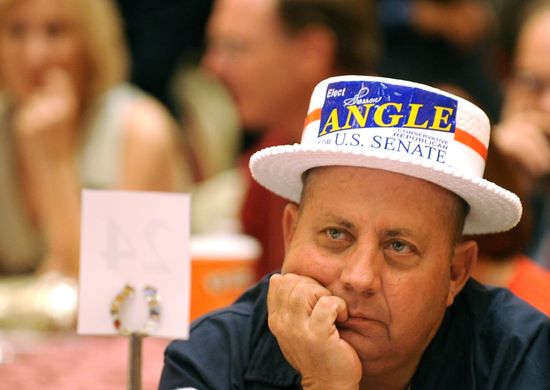
This was Angle’s race to lose, and boy, she lost it. She was the worst major Republican candidate in the country — who talked rather freely over a long political career on unusual and peculiar topics — and only went under the media radar in September because Christine O’Donnell emerged in Delaware. Reid turned the race into a referendum on Angle, and took it.
Democratic partisans will undoubtedly try to minimize the significance of this election. That’s claptrap. This is an extremely significant election. The Republican freshman class in the House is the largest in more than 60 years. If it rises over 65 it will be the largest in 80 years. Not only will that have reversed the gains in the House that Democrats achieved in 2006 (many of the Democratic House losses this year were those same new Congressmen), it has bettered the Republican gains of 1994 and, if when the final tally is taken there are more than 65 new Republican seats, it will have reversed the gains of Franklin Delano Roosevelt.
Lexington watched returns with Grover Norquist:
Mr Norquist told me the main thing he hoped for now was a concentrated Republican focus on winning the presidency in 2012 and a 60-vote supermajority in the Senate in 2014. The House allows you to apply the brakes, he said, mixing his metaphors, but not to control the rudder. As to possible presidential canididates, he listed the usual suspects, with a special emphasis on state governors, such as Rick Perry of Texas, Bobby Jindal of Lousiana and Haley Barbour of Mississippi. But what struck me most was his vehemence in demanding a new Contract for America, to make sure that the next Republican president, unlike George Bush, toes the line laid down by the party in Congress. "I don't want any stinking ideas from presidents," he said, "I want them in harness, pulling the plow."
Timothy Kincaid finds that NOM had a bad night overall:
[N]o indicator seems to have been more consistent this election than the extent to which a candidate was supported by the National Organization for Marriage. If you were a Senatorial or Gubernatorial candidate whom NOM supported, it seemed to be the kiss of death. …
This is not to say that NOM will not have any causes for celebration. The efforts to reject three supreme court justices in Iowa who were part of the unanimous decision to recognize gay Iowans as protected by the state Constitution, appears to have succeeded. Each appears to have only 46-47% support. Expect NOM to claim this as a clear mandate that the “people of Iowa have spoken” and that they don’t like their gay neighbors so much. NOM was not, however, successful in their effort to oust the Polk County judge who first found for marriage equality.
The Republicans may not have a mandate to repeal health care, but they do have one to cut spending. Many voters have concluded that Obama’s stimulus program actually contributed to the rise in unemployment and that cutting public spending will speed a recovery. It’s complete nonsense, as the experience of the United States in 1937 or of Japan in the 1990s demonstrated, but it will guide Republican thinking in Congress, and prevent Obama and the Democrats from passing a new stimulus program. Republicans will accede to tax cuts, especially if they are skewed toward the wealthy, but tax cuts can be saved rather than spent. They won’t halt the slowdown. Which leads me to expect that the slowdown will continue—with disastrous results for the country.
Peter Beinart makes the same point:
Last night’s biggest loser was not the Democratic Party. Democrats will rebound. In fact, the GOP’s victories probably improve Barack Obama’s chances of reelection since he can now position himself as a check on Republican radicalism, as Bill Clinton did in 1996. The real loser is Keynesianism: The idea that when businesses and individuals stop spending, government must. That idea will not rebound; it’s over for this period in economic history. First Britain, and now the United States, are responding to the worst economic contraction in 75 years by contracting government, despite the fact that the world’s best economists are screaming that it’s exactly the wrong thing to do. As Virginia Thomas might say, “Have a good day!”
John Boehner didn't claim a mandate, he claimed a repudiation. "We are witnessing a repudiation of Washington … a repudiation of Big Government … and a repudiation of politicians who refuse to listen to the people." It's a good thing he didn't claim a mandate, because the message from the electorate wasn't clear. In exit polls, 37 percent said the highest priority of Congress should be "spending to create jobs." The nearly equal priority was reducing the budget deficit, which 37 percent said was their No. 1 goal.
The obvious first impression is going to be that poor candidates cost the Republicans dearly in a handful of crucial high-profile statewide races: for Senate in CT, CA, NV, DE, CA and perhaps CO; for Governor in CA, perhaps in FL, and in some other states. That may be true; in fact I suspect it is true. The one race that the TV folks didn't seem to make a fuss about that I would is NH-Sen, in which Kelly Ayotte barely survived as the moderate or mainstream candidate in the primary and then romped over a seemingly solid candidate by a whopping 25 points, more or less. On the other hand, quite a few seemingly weak GOP candidates won. We'll need to look at these more carefully before drawing any firm conclusions.
One area where Republicans did not do well was in the West, where Democrats hailed their Mountain state gains in 2006 and 2008 as a harbinger of a future where Republicans could not depend on their electoral votes in presidential elections. Republicans, by my current count, gained 14 House seats in the East (where the Republican party was supposed to be in terminal condition), 18 seats in the Midwest (including 5 in Ohio and 4 in Barack Obama’s Illinois) and 23 seats in the South (where Democrats have become virtually extinct in districts without black or Hispanic majorities). But they gained only 7 House seats in the West and lost or seem to have lost Senate seats in Nevada, Colorado, Washington and California that at points during the campaign season seemed within reach. One reason is that very few California House seats are up for grabs, thanks to the bipartisan incumbent protection redistricting plan adopted in the redistricting following the 2000 Census. I will have more to write, surely, about the West as I have time to poke through the election returns, but I enter this as a cautionary point to Republicans now.
Democrats will spin Harry Reid’s victory and cling to it like the American people allegedly cling to their Bibles and guns, but I see a huge silver lining here for conservatives. What did we lose in Sharron Angle? Not 51, right? I understand that a lot of people viewed her as a fearless conservative stalwart, but there are plenty of reasons to think that she might have been a less-than-reliable crewmate when it came time to navigate the very difficult procedural straits that lie in wait for the newly strengthened Senate minority. Avoiding needless political damage is going to be the name of the game, and it’s not clear that Angle possessed that skill.
Whatever the final tally, this week’s turnover in Congress is a GOP mandate for legislative pugilism, not peace. Voters have had enough of big government meddlers “getting things done.” They are sending fresh blood to the nation’s Capitol to get things undone.
…Let us be clear, in case it hasn’t fully sunk into the minds of Obama and the trash-talking Democrats yet: You can take your faux olive branch and shove it.
(Image: Supporters of Nevada Republican Party Senate candidate Sharron Angle react after Fox News projected Democratic Party candidate Harry Reid as the winner of the race for the Nevada senate seat. By Robyn Beck/AFP/Getty Images)

 The Dish