Act One in the latest episode of This American Life is as insightful a look at the Tea Party movement – and local politics generally for that matter – as you'll find anywhere this election season.
Month: November 2010
Gateway Drug Update
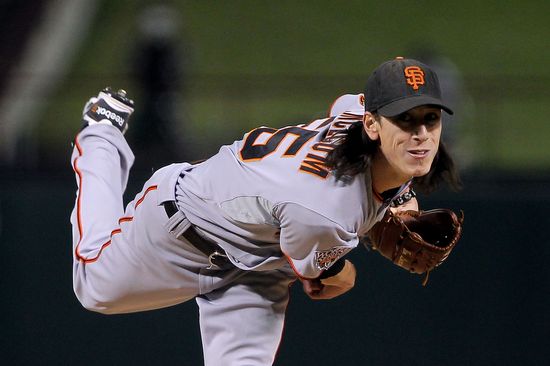
So now smoking marijuana isn't only a gateway drug to being president of the United States, it can also lead to winning the World Series. (Congrats to the Just For Men bear as well.) A kinda fitting victorious combo for San Francisco, no?
(Photo of Tim Lincecum by Doug Pensinger/Getty.)
Election Night Bingo
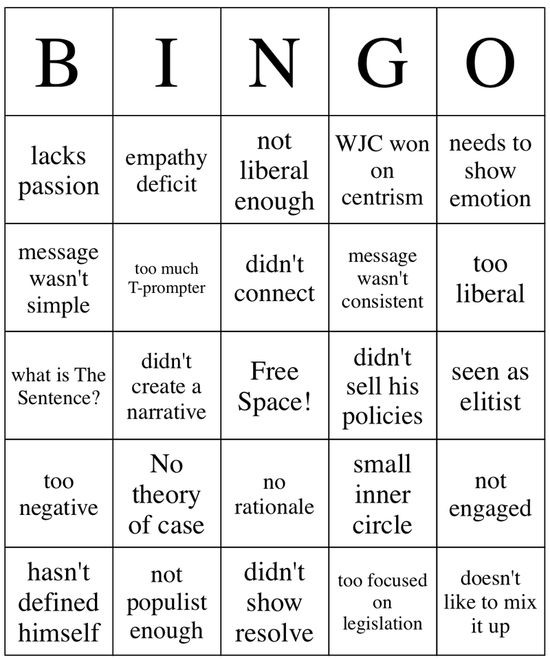
Brendan Nyhan made the above card in response to pundits ignoring fundamentals and using "ad hoc claims about messaging, tactics, etc. to 'explain' what has happened to Obama and the Democrats":
Some of these factors may play a role on the margin (particularly the public's view of Obama and the Democrats as too liberal), but the effects are likely to be relatively small and should be judged against an appropriate structural baseline rather than the implausible counterfactual that Democrats would be riding to victory if they had only used tactic X. The reality is that political tactics tend to work when the fundamentals are favorable and fail when they're not. That's why even Ronald Reagan and Bill Clinton couldn't save their parties from significant midterm losses in 1982 and 1994. Why would we expect Obama to succeed where they failed?
The Democrats’ Machine
It did what it could. And it's more effective than the GOP's.
Putting Sanity On The Spot
Tanner Ringerud translates this set of interviews:
The guys from New Left Media, who are usually so good at making tea baggers look insane, turned their sights on the Rally to Restore Sanity last weekend. As it turns out, they're pretty good at making liberals look insane too.
What To Look For Tonight
Ed Kilgore has a guide:
The first big hint of what's to come will be at around 5:45 p.m., when media outlets begin reporting partial exit-poll data about the makeup of the electorate. These news organizations actually receive all the exit-poll data that is available around the country at 5:00 p.m., but they don't use it to call races until polls close in the relevant states. Yet they are willing to report the non-candidate data from the exits earlier in the evening–and, if you read it right, that information can tell you a lot about who's going to win.
The first polls close in Kentucky and Indiana at 6 pm:
There are three House bellwethers in Indiana and Kentucky that bear close watching: IN-9, a perennially marginal district, where Democrat Blue Dog Baron Hill is a slight underdog to Republican Todd Young; IN-2, where a Class of 2006 Blue Dog Democrat, Joe Donnelly, is in a very close race with Jackie Walorski; and Lexington-based KY-6, where still another Blue Dog Democrat, Ben Chandler, who took the seat away from the GOP in a 2004 special election, is in a tough race with Andy Barr. This contest will say something about whether a candidate who voted for climate-change legislation can survive in a coal-producing state. If the GOP sweeps these bellwether districts, the odds are very high Republicans will control the House and could well exceed the 54 seats won in 1994.
The Pathologies Of Bureaucracies
Matt Yglesias thinks that Wikileaks proved that we make too much mundane material secret. Jonathan Bernstein yawns:
Matt Yglesias reminds everyone that way too much of what government does is classified secret. I agree. It also reminds me of one of the fascinating things about conservatives and liberals: the latter tend to ignore or downplay pathologies of bureaucracies when it comes to most government programs, while the former tend to ignore or downplay pathologies of bureaucracies when it comes to national security and corporate behavior.
When Poll Watchers Get It Wrong
Benjamin Sarlin reminds us that experts massively underestimated the size of the Republican wave in 1994:
As many of the analysts themselves acknowledge, just because the consensus number is about 55 seats, doesn't mean that much larger or smaller gains aren't possible for Republicans. There could still be some major factor in the races that the pollsters have so far failed to detect.
Judging The Backlash
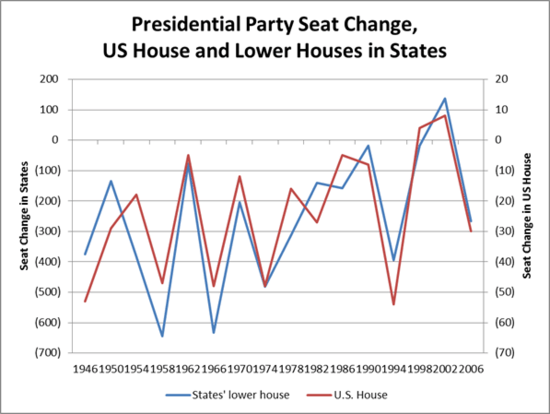
Kevin Drum doesn't believe that the election is referendum on Obama:
[T]he backlash against Obama probably isn't all that strong to begin with. As I mentioned on Friday, basic structural factors suggest a Democratic loss of 45 seats in the House this year. If Democrats instead lose 55, that's evidence of a backlash, but not actually a very big one. It means that we're still fundamentally the 50-50 nation we all talked about so much after the 2000 election, and a small shift among a small number of voters makes a big difference. It's true that voters are frustrated and tired, but I think it's a mistake to allow TV shoutfests to exaggerate just how frustrated and tired they really are.
Chart above via John Sides.
Every IT Department’s Nightmare
Gizmodo reports:
Across New York, there are USB drives embedded in walls, buildings and curbs. The idea is to create an anonymous, offline file-sharing network in public space. The drives are completely public and anyone can plug in to drop and download files.
 The Dish