A Long Night Tonight

The Cook Report warns:

[B]y sunrise Wednesday morning, we still may not have a clear idea of just how many seats Republicans have won in the House. As one smart Democratic operative points out, between 10 and 20 percent of all competitive races could not be called on Election Night in both 2006 and 2008, and there were only about 60 competitive races in each of those elections. This year, with 100 races listed as competitive on our chart, the number of races left without checkmarks until later dates could easily run in the double digits.

We will be live-blogging.

(Hat tip: Goddard)

Final Predictions

Silver gives odds:

Our forecasting model, which is based on a consensus of indicators including generic ballot polling, polling of local districts, expert forecasts, and fund-raising data, now predicts an average Republican gain of 54 seats (up one from 53 seats in last night’s forecast), and a median Republican gain of 55 seats. These figures would exceed the 52 seats that Republicans won from Democrats in the 1994 midterms.

Moreover, given the exceptionally large number of seats in play, the Republicans’ gains could be significantly higher; they have better than a one-in-three chance of winning at least 60 seats, a one-in-six chance of winning at least 70 seats, and have some realistic chance of a gain exceeding 80 seats, according to the model.

He also lists five reasons why Democrats might keep the House.

The Daily Wrap

Today on the Dish, Andrew lambasted Palin for wanting to be both "Republican Queen Esther and the Tea Party's Joan of Arc," when in reality she most closely resembled the Snooki of the Republican party. Andrew offered thanks that the FedEx bombs didn't work, and that the federal government's system basically did. Andrew thought the Dems showed more promise on fiscal responsibility than the GOP, and Reagan in '83 sounded a lot like Obama today. Andrew argued with readers over the rally's silent plurality, and Muslims rallied (with signs) and helped fight terrorism.

On the cresting election wave, Sam Wang made his predictions, Cook's here, Nate Silver explained how the GOP may outperform expectations, and Louis Masur hearkened back to history. Fallows thought divided government would kill clean tech, Douthat doubted the importance of immigration, and Evan Osnos read the tea leaves from Beijing. Joe Miller could ride the coattails of the enthusiasm gap, Reid could be ruined by it, and O'Donnell blamed Ladybug-gate on her opponent. Chait, Gelman and Drum debated the stimulus' repercussions on the election, and the Tea Party flunked history. Larison and Avent sorted out the GOP's war machine on Iran, and Larry Ferlazzo cautioned about turning beliefs into principles. We kept an eye on another sane conservative idea on social security and the retirement age, David Vitter didn't want to pay for tax cuts, and Alaskan governor Sean Parnell didn't want to speculate on the age of the earth. On the global front, the foreign press loved to hate the Tea Party, Google wanted to dominate the African market, and the Israeli loyalty oath sparked debates about the country's particularistic worldview. Inside Iraq griped on power price hikes, and the drug war in Mexico was less about drugs than about crime, according to Yglesias.

Zach Galifianakis toked up on television, Prop 19 made a last dash for victory, and Sullum showed why if alcohol wasn't always as bad as heroin, neither was pot. Economies loved delusional participants, Walter Kirn loved nachos on roadtrips, and buying little things made people happy. A megachurch pastor came out of the closet, we wished Bloggingheads a happy birthday, and sometimes nothing could be a real cool hand. No Shave November began, and Stephen Fry, speaking for all men, loved sex more than women. Global reality check here, scariest Halloween pumpkin here, quote for the day here, VFYW here, FOTD here, MHB here, and dissent of the day here.

–Z.P.
Prop 19: Up In Smoke? Ctd

SurveyUSA's final poll isn't pretty:

“No” has 46%, “Yes” has 44% at the wire, unchanged from SurveyUSA’s penultimate poll 1 week ago, and still within the survey’s theoretical margin of sampling error. Yet: momentum is with “No.”Among voters interviewed by SurveyUSA on their home telephones, 19 is opposed 53% to 43%. Among voters who do not have a home phone and who were interviewed on their cellphones, 19 is supported almost 2:1. When the groups are proportionally blended, opposition slightly outweighs support.

Arguing against passage is this: among voters who tell SurveyUSA they have already returned a ballot, 19 is opposed 57% to 39%. Support is strongest among those who have not yet voted and who, ultimately, may or may not. In SurveyUSA’s 1st tracking poll on marijuana, 4 months ago, women supported 19 by 7 points. On election eve, women oppose 51% to 40%. In the Bay Area, “Yes” led by 30 points a month ago, now is tied. Voters are split in all regions of the state now. Democrats supported by 30 points in August, but now by only 10.

The Most Harmful Drug

Drug_harms

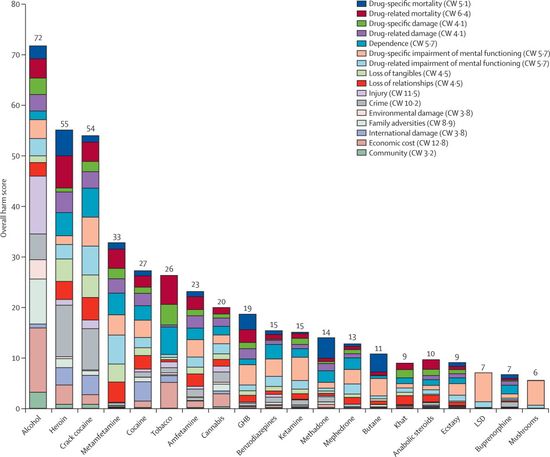
Jacob Sullum flags a new Lancet study that "rates the harmfulness of 20 psychoactive drugs according to 16 criteria and finds that alcohol comes out on top":

As usual, defenders of drinking are outraged by the comparison between alcohol and illegal drugs. Brigid Simmonds, chief executive of the British Beer & Pub Association, tells The Sun, "The vast majority of people know it's just not rational to say that enjoying a social beer with friends in the pub or glass of wine over dinner has the moral or societal equivalence of injecting heroin or smoking a crack pipe." Such reactions are based on the observation that the vast majority of drinkers are not alcoholics. Despite alcohol's very real dangers, they generally manage to consume it in a way that not only does not harm them or others but on balance enhances their lives. Here is the point that defensive drinkers like Simmonds miss: If this is possible with alcohol, it is possible with any intoxicant that large numbers of people have shown an interest in consuming. 

The Final Mile Of The Horse Race, Ctd

Cook submits final predictions:

The Cook Political Report's pre-election House outlook is a Democratic net loss of 50 to 60 seats, with higher losses possible.

In the Senate:

The Cook Political Report is adjusting its current outlook to reflect a net gain for Republicans of 6 to 8 seats, down from 7 to 9 seats. While it is becoming increasingly likely that Republicans will hold all 18 of its own seats, Democrats' prospects in three of their 19 seats have improved in recent days. Sens. Barbara Boxer in California and Patty Murray in Washington now appear to be headed for re-election, albeit by small margins. In the special election in West Virginia, Democratic Gov. Joe Manchin now holds an advantage. Currently there are 57 Democrats, two independents that caucus with Democrats, and 41 Republican Senators. Post-election, Republicans could hold between 47 and 49 seats to 51 to 53 seats for Democrats. This new outlook means that the odds of Republicans winning a majority in the Senate are now non-existent.

“And Miles To Go Before I Sleep”

Novelist Walter Kirn describes his commute:

Eight times a year or so for the last four years I've made the 1,200-mile trip from Livingston, Mont., where I live, to Los Angeles, where I often do business. I ought to fly, common sense tells me, but I drive because I'm hung up on the Beat-era idea that it's my duty as a writer to bypass the streamlined realm that I called Airworld in my novel "Up in the Air" and stay in touch with the gritty "real America" of perpetually flooded truck-stop men's rooms and quickie meals of stale tortilla chips doused in liquid cheese dispensed from pumps.

The amazing part: he does the drive straight through.

DEA: Drug War In Mexico Not About Drugs

Mark Kleiman fisks a new Drug Enforcement Administration and the International Association of Chiefs of Police report. Yglesias and Chait build off his analysis. Here's Matt: 

 If drugs were legal, it’d be like cigarettes or beer—sold on the retail level by regular retailers, and produced and wholesaled by large multinational corporations that lobby for light taxation and engage in large scale advertising to grow market share. Like all vendors of addictive substances, whether legal or illegal, they’d depend for their profits largely on growing the population of addicts and this would have bad public health consequences. But like most businessmen, they’d shy away from settling disputes via armed battles.

Is anyone really fooled by denying this? I’m not eager to see fully commercialized heroin sold at the corner store, but turning drug distribution into a serious criminal act has very clearly served to create a largish economic sector full of serious criminals.

One Country’s Trash

Wasteland

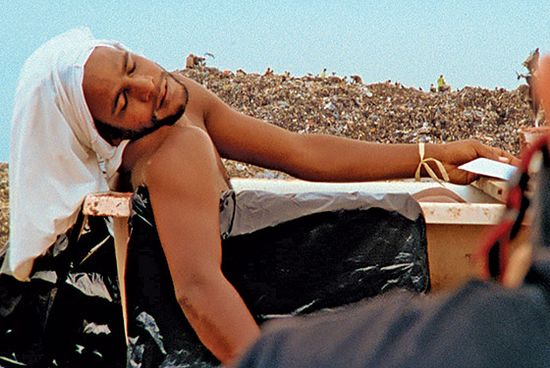
Mary Kaye Schilling reviews a new documentary about the people who comb through Rio de Janeiro’s Jardim Gramacho, the largest landfill in the world, and the artist who captured their portraits:

After shooting at Gramacho all day, [the filmmaker Lucy] Walker and her crew would head into Rio, to eat and drink with the city’s rich, sophisticated elite. “Those people all wanted things—more and more! But when we asked the people living in garbage what they wanted, their first response was that they had everything they needed,” says Walker.

“The women could easily have turned to prostitution, the men to crime or drug dealing. They chose garbage, where the only person you hurt is yourself. We fell in love with them, with their dignity. It reminded me of a line in Cool Hand Luke: ‘Sometimes nothin’ can be a real cool hand.’ ”