A man who uses manipulative ploys and bluffs? Say it ain't so.
Month: November 2010
Shut Up And Sing: Lisa Marie Presley
A reader writes:
The single tear at 1:16 seals it.
The original version is genuinely moving though, and a song that simply explores the pain of others is not what makes a Shut Up And Sing nomination. It's a performance that is really about the singer's moral preening that qualifies. And so Lisa Marie gets it, while her father doesn't. The best rendition, of course, is Cartman's (and Dina's).
The Big Lie, Ctd
I note this simply because it is important to resist the facile narrative that somehow Obama proved he was a radical leftist because he supported a stimulus package (after Bush's) in the face of the worst recession since the 1930s:
In an updated report [PDF] on the American Recovery and Reinvestment Act of 2009, the CBO said that the legislation will increase the budget deficit by $814 billion from 2009-2019, compared with an original estimate of $787 billion. “By CBO’s estimate, close to half of that impact occurred in fiscal year 2010, and about 70% of ARRA’s budgetary impact was realized by the close of that fiscal year,” the report said.
The CBO estimates that the expenditures had a big impact on the economy, though the benefits have likely peaked. For the third quarter it says the stimulus added between 1.4 and 4.1 percentage points to growth and reduced the unemployment rate by between 0.8 and two percentage points. The benefits from the stimulus are expected to wane for the rest of this year and through 2011 and 2012.
Unemployment, sans stimulus, would therefore now be between 10.4 or 11.6 percent without the stimulus. Now you can argue that the economy should have been allowed to collapse entirely and rise from the eventually settled ashes. But you cannot argue that and criticize the president for high rates of unemployment today. He did about as much as he could within the bounds of fiscal responsibility.
He acted not as a liberal or as a conservative, but as a responsible, pragmatic human being. Precisely as he promised to be. And precisely why the ideological cynics in the GOP gave him no support whatever.
“Blowhole Sex – Anything Goes!”
Eric Spitznagel interviews Isabella Rossellini about her upcoming show, "Green Porno: Seduce Me", a series of online shorts about kinkiness in the animal kingdom:
Last August, her strangely erotic take on bedbug fucking went viral, thanks to a perfectly timed bedbug epidemic in New York City. There was something revelatory about watching Rossellini get stabbed in the gut with a penis knife while muttering with orgasmic enthusiasm, “He ejaculates into my wound!” It was a moment when many of us realized that Blue Velvet might not have been entirely a product of David Lynch’s twisted imagination.
The entertaining interview eventually sours.
The Role Of The Unknown
J.J. Abrams's old TED talk focuses on his love of mystery in movies and TV. Sean Carroll isn't satisfied:
Yes, indeed, the concept of “mystery” is absolutely crucial to what makes a story compelling. But I think Abrams takes the idea too far, valorizing mystery for its own sake, rather than as motivation for the characters and the audience to try to solve the mystery. The reason why mysteries are interesting is because we want to figure them out! If they are simply irreducibly mysterious — if there is no sensible explanation that ultimately makes sense of all the clues — then it’s simply frustrating, not magical. …
The end of Inception is quite famously amenable to more than one interpretation. … This drives people crazy, trying to figure out which one is “right,” an impulse I think is misguided. It’s okay to accept that we don’t know all the answers! But in theses cases we understand quite well the space of all possible answers. There is no black box whose operation is simply mysterious. We don’t need to know all the final answers once and for all; but it’s better storytelling if we understand what the answers could be, and that they make sense to us.
A case for theology?
The Path Not Chosen
Ron Sider opposes marriage equality for the same exhausted "procreation-as-marriage" reasons that have been tossed around for years. What's striking about his essay in First Things is his acknowledgment that the religious right has ruined its own credibility on the issue:
We have tolerated genuine hatred of gays; we should have taken the lead in condemning gay bashing but were largely silent; we have neglected to act in gentle love with people among us struggling with their sexual identity; and we have used the gay community as a foil to raise funds for political campaigns. We have made it easy for the media to suggest that the fanatics who carry signs announcing “God hates fags” actually speak for large numbers of evangelicals.
Worst of all, we have failed to deal honestly with the major threat to marriage and the family: heterosexual adultery and divorce. Evangelicals divorce at the same rate as the rest of the population. Many evangelical leaders have failed to speak against cheap divorce because they and their people were getting divorced just like everyone else. And yet we have had the gall to use the tiny (5 percent or less) gay community as a whipping boy that we labeled as the great threat to marriage.
What a farce. It is hardly surprising that young non-Christians’ most common perception (held by 91 percent) of contemporary Christianity is that we are “antihomosexual.” Even more disturbing is that 80 percent of young churchgoers agree.
We did not need to do this. We could have preached against hatred of gays, taken the lead in combating gay bashing, and been the most active community lovingly caring for people with AIDS. We could have taken marriage more seriously. We could have shown the world that Christians could defend marriage while loving those who wanted to live a different way.
Mental Health Break
The evolution of Disney, as seen through all 50 of its animated feature films:
Will Israel Attack Iran By Christmas?
To me, the most revealing parts of the Wikileaks diplo-docu-dump are about the Middle East. We already knew that the Sunni Arab autocrats cannot bear the thought of a Shiite nuclear bomb and are almost as worried as the Israelis. But now the evidentiary proof brings it home:
The Saudi king was recorded as having “frequently exhorted the US to attack Iran to put an end to its nuclear weapons programme”, one cable stated. “He told you
[Americans] to cut off the head of the snake,” the Saudi ambassador to Washington, Adel al-Jubeir said, according to a report on Abdullah’s meeting with the US general David Petraeus in April 2008.
The cables also highlight Israel’s anxiety to preserve its regional nuclear monopoly, its readiness to go it alone against Iran – and its unstinting attempts to influence American policy. The defence minister, Ehud Barak, estimated in June 2009 that there was a window of “between six and 18 months from now in which stopping Iran from acquiring nuclear weapons might still be viable”. After that, Barak said, “any military solution would result in unacceptable collateral damage.”
Officials in Jordan and Bahrain have openly called for Iran’s nuclear programme to be stopped by any means, including military. Leaders in Saudi Arabia, the United Arab Emirates and Egypt referred to Iran as “evil”, an “existential threat” and a power that “is going to take us to war”.
If we take Barak’s word for it, the Israelis could launch World War III within a month. And would carry much of the Sunni Arab autocrats with it. One notes that Saudi foreign diplomats and functionaries are more wary about war with Iran than the royals. But there seems little discussion about the momentous consequences of a third war launched by the West against a Muslim country in less than a decade.
(Photo: Jim Hollander/Getty.)
The Wikileaks Cable Leak vs The War On Jihadist Terror
I’ve just read through a couple of summaries. Overall, I have to say that this brief glimpse into how the government actually works is actually reassuring. The cable extracts are often sharp, smart, candid and penetrating. Who knew the US government had so many talented diplomats?
But then, of course, there are the real dangers of this random transparency. Take the perilous situation in Yemen, where al Qaeda has a foothold and whence it is planning mass murder of Western citizens. Will the following leak make al Qaeda stronger and thereby increase the likelihood of American civilian deaths? You decide:
It has been previously reported that the Yemeni government has sought to cover up the American role in missile strikes against the local branch of Al Qaeda. But a cable’s fly-on-the-wall account of a January meeting between the Yemeni president, Ali Abdullah Saleh, and Gen. David H. Petraeus, then the American commander in the Middle East, is nonetheless breathtaking.
“We’ll continue saying the bombs are ours, not yours,” Mr. Saleh said, according to the cable sent by the American ambassador, prompting Yemen’s deputy prime minister to “joke that he had just ‘lied’ by telling Parliament” that Yemeni forces had carried out the strikes.
Mr. Saleh, who at other times resisted American counterterrorism requests, was in a lighthearted mood. The authoritarian ruler of a conservative Muslim country, Mr. Saleh complains of smuggling from nearby Djibouti, but tells General Petraeus that his concerns are drugs and weapons, not whiskey, “provided it’s good whiskey.”
Fascinating, colorful reporting – and an insight into the hypocrisy and cynicism among the elites in the Muslim Middle East. If it were reporting.
After There Was Blood
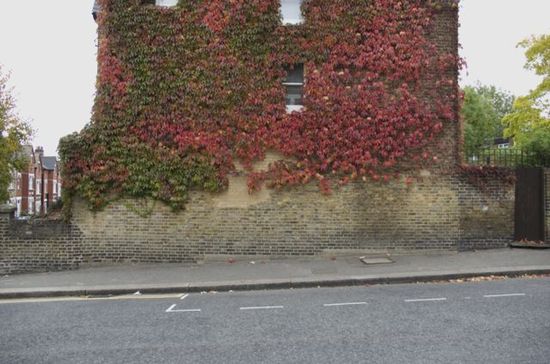
Photographer James Davies documents streets in London where shootings have occurred:
My aim in this series is to highlight the mundane. I didn't want to find the exact location where each incident happened or go into the details of each murder. The intention here is just to show the utterly ordinary places where the extraordinary took place, forever associating a street with a horrific crime.
 The Dish