Letters Of Hope

Carolyn Kellogg reviews Ted Gup's A Secret Gift: How One Man's Kindness–And a Trove of Letters–Revealed the Hidden History of the Great Depression. The book centers on the author's grandfather, who solicited letters from those in need and then mailed them $5 checks:

The letters, many of which are reproduced in full, are snapshots telling desperate stories their authors would later downplay or deliberately forget. “We do not own a home here, nor furniture, tho we once did,” wrote Edith Saunders. “Recently we were unable to pay any rent for five weeks and were ordered to move.” …

The necessary grimness of these true stories is leavened by the long view — the septuagenarians who remember the local amusement park, the boy who grows up to fight bravely in World War II, the grandchildren safe from want. …

The letters, Gup writes, “reminded me of the difference between discomfort and misery, between the complaints of consumers forced to rein in their spending and the keening of parents whose children went hungry night after night.” They also show that a gesture of generosity can deliver, along with small relief, good fortune that rings with hope.
A Proclamation

Lincoln Caplan reminds us of this quite extraordinary piece of prose from Connecticut in 1936 in the teeth of the Great Depression, issued by one Wilbur Cross. It speaks to me today, in this year, where gratitude and service seem to distant from our national culture:

Time out of mind at this turn of the seasons when the hardy oak leaves rustle in the wind and the frost gives a tang to the air and the dusk falls early and the friendly evenings lengthen under the heel of Orion, it has seemed good to our people to join together in praising the Creator and Preserver, who has brought us by a way that we did not know to the end of another year.

In observance of this custom, I appoint Thursday, the twenty-sixth of November, as a day of Public Thanksgiving for the blessings that have been our common lot and have placed our beloved State with the favored regions of earth — for all the creature comforts:

the yield of the soil that has fed us and the richer yield from labor of every kind that has sustained our lives — and for all those things, as dear as breath to the body, that quicken man's faith in his manhood, that nourish and strengthen his spirit to do the great work still before him: for the brotherly word and act; for honor held above price; for steadfast courage and zeal in the long, long search after truth; for liberty and for justice freely granted by each to his fellow and so as freely enjoyed; and for the crowning glory and mercy of peace upon our land; — that we may humbly take heart of these blessings as we gather once again with solemn and festive rites to keep our Harvest Home.

Amen.

The Myth That Turkey Makes You Sleepy

Aaron Carroll debunks it:.

The truth is, turkey is not to blame for your sleepiness.  Chicken and ground beef contain almost the same amount of tryptophan as turkey — about 350 milligrams per 4 ounce serving.  While you might have heard someone claim that turkey made them drowsy, you have probably never heard someone say that chicken, ground beef, or any other meat made them sleepy. Swiss cheese and pork actually contain more tryptophan per gram than turkey, and yet the American classic, a ham and cheese sandwich, somehow escapes blame.

The reason you get drowsy: 

Large meals have been shown to cause sleepiness regardless of what is eaten because the body increases blood flow to the stomach, and decreases blood flow and oxygenation to the brain. Meals both high in proteins or in carbohydrates may cause drowsiness.  And don’t forget about the booze. One or two glasses of wine, especially for people who only drink occasionally, can increase drowsiness.

Shut Up And Sing: White Lion

A reader writes:

"When The Children Cry" has to be one of the all-time worst representations of the moral conscience in music. I'm still not quite sure what the point of it is except it was from that late '80s/early '90s period when every heavy metal band had to have a power anthem that reflected their "depth". Mostly it was a chance to show the lead singer with glycerin tears sitting on a playground in a torn jeans looking like he's trying to pass a kidney stone for the children.

I cried. From laughter.

Rush’s Thanksgiving

Stephen Budiansky passes along the latest nonsense from the loony right:

According to the ever-reliable Rush Limbaugh, Glenn Beck, and various tea party websites, the original English settlers practiced a kind of collectivism is which all worked the land together and shared the proceeds; this led to bickering, thievery, idleness, and famine as the settlers refused to toil when they could not each reap the benefits of their own work. Only when they abandoned such dangerous socialist ideas and divvied up the land into individual privately-owned parcels did they at last enjoy a bountiful harvest . . . which is what we are actually celebrating at Thanksgiving. (Of course, no right-wing historical revisionism is complete without a conspiracy theory and a sense of victimization at the hands of the liberal elite: so it turns out that this "real reason for Thanksgiving" was "deleted from the official story," according to one widely circulated retelling that has appeared on tea party blogs.)

John Stossel, among others, engages in this bout of revisionist history. Thank God the famously capitalistic Native Americans were there to share with the pilgrims bounty from their private plots of land, tilled as if by the invisible hand itself.

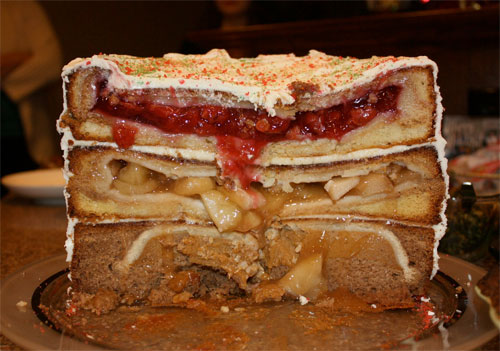
The Turducken Of Cakes

Cherpumple

Jaya Saxena marvels at the "cherpumple," a three-layer cake (yellow, spice, white) with a pie baked inside of each layer (cherry, apple, pumpkin):

[Creator Charles] Phoenix also advises serving it with spoons if it collapses, because "The physics of it provide a kind of 'will or won't it collapse' situation." Or you could just eat three pies and three cakes; gluttony does not discriminate.

(Photo via This Is Why You're Fat)