GM, In Context

Economics 21 counts the challenges facing the company:

Part of the longer-term problem facing GM and the U.S. automobile industry more broadly is that while automobile sales in emerging economies are increasing robustly, they are decreasing in the mature economies of Europe, North America, and Japan. Aging populations, deleveraging households, higher gasoline prices, denser metropolitan areas, and the advent of sharing platforms like Zipcar have dampened demand, and many if not all of these trends are likely to accelerate. We can expect governments throughout the industrialized world to continue subsidizing “national champions” in the automotive sector, creating a powerful beggar-thy-neighbor dynamic that could badly undermine free trade. As this dynamic unfolds, the U.S. will be in no position to lecture its trading partners.

(Hat tip: Reihan)

Shut Up And Sing: Madonna

A reader writes

Probably the worst, and most cringe-worthy political song in pop music history has to be Madonna's "American Life",  in which she simultaneously decries American materialism while reveling in it, and spouts lines like,  "I'd like to express my extreme point of view! I'm not a Christian and I'm not a Jew!".

The original (and subsequently pulled) anti-war video features a bizarre and bloody fashion show in which dismembered American troops are dragged across the catwalk. From her obviously well-earned place in the pantheon of celebrity icons, Madonna in 2003 felt she had some serious moralizing to do – all of which could have been forgiven were the song not so ear-bleedingly awful. "American Life" is pop pretension at its worst: nonsensical, hypocritical, poorly written, and, perhaps most unforgivably, lacking a decent hook!

And so I sit in a defensive crouch, waiting for Aaron to file for divorce.

Intoxicated With Diversity – And Choice

Reihan loves America:

Speaking only for myself, I prefer the endless potential for novel experiences and encounters that I find in the diverse neighborhoods I've had the pleasure of living in to the correlates of civic health one finds in more homogeneous neighborhoods. It's possible that my preferences will change if I have children, etc., as parents tend to place a high premium on the perception of security. And that's part of why I strongly believe that no one should be condemned for choosing to live in a more homogeneous neighborhood. Diversity-lovers will continue to concentrate in places like New York city and stretches of southern California, where civic health might suffer but the quality of life will nevertheless remain high. Diversity-skeptics will continue to concentrate in places like Prince Georges County, Maryland, home to a number of middle- and upper-middle-class African American suburbs, and states like Vermont, Idaho, and Montana.

Airbrushing Childhood

Ps_Disasters

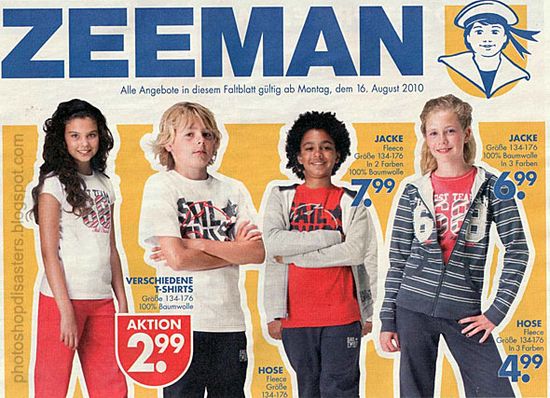
It's standard practice these days:

The practice of altering photos, long a standard in the world of glossy magazines and fashion shoots, has trickled down to the wholesome domain of the school portrait. Parents who once had only to choose how many wallet-size and 5-by-7 copies they wanted are now being offered options like erasing scars, moles, acne and braces, whitening teeth or turning a bad hair day into a good one.

School photography companies around the country have begun to offer the service on a widespread basis over the past half-dozen years, in response to parents’ requests and to developments in technology that made fixing the haircut a 5-year-old gave herself, or popping a tooth into a jack-o’-lantern smile, easy and inexpensive. And every year, the companies say, the number of requests grows.

(Image: Photoshop Disasters. It'll take a moment.)

Mark Twain Wouldn’t Approve Of Iraq, Ctd

A reader writes:

Sorry, but your reader cannot out-think Twain on the Philippines.  One of Twain's more political, if less-widely-appreciated, writings was "To the Person Sitting in Darkness", a 1901 essay about the American occupation of the Philippines, in which we see the full venom of Twain's fury at colonial barbarism unleashed.

Gone is the gentle nudging of Twain's satire.  Instead there is a brutally frank analysis of the geopolitics of colonialism, observed through the puzzled eyes of the "person sitting in darkness" (the liberated/colonized peoples), who wonder to themselves: "There must be two Americas: one that sets the captive free, and one that takes a once-captive's new freedom away from him, and picks a quarrel with him with nothing to found it on; then kills him to get his land."

Twain would not have been impressed with developments in education and health care 100 years after the fact, which would have been in his view accomplishments delayed by 50 years of the raw and direct use of the Philippines for American geopolitical ends.  The latter was his real issue: the American role in "The Game", liberating economically-stagnant European colonies and incorporating them into a more vibrant American economy, can produce good or bad "development" outcomes, but never without the degradation and humiliation of subject peoples. Twain's argument is moral, not to be measured in future GDP:

There have been lies; yes, but they were told in a good cause. We have been treacherous; but that was only in order that real good might come out of apparent evil. True, we have crushed a deceived and confiding people; we have turned against the weak and the friendless who trusted us; we have stamped out a just and intelligent and well-ordered republic; we have stabbed an ally in the back and slapped the face of a guest; we have bought a Shadow from an enemy that hadn't it to sell; we have robbed a trusting friend of his land and his liberty; we have invited our clean young men to shoulder a discredited musket and do bandit's work under a flag which bandits have been accustomed to fear, not to follow; we have debauched America's honor and blackened her face before the world; but each detail was for the best. We know this.

Another writes:

There’s a big irony in your reader’s reading of A Connecticut Yankee in King Arthur’s Court. Twain was indeed writing about “the folly and hubris of trying to change a barbarous society,” but the society he had in mind was the American South. And while the folly and hubris of the eponymous Connecticut Yankee’s efforts are on display, I don’t think it’s correct to call the book a scathing indictment of them. The most scathing passages in the book depict the “chivalry” of a small minority that rests on the systematic enslavement of everyone else.  These passages (and there are many of them) are simply dripping with outrage.

And this is not a small literary quibble. When people today talk of the futility and arrogance of trying to “reconstruct” a backwards society, they are echoing the words of those who abandoned the American South to the white supremacists in 1876.

“Ni**ger” Ctd

Very NSFW and hilarious video above. A reader writes:

When I read your reader's comments on censoring "nigger", I immediately thought of this perspective from Louis C.K., my favorite of favorites (and I know you appreciate him, too).

I sympathize with your gut but also think your reader is right.  Louis gets it: You're putting the word in all our heads anyway, so take responsibility for it.  Especially when, as in discussions of old literature or discrimination or hateful rants by public figures, the whole point is the power and the violence of those words.  When reporters note that so-and-so said "the 'N' word" or when a blog says "n***er", they're not conveying the essence of the story while avoiding the words; they're just making the word float around the air and reverberate in the heads of their audience.  No effective censoring is actually taking place.

What Can The Economy Tell Us About 2012?

Yale economist Ray Fair's election model, which relies on GDP data, predicts that Obama will win re-election. Nate Silver spies a flaw – the relationship between GDP and employment has broken down this recession:

G.D.P. — as it is usually measured — did not mirror employment the way it normally does.

That is problematic for models like Mr. Fair’s. What we’d like to see is what happened in the past when there had been a similar discrepancy: when the economy performed all right according to G.D.P., but very poorly according to employment. However, since violations of Okun’s law are fairly rare, and since presidential elections are also fairly rare, there are really no good data points to work with: an econometrician would say the solution lies “out of sample.”

Trains, Wind Farms, And Glamour

Virginia Postrel says they are all related:

Policy wonks assume the current rage for wind farms and high-speed rail has something to do with efficiently reducing carbon emissions. So they debate load mismatches and ridership figures. These are worthy discussions and address real questions. But they miss the emotional point. To their most ardent advocates, and increasingly to the public at large, these technologies aren't just about generating electricity or getting from one city to another. They are symbols of an ideal world, longing disguised as problem solving. You can't counter glamour with statistics.

Glamour always contains an element of illusion. (The word originally meant a literal magic spell.) By obscuring some details and heightening others, it offers an escape from the compromises, flaws and distractions of real life. It shows no bills on the kitchen counter, no blisters under the high heels, no pimples on the movie star's face. In those glamour shots, wind power seems clean, free and infinitely abundant. Turbines spin silently and sometimes appear barely taller than a child. The wind blows constantly and in exactly the right amount—never so much that it piles up unwanted power and never so little that it requires backup supply. The sky is unfailingly photogenic, a backdrop of either puffy clouds or a brilliant sunset; the landscape is both empty and beautiful; and there are no transmission lines anywhere.

Austin Bramwell isn't convinced.