Compact City vs Sprawlville

Clark Williams-Derry points to methodological flaws in the Urban Mobility Report that could drastically change how we measure congestion in cities:

Consider two hypothetical cities, Sprawlville and Compact City.  In Sprawlville, people travel a long way to work — an average of 20 miles door to door.  In free-flowing traffic, the trip would take 20 minutes, but it takes 10 extra minutes during rush hour, for a total commute of 30 minutes.  In Compact City, people don't have to travel as far:  it's just 10 miles from home to work on average; the trip takes 10 minutes off-peak, and 10 extra minutes during rush hour, for a total of 20 minutes. 

In this example, congestion slows commutes by the same amount — 10 minutes — in both cities. Sprawlville residents wind up with longer total commutes, since residents travel longer distances.   Yet the "Time Travel Index" shows that Compact City has a worse rush hour!!  That's because the Time Travel Index shows a 2:1 ratio (i.e., 20 minutes vs. 10 minutes) for rush hour vs. off-peak travel in Compact City, and a 3:2 ratio (i.e., 30 minutes vs. 20 minutes) in Sprawlville.

How Jesus Kicked Ass On The Cross, Ctd

A reader writes:

The view of Christ catching the Devil with a baited hook described by your reader is often referred to as the Ransom view of the Atonement.  More recently, it's been called the Christus Victor view. It's the one I personally prefer.  And it's the one depicted in C.S. Lewis' "The Lion, The Witch and the Wardrobe." If you're interested, Greg Boyd has a great essay on Christus Victor

Boyd also delivers a riveting history lesson above.

The Nomadic Catholic: “Is God Telling Me To Leave?”

Valerie Schultz confesses:

Much of my personal pain has stemmed from writing columns in the secular press in support of civil marriage for same-sex couples and the ordination of women, and the unpleasant admonishments and consequences thereof. Public dissent, apparently, has no place in ministry. I have been politely removed from the Catholic part of detention ministry, although I am still welcome to serve in a nondenominational capacity. People in power have told me to shut up or leave, but is God telling me to leave? Is God telling me to shut up? […]

A small revelation sustains me: In order to stay Catholic, I’ve had to cut away, at least temporarily, my distraction with everything between the Eucharist and me. The parish, the ministry chain of command, the diocese, the Roman hierarchy: everything. A day spent alone and in prayer led to this understanding, born not of conceit but of desperation. My relationship with the Eucharist has been the only way to salvage and practice my Catholicism.

Bring On The Yawns

The reflex is good for your health:

Yawning doesn’t just relax you—it quickly brings you into a heightened state of cognitive awareness. Students yawn in class, not because the teacher is boring (although that will make you yawn as well, as you try to stay focused on the monotonous speech), but because it rids the brain of sleepiness, thus helping you stay focused on important concepts and ideas.

Tell that to this Cornell professor.

(Hat tip: Frank Wilson)

Face Of The Day

106967096

Robin, a two-week-old gray seal, swims through her basin at the animal collecton point in Friedrichskoog, northern Germany, on November 19, 2010. The orphaned seal was found on the North Sea island of Pellworm and will be brought up at the Friedrichskoog station now before returning to the North Sea in two or three months. By Carsten Rehder/AFP/Getty Images.

“Get There First Or Not At All”

Ben Greenman finds:

The Internet’s search capabilities, which permit easy detection of unoriginality, also have a chilling effect on originality.

An example: There’s a guy in my neighborhood who dresses exactly like Bruce Springsteen, circa 1975. He has the jeans. He has the cap. He has the beard. After seeing him a handful of times on the street, I nicknamed him “Born to Rerun.” It made me laugh, for a second. It was a pointless little joke, no more than that. Out of curiosity, I searched for the phrase, which I thought I had invented—or rather, which I had invented, at least for my purposes. I discovered, predictably, that the phrase has been used before, frequently: in 2003 by Entertainment Weekly, last year by a fan posting a review of “Darkness on the Edge of Town,” and on and on.

I’d like to report that I don’t care about those earlier occurrences, that I brushed them off and moved on, but the fact is that I do care. It’s deflating to learn that your original idea, no matter how trivial, has already made an appearance. Before the Internet, I might have kept that pointless little joke alive in my head. It might have ripened into something or it might have died on the vine. But it would have been my tomato. Now, the process works differently. The incontrovertible proof that the phrase was already circulating made it difficult, if not impossible, for me to claim it as my own. It acquired the feel of something shoddy and second-hand, and I jettisoned it.

A Poem For Saturday

LeavesGetty

"Gifts" by Peter Davison appeared in The Atlantic in October 1965:

When I was a child, a heartstruck neighbor died
On her birthday. Dying was strange enough,
But what a way to choose to spend your birthday,
I thought, and what sort of a gift was this?
From time to time, people have done it since–
Dying in the environs of a celebration
As though they had picked out the day themselves.
Perhaps they had, one way or another,
Prayed for something to happen, and prayed wrong.
Sophocles, when old enough to die,
Suspected prayer and entered a caveat:
'Zeus, act kindly whether or not I pray;
And, though I plead for it, turn harm away.'
I keep a wary silence on my birthdays,
Make up no lists at Christmas, lie low
When asked what I really want. How should I know?
Best ask for gifts as though I had none coming.

(Photo: Joel Saget/AFP/Getty Images)

Arm And The Man

Mike Deri Smith contextualizes the new film 127 Hours:

These kinds of accidents are usually due to human error rather than lightning-strike bad luck. Despite many years of climbing experience, Ralston made the near-fatal error of failing to tell anyone where he was going. Had he told someone his plans, he may not have lost his hand and would have had a better chance of being rescued. Ralston’s idiocy should be condemned in equal measure to the extent that his heroics are applauded. After all, the heroics were in response to a self-inflicted predicament.

What’s In A Shirt, Ctd

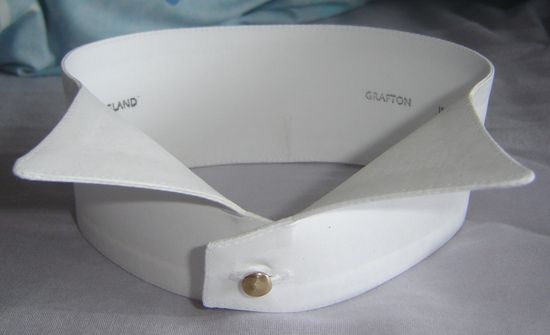
Detachable_Collars

Last weekend we posted a quote by Paula Marantz Cohen on the meaning of the shirt collar. Dozens of readers pounced on the post, criticizing Cohen for her apparent failure to recognize the practical reasons for detachable collars. Jesse Kornbluth made related criticisms a few weeks back. The article appears to have been updated. It now reads (the bolded part is new):

As originally designed, the collar was detachable, like the tie. One could speculate on why this was and why it changed. Ostensibly, the detachable collar (and cuffs) facilitated more targeted starching and cleaning. Given the abundance of Industrial Era dirt and grime, "ring around the collar" (what later detergent advertisers made the bane of serious housewives) could be efficiently mitigated. But more theoretical explanations are also possible. Perhaps the 19th-century man only needed to give emphasis to his head in public settings; at home, he could disregard this part of his anatomy, either because he deferred to his wife’s judgment or, contrarily, because brute force could serve him in lieu of brain power. Whatever the reason, in the 20th century, the collar ceased to be detachable. Public and private became less differentiated.

Dish readers had some great things to add on the subject of shirt collars. One writes:

Once mechanical washers became common, it was just as easy to wash the entire shirt.  And by then, our advertising industry insisted that you had to wash the shirt after just one wearing, since that's how they got you to buy ever more soap.

Another:

By the 20th century, mass production of clothing became more common and it became acceptable for men and women to buy premade clothing rather than having it tailor made, and so it became less expensive to replace shirts and dresses when the collar got too dirty or wore out.

Another:

Having grown up as the grandson of a NY clothing manufacturer, I believe the main reason for detachable collars was far more mundane than one might think. That reason was sweat. Before the advent of automatic washing machines and air conditioning, one could get an extra days use from a well-starched dress shirt by changing the collar.  In the current HBO series Boardwalk Empire, there is a scene where Arnold Rothstein, wanting to look fresh for dinner, changes his collar (but not his shirt) after a long, and presumable sweaty, game of poker.  Air conditioning was an invention which dramatically altered everyday life in America, from population patterns to contemporary fashion.

Another:

The detachable collar and cuffs became fashion in a time, around the 1850s, when most did not have a clean shirt daily. If a man had more than two shirts, he was doing well. If he had more than two suits and an extra pair of pants, he was wealthy.

Nearer the 20th century, the "white collar" office clerk would have paper or celluloid detachable collar and cuffs. A "blue collar" working man or farmer might only have one shirt to go to church on Sunday and was probably his wedding day shirt. The rich may have same fabric detachables. The first washing machines the rich had beat the hell out of clothes, and the poorer or more old fashioned used washboards. All classes replaced just the collars and cuffs in a time where clothes were a larger percentage of incomes, they are the part of a shirt that wears out first and becomes un-cleanable first.

Another:

The fuel of the Industrial Revolution was coal – soft coal, to be specific, which burned dirty.  That coal stove in the corner of the office? Multiply it by ten thousand, and you get this 1902 report from a London a fog monitor:  "White and damp in the early morning, it became smoky later, the particles coated with soot being dry and pungent to inhale. There was a complete block of street traffic at some crossings. Omnibuses were abandoned, and several goods trains were taken off."

Why did men change their collars – and cuffs – several times a day in London? Because white turned black in a matter of hours.

Another:

Or perhaps becuase 19th century collars, starched to iron stiffness, were basically choking hazards that a reasonable man would only wear as long as necessary.

Another points to the article, "A General History Of Detachable Collars On Custom Made Business And Formal Shirts." Another recommends Kathleen Brown's Foul Bodies: Cleanliness in Early America to "anyone interested in the history of laundry." One last reader:

Paula Marantz Cohen's mention of detachable collars brought back a great memory concerning my dad.  I grew up in England during the post-war period and my dad worked at a Harley Street opticians as one of the first contact lens practitioners in the country.  For those who are unfamiliar with Harley Street in London, it remains the location where many of the British upper class go to receive medical care from well-known, socially acceptable and expensive medical specialists.  As a result, my dad had to dress up to fit the part.  That included shirts with detachable and highly starched collars.  The collars were attached to the shirt with studs.  My mom would wash the shirts by hand (very few homes in England had washing machines in those days) but the collars were sent out to be washed and starched.  I believe my dad changed his collar every day but not his shirt.  In England, standards of hygiene were not up to North American standards in those days.

As a young boy, I fondly remember my dad walking around our house in Twickenham with his collar partially detached asking my mom if she had any clean collars. Thanks for the memory.

(Photo via Wikipedia)