Why Bailouts Should Be Painful

An intriguing point by Adam Ozimek:

[W]e should be concerned about profitable bailouts. No matter how necessary bailouts are at some points in time we want them to be costly both for those being bailed out and for those doing the bailing. Long in the future when the economy is back at full employment, the argument that “we bailed out banks before and made money on it” or “we bailed out G.M. before and made money on it” will be more salient than today’s popular anti-bailout sentiments are. It is an easy debate point that I am afraid will stand the test of time whereas the popular backlash will fade into memory.

Tracing The Soviets’ Steps

SovietTanksMiguelVillagranGettyImage

Ackerman is worried about the firepower Petraeus has unleashed on Afghanistan:

Increasingly distant are the days when Defense Secretary Robert Gates worried aloud about replicating the Soviet Union’s failed heavy footprint in Afghanistan. Under the command of General David Petraeus, the military’s leading advocate of counterinsurgency, an unconventional war is looking surprisingly conventional. NATO planes are dropping more bombs than at any time since the 2001 invasion. Special Forces have been operating on a tear since the summer, to the point where Afghanistan’s president is saying enough is enough. The coalition is using massive surface-to-surface missiles to clear the Taliban out of Kandahar. And now the tanks are rolling in.

(Photo: A German soldier balances on the wreck of a former Russian tank on October 1, 2010 in Feyzabad, Afghanistan. By Miguel Villagran/Getty Images)

The Rich And The Rest

Nicholas Kristof contends that economic inequality makes America a banana republic. Will Wilkinson combats this notion:

As a general rule, Mr Kristof is right. A lack of social cohesion and abundance of socio-political stability does tend to coincide with a high level of inequality. But that's because a high level of inequality is generally the result of one group of people dominating and marginalising another, which is not a recipe for widespread amity and fellow-feeling.

More relevant to the American case is the fact that a great deal of ethnic and cultural diversity tends to dampen the general sense of solidarity and social cohesion, and this in part explains why Americans demand less progressive redistribution than do voters in smaller, more homogeneous countries. However, I have yet to see any evidence that America's unusual quantity of stupendously large fortunes threatens to unweave its social fabric. America's "war on drugs", its failing urban schools, its treatment of undocumented immigrants, its monstrous incarceration rate… surely these "corrode the soul" of the nation. If only retarding America's spiritual corrosion was so easy as letting the Bush tax cuts expire! If only it was so easy as nicking half of every damn plutocrat's stash! 

Reihan is also up in arms.

Poseur Alert

“Over a perfectly prepared bowl of cholent, the coarse stew to which all Galicianer souls are superstitiously attached, I sat in the kosher restaurant in Munich last week, on the gleaming modernist island of the city’s new Jewish institutions, and read the correspondence between Gershom Scholem and Hannah Arendt, which has just been published in Germany,” – Leon Wieseltier, TNR.

Yglesias Award Nominee II

"Free-market capitalism and the constitution are among our noblest concepts and vitally important to the life-blood and character of this nation; they are what made us great, but they are not suicide pacts.  And I ask those of my libertarian friends who love no government at all, those who claim they would have let the banks die, to consider the history of fascist states and remember that the rise of dictators and despots is often through the exploitation of major social/economic upheaval.  America is not immune to this phenomenon.  I was not willing to run the risk should the free marketers have truly underestimated the severity of the crisis and chaos which ensued," – Brad Schaeffer, defending TARP at Frum Forum. 

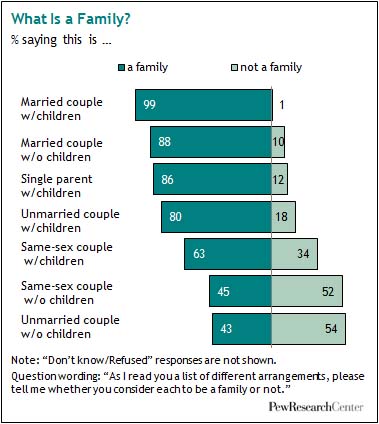
Chart Of The Day

From Pew:

Family

Catherine Rampell hopes that "Pew continues to ask this particular question in the future":

It’ll be interesting to see how the evolving definitions of such social terms affect how Americans think about the social safety net and related economy policies.

The whole report, which takes a look at the state of marriage and family life, is well worth a read.

Disturbing Online Firsts: Abortion Voting, Ctd

Jeff Fecke tracks down the husband from this website. Amanda Marcotte summarizes:

Jeff discovered that the Web site owner, Pierre "Pete" Arnold, has worked for a right-wing radio talk show and blogged for an anti-choice right-wing Web site. He's also run other poorly done parody sites. He's also quite likely to be a man who trolls progressive wikis, vandalizing entries on reproductive rights.

But the most telling detail of all is the way the Web site presents pro-choicers, as people who somehow love abortion so much they would deliberately get pregnant just to have one. Even if you think that a fetus has no moral value at all, it's completely silly to think that women enjoy abortions. That's like suggesting someone eats a lot of candy not because they like the candy, but because they really want that root canal.

The Doctor Did The Wrong Operation

Maggie Koerth-Baker reports:

Massachusetts General Hospital's Dr. David Ring performed the wrong surgery on a patient. This kind of thing isn't as uncommon as you might hope. One study showed 1 in 7 hospitalized Medicare patients got the wrong treatment. What is rare: Ring apologized to his patient immediately and has gone on to write up a public acknowledgment of his mistake —with an eye toward preventing future mishaps—in the New England Journal of Medicine.

It's important to acknowledge this kind of integrity and personal accountability. Especially when considering how our medical malpractice laws discourage it. And how absent it appears to be in every major walk of life.