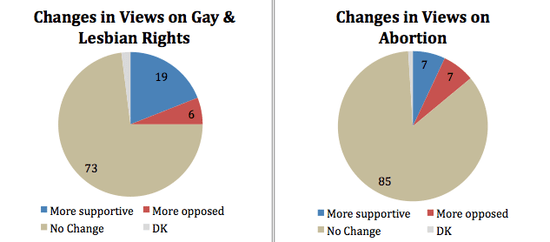
The American Values Survey compares two culture war issues and public opinion in the last two years:
(Hat tip: Drum)
The American Values Survey compares two culture war issues and public opinion in the last two years:
(Hat tip: Drum)
Lee Drutman's basic understanding of the process:
[W]e are left with yet another paradox of American democracy: opportunistic politicians railing against a process they willingly participate in and benefit from, knowing very well that there is actually very little they could do to change it even if they wanted to, and voters rewarding behavior — at the individual level — that they supposedly dislike at the national level. Pork-barrel politics are as old as the system of geographic representation enshrined in the Constitution, and it doesn’t appear things are going to change anytime soon.
Aaron Carroll asks what insurance in the healthcare exchanges will actually look like:
Such insurance is going to have to come with restrictions. There might be network restrictions (such as seeing only certain providers). There might be gateways people don’t like. And there might be other rules in place that people don’t anticipate.
My conversations [with insurance company executives and managers] lead me to believe that many people are expecting that the plans offered in the exchanges will be Medicare-like in many ways. I feel like many people think they will have choice of doctor, choice of hospital, and the ability to dictate care. I’m not seeing how insurance companies will be able to offer such products at prices people can afford. As I talk to more and more people in the insurance industry, my thoughts seem confirmed.
I may be wrong, but I think it’s worth addressing. Mistaken expectations have been, and continue to be, a real problem in health care reform.
The manufacturer of Four Loko caves to federal pressure by agreeing to remove the caffeine. Sullum sums up the FDA's approach:
In short, a caffeinated alcoholic beverage targeted at "young adults" is "adulterated," while exactly the same beverage targeted at middle-aged drinkers is not. The FDA is not really banning drinks; it is censoring speech.
He follows up with some parting words:
For those who are worried about what will happen when their stockpiles of genuine Four Loko run out, BuzzFeed has instructions for making your own at home. For those who want to stay awake while they're drinking but would not touch a declassé drink like Four Loko with a 10-foot tongue (why am I thinking of Freddy Krueger all of a sudden?), New York Times restaurant critic Frank Bruni reviews hoity-toity coffee cocktails served by boutique bars in Brooklyn and Manhattan. Something tells me these drinks, despite providing a pharmacologically identical experience, will never inspire a moral panic like the one that drove Four Loko and its ilk from the market.
Noam Scheiber contemplates Palin's anti-Fed speech:
What Palin is after here, of course, isn’t a debate over the finer points of interest-rate setting. It’s just the latest instance of her lashing out against meritocrats and intellectuals, whom she feels talk down to her and her fellow repositories of homespun wisdom. Palin has always practiced a kind of identity politics in which one’s views deserve privileged status by virtue of they’re not being informed by any specialized knowledge. Hers is a politics of resentment—resentment at being led by the sort of snobs who think governing requires expertise. She betrays herself by getting so defensive in her exchange with Reddy, whom she sneeringly labels a “prestigious reporter for The Wall Street Journal”—another pointy-head, in other words.
Today on the Dish, Andrew rejected Adam Serwer's understanding of Awlaki. Palin earned more free air time from Bristol's rigged appearance on DWTS, while the dancing made this man shoot his TV. Bristol teamed up with The Situation to teach kids about safe sex, Bernstein ignored the polls, and Palin relied on Todd and God to protect her from all outside forces. Willow defended her mother's show on Facebook by calling a kid a faggot, while the show's producer insisted the show isn't political at all. Sarah Palin accused Obama of not being vetted, and Conor called her out for being the ultimate inauthentic politician.
Dick Morris exemplified stupid, James O'Keefe made our stomachs churn with his latest antics, and Hugh Hewitt followed the Palin model of press. E.D. Kain destroyed the illusion of a conservative movement on Fox News, the House GOP feared Obama, DADT wasn't dead yet, and Murkoswki prevailed. The pill benefited the budget and the environment, but the Catholic contingent of pro-lifers still won't allow it. Andrew argued a blogger's home can affect the output, and Hitchens regretted not speaking out against Mugabe. Noah Shachtman didn't believe scanners were keeping us safe, and Seth Masket argued it was really all about a humiliated professional class. Neocons supported START, Andrew recommended Bjorn Lomborg's new film, and answered global warming critics. Cheaters proliferated with the help of an anonymous source, and Americans borrowed money to sue.
Sullum briefed us on the war on meth, qat threatened Yemen's water supply, and Julian Sanchez was tracking his own burglar. Andrew articulated his gay version of hell, Four Loko was banned, a reader enjoyed the pirates' khat, and Christmas just got gayer. Writing about ignoring a royal engagement still counted as covering it, and beards encouraged foreplay. VFYW here, quote for the day here and here, cool ad watch here, MHB here, Yglesias award here, Malkin award here, and FOTD here.
–Z.P.
Jonathan Martin draws lessons from Robert Draper's NYT Magazine story:
Draper vividly depicts Palinworld for what it is: a seat-of-the-pants-operation where loyalty is everything and in which convention is lightly regarded. This is a large part of why she was such a logistical nightmare for campaigns. Palin didn’t want to expand her circle in a fashion necessary to meet all the demands somebody of her celebrity faces. So she wound up creating undue headaches for herself. Draper adds to the litany, reporting that the former governor has blown off figures such as Roy Blunt and Orrin Hatch and institutions like National Review thanks to what he calls the “the inefficiency of her network.”
But even Palin’s uber-loyal network seems to consist of individuals who act more as protectors than advisors. She and her husband, Todd, effectively run Palin Inc off their BlackBerries.
When you have as many lies to defend against as Palin does, when your entire public persona is a fiction, when you have nary a clue about the issues of the day … of course, you have to have protectors rather than advisers. No one advises Palin, except Todd and God. She has the glib cruelty of George W and the character of Richard Nixon. But Nixon, for all his faults, was authentic. Nothing about Palin is authentic. She knows nothing but appearance and the constant deception and seclusion necessary to maintain it.
Julian Sanchez was burglarized. He's trying to use the power of Big Brother for good:
The police arrived and duly dusted for fingerprints, but I wasn’t holding out any hope of recovering anything until it occurred to me a few hours later that the PS3 is, after all, a network device with a unique MAC address—and a lot of the cool stuff you can do with it requires connecting it to a network. A little Googling and, sure enough, Sony has the capability, at the request of law enforcement, to flag a stolen system and record the IP address from which it’s connected—even if the thieves (or an unwitting buyer) wipe the machine and try to create a new account. From there, you’re a §2703(d) order away from getting a physical address. The folks I spoke to at MPD sounded as though they were unfamiliar with the capability, but willing to look into it… which means, I suppose, that spending as much time as I do thinking about the ways people can be tracked online could wind up having some direct practical benefit.
A reader writes:
Your reader makes a very impassioned case for qat in terms of its properties as a drug, but the problem with qat is not really that it has particularly ill effects on the body and mind (although it is pretty addictive, which is cause for concern). The big problem is environmental; the plant has practically destroyed Yemen. Around 40% of Yemen's water supply goes into growing it, and that number is going up even as the water supply dwindles. Yemen today is pretty much desiccated, yet continues to pour large quantities of water into qat production, at the expense of food agriculture, industry and availability for personal use.
I wrote earlier today:
When I burn in hell, I'm sure I will be surrounded by rainbow Christmas trees under fluorescent lighting – with HRC logo ornaments and anti-bullying bracelets festooning the bloody thing.
But it could be even worse: I could be buried in this.
 The Dish