In Defense Of Awkward Obsessions

Robin Hanson worries that his kids will grow sophisticated:

Sophisticated folks are horrified to seem to not care or know the standard amount about any standard hobby. The sort of folks one wants to know, e.g., to invite to a dinner party, simply must be ready to converse lightly and intelligently (if not insightfully) on the latest fashions in all such areas. The problem is that maintaining a basic proficiency in all these topics, in addition to keeping up a job and family, etc., takes a up pretty much all their time and energy.

Interesting folks, in contrast, get so far into a particular topic that they become at risk of violating conversation etiquette, by talking too enthusiastically for too long on topics of minor interest to sophisticates. Yes, interesting folk are at risk of being distracted from dress or hygiene, or from carefully climbing their local status ladder. But they are also at risk of making a unique contribution to the world. They are also the sort of person from which you might actually hear something new, something you couldn’t hear from a million different sophisticates.

What Money Can’t Cure

Afghanistan_Bombing_Getty

Over the weekend Afghan President Hamid Karzai blamed the corruption of his government on a deluge of American money. Matt Steinglass zooms out:

Why, in the famous Green Beret refrain, were their Vietnamese so much better than our Vietnamese? For over 40 years, we've known the main answer: it's because the incentives we've offered our protegés, by throwing money at them, have destroyed their capacity to act as a unified self-interested governing force.

The first problem is that America seems incapable of acknowledging this dynamic. The second problem is that, even once we've recognised it, we don't seem to know what else to do. What can America do about Afghanistan besides spend money on it? What possible American solution to Afghanistan's problems (as we perceive them, anyway) could involve not spending over four times the country's GDP?

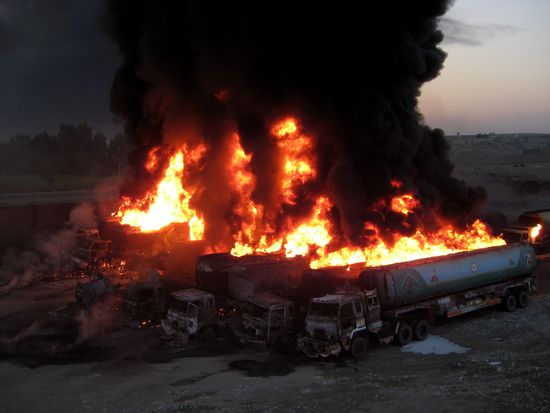
(Photo: Smoke and fire burns NATO fuel trucks in Jalalabad on November 14, 2010. Three civilians were killed and 20 others were wounded in home-made bomb blasts in eastern and southern Afghanistan on Sunday, the government and local officials said. By STR/AFP/Getty Images)

The GOP’s Lame Horses, Ctd

Jonathan Bernstein discounts Palin and Romney:

[T]he 2012 cycle will be only the third truly open nomination without a serious heavyweight in modern GOP history. Now, it may well be that Republicans are simply inclined to follow hierarchies (although don't ask Lisa Murkowski about that!), and that they saw Bush in 2000 and McCain in 2008 as more "next in line" than the others. But that doesn't really tell us that Romney or Palin will (necessarily) be helped by that tendency; it implies only that whoever does benefit will seem, after the fact, to have been the logical next in line. 

The Daily Wrap

Today on the Dish, Andrew mused over Beastweek and the future business of web journalism. We kept tabs on DADT, and the repetitive list of McCain's absurd requests. Drum and Avent duked it out over the deficit, and Heather Mac Donald challenged the Tea Party to step up to the plate. Frum called out the Republican fiscal farce, and Felix Salmon didn't love the NYT's tool for fixing the budget. Ezra Klein insisted the healthcare bill was moderate, while the GOP pledged to ignore the 50 million uninsured.

Andrew took stock of Khalid Sheik Mohammed's detention for the foreseeable future. Yemen is capable of beating Al Qaeda back, and Andrew distanced himself from an ACLU so ready to represent Anwar al-Awlaki. The unconditional became the conditional in Israel, Mark Lynch was skeptical of the new deal, and readers offered situations similar to Cantor pre-empting Clinton.

Tim Pawlenty couldn't get people to remember his name, Palin was inept at firearms, and the rest of the country liked her more than Alaskans. Andrew praised Obama's era of pragmatism which was different from Kennedy's idealism. E.D. Kain doubted governments just as much as the people who run them, and Adam Bonica predicted the most polarized Congress in recent memory. Jay Rosen was sick of national security journalists cozied up to the state. Dialysis was dangerous in ways you wouldn't expect, and rocket dockets accelerated foreclosures. We marveled at the earth's ecosystems from space, fake pot could be enjoyed, and Arizona won medical marijuana. Travellers didn't want their junk touched, fish were farmed too, and this reader enjoyed eating dog. A Rubik's cube was no match for this kid, sexy robot girls would always exist, and Andrew preferred zombies to vampires any day. Springsteen sang about the Promise, and Ebert comforted the internet's lonely.

VFYW here, full disclosure of the day here, chart of the day here, transsexual carte-de-visite here, MHB here, and FOTD here.

–Z.P.

You Are Not Alone, Ctd

Glow_of_web

Roger Ebert follows up on his recent post:

I had no idea. For days I've been reading waves of messages from the lonesome, the shy, the alone, the depressed. Some who live as virtual hermits. Some who have few or no friends. Some who rarely speak with their families. Some who have never dated, or ever had sex. Some who consider it a good day when they never speak to anyone. Some who are sad to be alone. Some who are relieved. Some who can't do it any other way.

…Were any lives changed? Not much, I'm sure. Fundamental shifts in life take time. Did people feel better after posting? I think maybe so. For everyone who posted, hundreds of others read. Maybe they identified with another person's experience. Yes, the internet is anonymous. Sometimes that can be a good thing. Sometimes it is good to bear witness to your life. Maybe this was one of those times.

(Photo by Evan Baden)

The EPA Versus CO2

Dave Roberts reports:

Documents released early this week finally start to offer a glimpse into EPA thinking. Long story short: Climate hawks shouldn't expect much from these upcoming regulations. They won't be a substitute for the climate bill. Not even close.

Here's the basic problem the EPA faces: The best way to reduce greenhouse gas emissions from stationary sources — primarily power plants — is to approach the situation holistically: shut down a bunch of dirty power plants, build a bunch of clean power plants, and push hard on efficiency to cover the cost differential and protect ratepayers. Legislation could have done that. EPA can't. EPA can't make anybody build anything.

Palin Loses Alaska

PPP releases another batch of 2012 polls. One wrinkle:

In Alaska the big story is Sarah Palin's strength- or more precisely lack thereof- only 15% of her home state Republicans say she's their pick to be President, putting her behind Huckabee at 17% and Gingrich and Romney at 16%. When you see that lack of support for Palin in the state Joe Miller's apparent loss in the state's Senate election begins to look more and more understandable. It's clear at this point that Palin is a lot more popular in the rest of the country than she is in her home state.