From Radicalism To Pragmatism

Two quotes – one from the Bush era:

The aide said that guys like me were "in what we call the reality-based community," which he defined as people who "believe that solutions emerge from your judicious study of discernible reality." … "That's not the way the world really works anymore," he continued. "We're an empire now, and when we act, we create our own reality. And while you're studying that reality—judiciously, as you will—we'll act again, creating other new realities, which you can study too, and that's how things will sort out. We're history's actors…and you, all of you, will be left to just study what we do."

The other from the Obama era:

"We have to take the world as we find it."

From Rove (allegedly) to Axelrod, we have the return to sanity. Some regard it as a transition from strength to wimpiness. But Bush's strength was brittle; and Obama's pragmatism needs to be judged on its long-term results.

The Healthcare Bill Was Moderate

Ezra Klein holds his ground:

People tend to form their impressions of how liberal or conservative something is by looking at how much partisan activity there is around it. And there was, of course, a lot of partisan activity around Obama’s signature legislative effort. But if you believe “liberal” and “conservative” refer to coherent schools of ideological thought, the health-care bill was the most moderate universal health-care proposal offered by any president, of any party, in the last century. 

The empirical case against the Big Lie is water-tight. And it reveals just how successful – and desperate – the FNC/RNC’s meme of Obama as some crazed far leftist is.

What this distortion of reality reveals is just how successful propaganda can be – especially when disseminated by a cable news network fused with one political party and directed at an epistemically closed niche audience. In a follow-up post, Klein calls out Republicans:

Democrats have been willing to adopt Republican ideas if doing so meant covering everybody (or nearly everybody), while Republicans were willing to abandon Republican ideas if sticking by them meant compromising with the Democrats. But because Democrats were insistent on getting something that would help the uninsured, they’ve ended up looking like the partisans, as they keep pushing bills Republicans refuse to sign onto.

The Earth As Found Art

2608

A stunning view from a United States Geological Survey satellite reveals the following:

In the American Southwest, transitions from one ecosystem to another can be dramatic and abrupt. This certainly is true in northern Arizona, USA, where the parched Painted Desert, shown here in a palette of purples, adjoins Sitgreaves National Forest (shades of green), a realm of pine woodlands with abundant wildlife. Within the Painted Desert lie the Hopi Buttes, a field of ancient volcanic cones, seen here as a scattering of dark, circular shapes near the top of the image.

More here. Via Madrigal.

McCain On DADT

A helpful summary of his (non)evolution:

We can't repeal DADT until the Secretary of Defense says it's a good idea. Oh, he does?

Well then we can't repeal DADT until the Chairman of the Joint Chief of Staff says it's a good idea. Oh, he's on board, too?

Well then we can't repeal DADT until we've surveyed servicemen and women, asking their opinion on the policy. They're fine with repeal, too?

Well then we can't repeal DADT until we've studied the survey results for months.

Translation: I will single-handedly prevent it. Because I can. And because president Obama (who beat me bad) is in favor.

Cantor Pre-Empts Clinton, Ctd

A reader writes:

Another precedent that I can think of is Nancy Pelosi going off to meet with Bashar Assad of Syria three years ago in contravention to the clear policy of the Bush administration and the United States.

Another writes:

How about Congressmen Miller, McDermott and Bonior going to Iraq in 2002 and trashing the shit out of Bush on American national television?

Another:

Mark Kirk, the Republican who now holds Obama's senate seat, personally told Chinese officials not to believe US budget numbers. He even bragged about the incident on video.

Another:

As loathesome as Eric Cantor may be, his actions are by no means unprecedented.  In fact, there is a statute, the Logan Act, that directly addresses the issue of unauthorized interference in US foreign affairs by private individuals.

The statute was enacted in 1799 during the Adams Administration to deal with what was considered to be meddling by private US citizens in connection with the US position in conflicts between Britain and France.  Notwithstanding the longevity of the statute, no one has ever been prosecuted for violating it.  In recent years the Logan Act has frequently been brought up in connection with "private diplomacy" by people such as Jimmy Carter and Jesse Jackson.  In 1975, there were accusations that Sens. McGovern and Sparkman should be charged under the Logan Act because of a trip they made to Cuba.  The Department of State rendered a legal opinion, however, that the law should probably not be applied to members of Congress.

Bowles-Simpson And The Tea Party Bluff II

"When they were out in the Boston Harbor, they weren't arguing about who was gay or who was having an abortion … Am I going to be the best man at a same sex-marriage wedding? That's not something I necessarily believe in. I look at myself as pretty socially conservative. But that's not what we push through the Tea Party Patriots," – Ralph King, a Tea Party Patriots national leadership council member.

It seems to me there are two Tea Party litmus tests in the coming weeks and months: the first is how seriously they embrace the Bowles-Simpon plan for real debt-reduction; the second is whether they really are just Christianists in anti-tax clothing. I expect them to fail both tests easily. But I'd love to be proven wrong.

Bowles-Simpson And The Tea Party Bluff

Heather Mac Donald challenges the Tea Party to live up to its alleged principles:

It would be refreshing if, instead of exclusively blasting the proposal’s relatively modest tax increases, such as raising the federal gas tax fifteen cents to pay for transportation projects (a legitimate user fee), they supported the proposal’s more audacious cuts, such as reducing the mortgage deduction.   (The commission would eliminate the deduction only for mortgages over $500,000, alas.)  The willingness to take on this middle class subsidy would be stronger proof of iconoclastic independence than pushing for repeal of 17th Amendment, a favorite piece of Tea Party arcana.   Both would be an uphill battle; I’d rather see political capital expended on getting rid of a constitutionally-suspect government hand-out, especially given the contribution of the federal government’s obsession with increasing home ownership to the 2008 fiscal crisis.

She concludes by listing several other cuts they should support, and arguing that

"The Tea Party will justify its claims to significance if it can create the political will to reduce entitlements and to challenge Republican sacred cows."

As I've said before: the Tea Party will soon reveal if they are anti-debt for real or just anti-Obama. It will be far more instructive than any attempt to penetrate what they're about until now. If they are just another supply-side, Christianist, fanatically anti-tax group, we can safely file them back into the loony-populist wing of the GOP. If they could actually align with Obama in bringing about a small government, debt-defusing revolution, that relies on spending cuts far more than tax hikes, we can wish them well.

Tax Reform And The Debt

Kevin Drum feels that a deficit commission should "focus solely on cutting spending and increasing revenue, not on remaking the tax system." Ryan Avent rebuts

[T]he principle that tax reform is a healthy part of deficit reduction is a sound one. And not really an ideological one. On the contrary, a government with a more efficient tax system will find it easier to support a more progressive social safety net. Improvements in the tax code are low-hanging fruit, and it's good that reforms have been placed on the table.

The Rift Widens

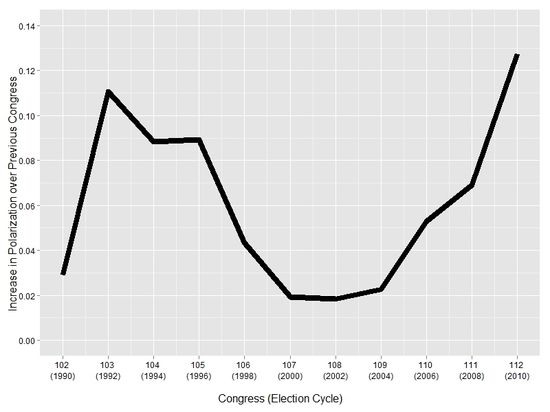
Polarization

Adam Bonica expects the 112th Congress to be the most polarized in recent memory:

The hollowing out of the political center explained the momentous rise in polarization during the Southern realignment. Now that only a handful of moderates remain in the House, polarization can no longer be portrayed as a story of vanishing moderates. It appears the rise of the extremists has stepped up as the driving force behind congressional polarization.

Yglesias analyzes.

To Doubt With Conviction, Ctd

E.D. Kain engages the subject again:

I’m skeptical of the collective wisdom of the American people. I’m not any more skeptical of the people we put in government. But those people wield enormous power; and nor are they acting in isolation. What they can and cannot do is often limited by other people perhaps less brilliant or less honest. Even the most skilled technocrat with the best intentions has to navigate the labyrinthine halls of power, compromising here, giving special favors there. Often it is the very corporations and special interests that liberals decry who benefit the most from centralized power and complexity, from the good intent of human failings. Limiting government, then, in my view is a very progressive goal. We will have experts in government no matter what – and that’s not a bad thing – but we should expect what they can achieve in real life to be far less than what they can achieve in theory. They are as human as we are and as prone to mistakes. We should look to limit the scope of their mistakes.

Again, conservatives are as guilty of certainty as liberals are – often more so.