“Selling Lead As Gold, Shit As Chanel No. 5”

Matt Taibbi reports on "rocket dockets," the high-speed housing courts that are helping major banks by speeding through foreclosures in Florida:

[The rocket docket] exists to launder the crime and bury the evidence by speeding thousands of fraudulent and predatory loans to the ends of their life cycles, so that the houses attached to them can be sold again with clean paperwork. The judges, in fact, openly admit that their primary mission is not justice but speed. One Jacksonville judge, the Honorable A.C. Soud, even told a local newspaper that his goal is to resolve 25 cases per hour. Given the way the system is rigged, that means His Honor could well be throwing one ass on the street every 2.4 minutes.

The Sharp End Of The Needle

KidneyDialysis

Robin Fields reports on the appalling state of kidney dialysis in the US, especially among Medicare patients:

Taxpayers spend more than $20 billion a year to care for those on dialysis—about $77,000 per patient, more, by some accounts, than any other nation. Yet the United States continues to have one of the industrialized world’s highest mortality rates for dialysis care. … 

Conditions within clinics are sometimes shockingly poor. I examined inspection records for more than 1,500 clinics in California, New York, North Carolina, Ohio, Pennsylvania, and Texas from 2002 to 2009. Surveyors came across filthy or unsafe conditions in almost half the units they checked. At some, they found blood encrusted in the folds of patients’ treatment chairs or spattered on walls, floors, or ceiling tiles. Ants were so common at a unit in Durham, North Carolina, that when a patient complained, a staffer just handed him a can of bug spray.

(Photo by Flickr user Canuckshutterer "Bill" (W.J. Gibson))

The Case Against Tim Pawlenty

In a rebuttal to Jonathan Bernstein, Nate Silver makes it:

The other potential flaw [with Bernstein's analysis] is in assuming that name recognition itself is something exogenous from candidate quality. In plain English: the fact that a candidate hasn’t been very successful at getting voters to recognize his name is often a sign that he is an unremarkable candidate.

DADT: Forget The Supreme Court?

Jason Mazzone thinks the Ninth Circuit DADT ruling, whatever that may be, won't be overturned by the Supreme Court:

Justice Elena Kagan has recused herself from the case. This represents some very good news for the Ninth Circuit: its decision on the merits will almost certainly be the last word in the case. This is because if the Supreme Court reviews the Ninth Circuit, it will likely split 4-4, thus automatically affirming the Ninth Circuit's decision. The Ninth Circuit has something of a reputation for zany decisions that end up being overturned. Let's see what it does now that it knows it isn't going to be reversed.

Reflections In A Mirror

Sarah Bakewell reiterates what I’ve long argued, that the greatest blogger avant la lettre was Montaigne:

Montaigne raised questions rather than giving answers. He wrote about whatever caught his eye: war, psychology, animals, sex, magic, diplomacy, vanity, glory, violence, hermaphroditism, self-doubt.

Most of all, he wrote about himself, and was amazed at the variety he found within…

“In taking up his pen,” wrote the great essayist William Hazlitt of Montaigne, “he did 550px-Michel_de_Montaigne_1 not set up for a philosopher, wit, orator, or moralist, but he became all these by merely daring to tell us whatever passed through his mind.” He wrote about things as they are, not things as they should be—and this included himself. He communicated his being on the page, as it changed from moment to moment; we can all recognize parts of ourselves in the portrait.

In America, Ralph Waldo Emerson felt this shock of familiarity the first time he picked up Montaigne in his father’s library. “It seemed to me as if I had myself written the book, in some former life, so sincerely it spoke my thought and experience,” he wrote. “No book before or since was ever so much to me as that.” From Renaissance winegrower to nineteenth-century transcendentalist seems a big leap, yet Emerson could hardly tell where he ended and Montaigne began.

These days, the Montaignean willingness to follow thoughts where they lead, and to look for communication and reflections between people, emerges in Anglophone writers from Joan Didion to Jonathan Franzen, from Annie Dillard to David Sedaris. And it flourishes most of all online, where writers reflect on their experience with more brio and experimentalism than ever before.

Bloggers might be surprised to hear that they are keeping alive a tradition created more than four centuries ago.

Psychologists And Torture

A critical test for the integrity of American psychology: whether the Texas State Board of Psychologists will remove the license of a psychologist because he helped devise techniques for victims of the Bush administration's torture program:

The complaint, which was brought in June, alleges that the doctor misrepresented his qualifications to the C.I.A., placing “his own career and financial aspirations above the safety of others” while designing a “torture regime” with a “complete lack of scientific basis.”… The severity of the accusations led the American Psychological Association to take the rare step of submitting a public comment to the Texas licensing board. The group’s letter said that if Dr. Mitchell were a member of the professional association — he is not — and if the accusations were true, he would be expelled.

If we cannot get legal accountability for war crimes, we can at least aim for professional ethics being upheld.

Cantor Pre-Empts Clinton, Ctd

A reader writes:

You asked, “There are no parallels with this kind of direct undermining of the president on foreign policy that I can think of. Am I wrong?”

I can think of at least two from the Washington administration and one by Nixon against LBJ.

In 1791, Secretary of State Jefferson was involved in talks with the British ambassador.  Hamilton, fearful that Jefferson would take too hard a line, “secretly informed British officials that the secretary of state’s views did not represent administration policy and hence implied that they could be disregarded with impunity.”  (Alexander DeConde, A History of American Foreign Policy, p. 49)  Three years later, he undermined John Jay, who had been sent by President Washington to negotiate a treaty with the British: “Fearing any action that might endanger relations with the British, Hamilton blunted the only coercive weapon Jay possessed.  He told the British minister in Philadelphia that American policy was predicated on the principle of avoiding entanglement in European affairs and hence the US would not join the new armed neutrality.  Hamilton thus weakened Jay’s already shaky bargaining position.” (DeConde, p. 55).

More recently, and infamously, in October 1968, fearing an “October surprise,” the Nixon campaign used Anna Chennault to communicate to the Thieu government in South Vietnam that it should resist pressure from LBJ to participate in peace talks with the North Vietnamese.  Vice President Ky wrote: “out of the blue, Nixon’s supporters stepped into the picture. Approaches were made to Bui Diem, the Vietnamese ambassador in Washington, to the effect, ‘Hold on!  Don’t accept the invitation to go to Paris.  If Mr. Nixon is elected President he promises he will increase support for the Vietnam War.’” (Larry Berman, No Peace, No Honor, p. 33.)

These were all secret, of course – not public.  But sadly we have a history of undermining a sitting president’s foreign policy, all talk of politics ending at the water’s edge notwithstanding.

Bowles-Simpson And The Republican Bluff

Jonathan Chait defends his belief that the right isn't primarily motivated by a desire to shrink government:

…the debt commission's report entails a massive rollback of government. It does have some revenue increases, but those are accompanied by enormous cuts in income and corporate tax rates, and it's not clear if the net effect of the changes is to increase or decrease the share of taxes paid by the rich.

If the Republican Party was generally motivated by opposition to government, they would be dancing in the aisles.

Which, of course, some of us non-Republican small government types were doing much of last week. Bowles-Simpson is about as close to a Dish-style agenda as we can imagine. Chait goes on:

After all, this is a plan to both slash the size of government by about as much as it's ever been slashed, and slash tax rates. And yet the right's reaction is fairly tepid. The Tea Party movement is opposed. Grover Norquist is on the warpath. The Wall Street Journal editorial page is highly skeptical. I've seen a mostly positive editorial from National Review, but as of Friday evening, the Weekly Standard has written nothing at all. I wrote that the plan is overwhelmingly titled toward Republican priorities, and by that I meant putative priorities. The mixed response to a plan that would represent massive progress toward limited government makes my case for me.

Agreed.

A Breakthrough?

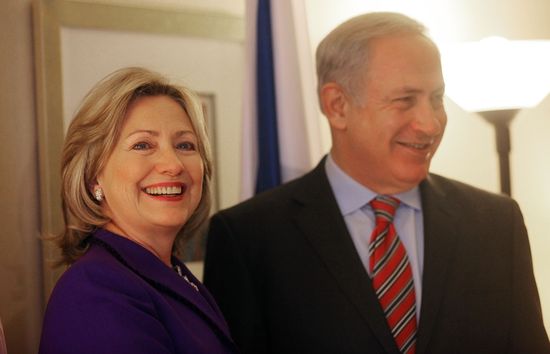
HILLARYBIBIMarioTama:Getty

Netanyahu has reportedly agreed to a further three-month settlement construction freeze in the West Bank (but not Jerusalem) while he and Abbas try to nail down final boundaries for a new Palestinian state. It appears he has a majority in his cabinet to approve the deal:

The deal includes a U.S. undertaking not to request a further extension of the freeze, and to veto any attempt by the Palestinians to win UN recognition of their state unilaterally…

An Israeli political source said the security cabinet vote was expected later this week and that seven ministers – Netanyahu among them – were likely to back the U.S. proposal, against six who would vote against and two who would abstain. The forum includes representatives of major coalition partners, from the center-left Labor party of Defense Minister Ehud Barak to Netanyahu's rightist Likud to the far-right Yisrael Beiteinu party of Foreign Minister Avigdor Lieberman.

The $3 billion bribe is contingent on a successful two-state agreement, and is designed to assuage Israeli security concerns:

The Obama administration would also ask Congress to approve a $3 billion sale of warplanes to Israel and, should there be peace with the Palestinians, guarantee its wider security needs. These would supplement the 20 F-35s Israel already plans to buy for $2.75 billion drawn from annual grants it gets from Washington.

So Obama's implicit willingness to take this to the UN was the stick added to the $3 billion carrot. It hasn't been an easy process, and Obama has had to allow himself to be humiliated to get this far. But we know that Obama's modus operandi is often to give his opponents a tactical victory, as long as it advances his own strategic goal. Bernard Avishai compares Obama's tortuous, humiliating approach in the peace process to his health insurance reform strategy:

The administration has been criticized for allowing Senate committees to debate the shape of the healthcare bill before committing itself to a final plan. The process was ugly; and the administration sweetened the outcome for resistant blue-dogs along the way. In the end, however, it got senators who had skin in the game, and it used their disagreements to define the "solution space" in which to intervene. And once (as Jonathan Cohn has shown) Obama saw the shape of the bill he could get, he still had to choose: let it go, for political reasons, or campaign for it, for historical ones. Had he not chosen the latter course, we would not have had a health reform bill at all.

Something like this moment is now in the offing in the Middle East. What the administration has done is allow Netanyahu the equivalent of (forgive me) pork to bring the Israeli state, so that the most critical issue defining a Palestinian state can be brought into relief. Israeli ministers most vociferously opposed to any state are justifiably in a panic (a "honey-trap" says Moshe Yaalon). Like Republicans who had hoped to kill any reform in committee, they are not so much convinced that they have lost the game as understand that now they are in one…

Ensuing negotiations, over the next couple of months, will almost certainly not produce an agreement. But they will define the solution space Obama will have to move into and the line he will have to publicly fight for. It will tee-up perhaps the most important foreign policy test of his presidency, and set up the right moment to visit Jerusalem. As with President Kennedy during the Cuban Missile Crisis–who had previously been thought weak, but proved how shows of strength require a sense of timing–it may be Obama's best chance to reignite the global hopes invested in him.

Maybe Netanyahu will have to forge a new coalition with Kadima to have this work. But it looks as if he can squeeze it by his current cabinet, which is preferable. The more right-wing a government that agrees to a two-state solution the better for the boundaries' future legitimacy. And so Obama fitfully but persistently moves toward his central goal for the next two years. A first term that brought universal healthcare to the US and a resolution of the Israel-Palestine conflict would be quite something, wouldn't it? Even the lefty complaint chorus might be able to muster a few cheers for that.

(Photo: Israeli Prime Minister Benjamin Netanyahu and U.S. Secretary of State Hillary Rodham Clinton speak with the media prior to their meeting November 11, 2010 in New York City. The two were expected to discuss the rift over settlements in Arab East Jerusalem and other Mideast peace issues. By Mario Tama/Getty Images)