From Jews To Muslims

In light of the recent violence at a Syrian Catholic Church in Baghdad, John L Allen Jr proposes a new thesis:

The last decade has witnessed a historic shift from Judaism to Islam as the paradigmatic interfaith relationship of the Catholic Church.

That's not to say Judaism has become unimportant, or that Catholics won't continue to work on the relationship. Islam, however, has become the primary interfaith concern. Not only is Islam where the bulk of the church's time and treasure is being invested, it's the new template for all of Catholicism's relationships with other religions.

Making Pain Visible

Daisy Banks interviews David Biro on his studies in pain. Here they discuss Elaine Scarry's book The Body in Pain:

We are forced to speak of pain in terms of other, more visible objects, ie we are forced to speak metaphorically. The most common metaphor of pain is the weapon. We say, for example, that pain is shooting or stabbing or crushing. 

When you think about it, these words are all being used metaphorically – since most of the time we haven’t been shot or stabbed or crushed but are just imagining that something like this must be happening. So one way of talking about pain is to talk about guns, knives, and hammers, or the damage those weapons can inflict on the human body. There are also other ways to represent pain metaphorically which I discuss in my book. The bottom line is that we have to be exceptionally imaginative when it comes to pain or else it will remain incommunicable and invisible, not only for the sufferer but also for friends and doctors trying to help. 

A Letter From A Catholic Mother

A reader writes:

My husband and I are raising our sons in the Catholic Church.  We are active in my church, I teach religious education, we perform corporeal works of mercy with our fellow parishioners (our food pantry has added 100 families in the last six months). We are anti-abortion but pro-choice, we support gay marriage and female priests.  We are not alone in our beliefs in the parish and we are often at loggerheads with our rather strict constructionist brethren.

I was quite proud of my sixteen-year-old son, who after completing two years of confirmation preparation wrote his letter to the Bishop telling him quite proudly why he did not want to become confirmed as an adult in the current church. 

He stated his positions on sexual equality, freedom of choice and the treatment of woman as second-class citizens.  He laid out precise logical arguments on how the church was losing its young by neglecting to follow the example of Jesus.  Our Director of Religious Education was also proud of him and uses his letter (with our permission and his name redacted) as an example of the seriousness of the decision of confirmation. She told us how many of the teenagers go through the motions, do it for their parents and then are never seen again. 

Our son attends mass, helps when he can when he is home from college, and works with a local parish near his school.  He still considers himself Catholic but cannot in good conscious swear to obey the tenets of the current church.

I consider him a good Catholic – in fact a better Catholic than I – because I had doubts as a teen but got confirmed anyway because I didn't want to disappoint my parents.  His faith is strong, but his desire to build a better church is what keeps me teaching and trying to live up to his example.  He is the reason that I believe the American Catholic Church will become in the future a separate branch, rather than Roman Catholic.

How Beer Made Us Civilized

Charles Q. Choi interviewed archaeologist Brian Hayden on how beer may have aided in the rise of civilization:

Feasts are essential in traditional societies for creating debts, for creating factions, for creating bonds between people, for creating political power, for creating support networks, and all of this is essential for developing more complex kinds of societies… The brewing of alcohol seems to have been a very early development linked with initial domestication, seen during Neolithic times in China, the Sudan, the first pottery in Greece and possibly with the first use of maize.

(Hat tip: Max Read)

Fragments From The Wars

Battlespace9_0

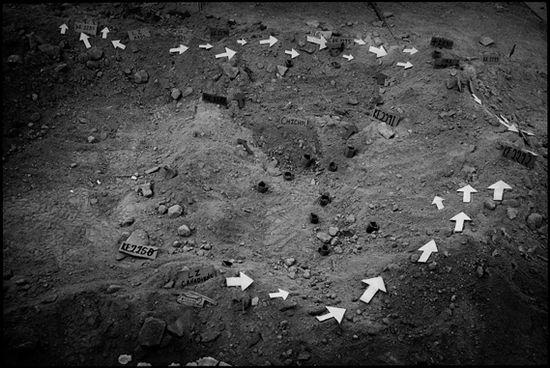
Eliza Williams previews a London photography show, Battlespace, presenting an "unsanitized view" of the conflicts in Iraq and Afghanistan. From the exhibit's catalogue text:

These photographs were made in Afghanistan and Iraq, but they don’t claim to depict either country. They are glimpses of an alternate reality built upon those countries. The images do not provide a comprehensive account of these wars, or an understanding of these nations or their peoples. They are fragments, seen in off-moments behind the walls of concrete super-bases, or outside them, through night-vision goggles and ballistic eye shields. …

The battlespace is not solely defined by map lines or grid squares, but also in the areas of perception and illusion. … In this shifting, human terrain, there are no facts or truths, only competing agendas. … Unpleasant, complex, or off-message images are filtered by both sides, and war stories are recycled through the echo chamber.

(Image: Battleplans, Operation Rock Avalanche. Afghanistan, 2007. By Balazs Gardi)

Don’t Mix Shots and Social Media

Brenna Ehrlich reports on a new web plugin called “The Social Media Sobriety Test” whose motto is, “Nothing good happens online after 1 a.m”:

Set your hours of intoxication, and if you try to sign on to one of those sites during those times, you’ll be asked to pass a test.

I tried it out — about five minutes ago and fully sober — and failed said test …

“If You Can’t Fix It, You Don’t Own It”

Ifixit pens a self-repair manifesto:

. … Manufacturers push new models every year with just enough style tweaks to make our last one feel obsolete. They use legal threats to keep repair manuals away from us and deploy so-called ‘security bits’ in new products to prevent us from opening our own things. They have even gone so far as patenting screw heads to keep us out of our stuff.

How To Eat At Chipotle

A primer:

If the burrito tears and they have to add a second tortilla, CONGRATULATIONS, you ordered the proper way.

And if you've impressed the manager so much that he says “That’s a big fuckin’ Burrito” as you’re paying, then not only have you done your job well, but I’d like to go out to lunch with you. It was the proudest day of my life. This manager watches burritos being made all day long, so if you have impressed him/her to the extent of f-bomb dropping, you know you’re good.

Refusing To Be Shamed

LOVEGabrielBuoys:Getty

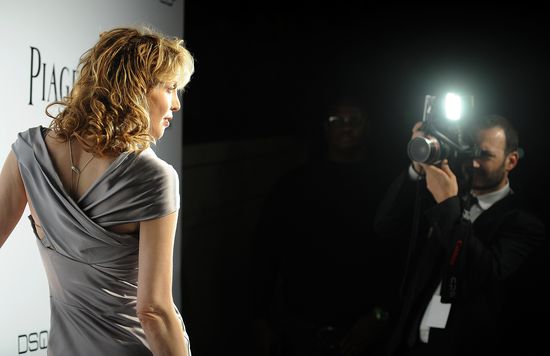
Jenna Sauers explains why Courtney Love matters, in light of a highly entertaining profile in last week's NYT:

What other woman in recent memory, having been given (hell, earned) the media's Bad Girl label, has snarled at the designation — and then continued on her own, misguided but apparently basically contented, way? (Angelina Jolie wriggled out of her "reputation" with supermotherhood and charity photo-ops; Juliette Lewis found God, or at least Scientology.) …

So even though she is a bad singer (the point of Courtney Love is kind of that she's a bad singer, just like it's kind of the point of Dylan) and (probably) a bad mother, and even though her Twitter was like a harrowing download from her Id, and even though I do not really understand what she was doing wandering a hotel naked with Anselm Kiefer and I do not believe that "a combination of Zoloft and a cocktail" really explains it, I love Courtney Love.

Because she's not a role model — and, even more, because she has never aspired to be. Because she's not passive. Because she's a woman who takes issue with the view that she ought to be defined by who she used to fuck in the early 90s and who she gave birth to as a result. Because she auditioned for the bloody Mickey Mouse Club at age 12 by reciting Sylvia Plath's "Daddy." Because she is subjected (and subjects herself) to industrial-strength moral and legal scrutiny at every turn and still gets up in the afternoon, applies lipstick in the vicinity of her mouth, and faces the world. Are these achievements too small to cheer? In a world that still orders up sacrificial pop virgins — Britney, Lindsay, Demi — to swallow down whole, I'd argue they're anything but.

(Photo: Actress Courtney Love arrives at the amfAR's Inspiration Gala Los Angeles to benefit the Foundation's AIDS research programs at the Chateau Marmont in Hollywood, California, on October 27, 2010. By Gabriel Buoys/Getty.)