Alexander: Gay Alcoholic

Tony Perrottet reviews the history of Greek homosexuality:

Grown men could have their way with adolescent boys up to the age of 16 or so; it was even part of a Greek boy’s education, as the older lovers would “mentor” them in the finer aspects of art and philosophy, while their fathers looked on with approval. But adults had to keep their hands off other grown men. The question of who was the active and who the passive partner was crucial; the older, socially superior male could give but not receive. 

For the Greeks, the real scandal about Alexander’s passion for the Persian boy Bagoas was that he was a barbarian and a eunuch — and thus barely human, in their eyes. Also shocking for the day was Alexander’s ongoing romance with Hephestaion once he had become an adult; if it ever came out that the king was the passive partner, he would be the object of mockery and contempt. Nobody has posted an opinion on this, but it appears that Alexander’s fantastic achievements in the battlefield allowed him to flout convention. Still, the pressure might have increased his severe drinking problem: Alexander’s vast wine consumption is blamed for his untimely death at the age of 32.


Staying Fully Human Online

Ross Douthat feels the push and pull of the web:

With rare exceptions, our miraculous communications technologies always seem to tug me toward superficiality and inattention, and away from deep intellectual engagement and true personal intimacy alike. (And I don’t even really use Facebook …) What’s more, the assumption that “humans will always find new ways to stay human” strikes me as too blithely pollyannish: All societies are human, but some are more human than others, and I’m not at all convinced that internet culture is nearly as conductive to the fullest sort of human flourishing, whether personal or cultural or political, as its boosters constantly insist.

On the other hand, the internet isn’t exactly going away, retreating from the world that Mark Zuckerberg helped build isn’t an option for most people — and so Madrigal’s exhortation to mastery is perhaps a more plausible prescription than Smith’s wistful suggestion that we should resist and/or withdraw from social media’s flattening embrace. All of which is to say that you should read both pieces in full, because they both have something important to say about the challenge of staying fully human in the brave new online world.

Creepy Ad Watch

Edith Zimmerman is stunned:

Yes, a mere $16.95 unlocks the secret to peeing at a urinal from "between 2.5 feet and 3 feet in distance" and possibly even "over five feet," which means you wouldn't even need to wait for that guy in front of you to finish — just stand behind him and blast your urine over his shoulder in an elegant arc. Because it does involve "blast"ing.

Just Look

Peter Campbell rants about museum audio tours:

It’s illegal to drive while you’re on your mobile phone, so why do galleries ask you to listen on headsets while you look at pictures? There is plenty of evidence – intuitive, anecdotal (scientific too, for all I know) – to show that concentrated listening and concentrated looking interfere with one another. Is it the money the headsets bring in?

Poem For Saturday

Kiss_In

"The Idea Of Beauty" by Meleagros from the 3rd century B.C.E., was translated by Brooks Haxton, and appeared in the Atlantic in June of 1998:

Shy, he stepped off into the cornfield. I could see
   his back muscles under the damp shirt quiver and go slack.
Turning again to face the shade, he smiled at me, not
   squinted, smiled, and finished tugging shut his fly.
Now, when the cornstalks in the night wind slide
   like fire, I see him. He steps closer in my dream.
I don't know, where he sleeps, if sleep refreshes him,
   but here it works me like hot metal over a flame.

(Image by Flickr user Philippe Leroyer)

“Die, Tory Scum!” Ctd

   Chris_killip 

I wrote earlier this week about British student protests against the Tories and how they reminded me of the 1980s. Right on cue, Yael Friedman reviews the work of British photographer Chris Killip, whose pictures show "the de-industrialised north in the 1970s and '80s, where the stark landscape, massive unemployment, and history of radical political defiance combined to pose as the underbelly of Margaret Thatcher's reforms." But visuals don't always mirror political fortunes. Paul Goodman points to favorable Tory poll numbers:

On welfare, schools and localism in particular – as well as deficit reduction, the crux of its programme – the Coalition's doing the right thing, and Tory Ministers are in the lead.  The only workable explanation of the Party's present poll ratings is that the voters sense this, and like it.  Which is why the best response to [this week's] disgrace is: keep calm and carry on.

Peter Hoskin believes that "violent protest may actually end up helping the coalition's cause." He excerpts this bit from an old Julian Glover column:

UK politics is often characterised as a contest for the centre ground, but that misdescribes the nature of the quest. Centrism implies banality, but I don't think voters want their governments to be mundane. There is a willingness to endorse radical action if it is explained and if it looks practicable. It worked for the left under Attlee and Blair; it worked for the right under Thatcher; and it is working – so far – for this government.

That a large number of people oppose what you are doing, very strongly, can become a strength, so long as they are seen to be opposing something rooted in a kind of imperative. Eight years ago almost half a million people marched through London with the aim of blocking the hunting ban – and to their dismay, the public took the government's side. The miners' strike, the Iraq war – examples are legion. Half a million people and more will probably be marching against the budget cuts soon, and will feel just as strongly that their solidarity brings invincibility. They may be proved wrong."

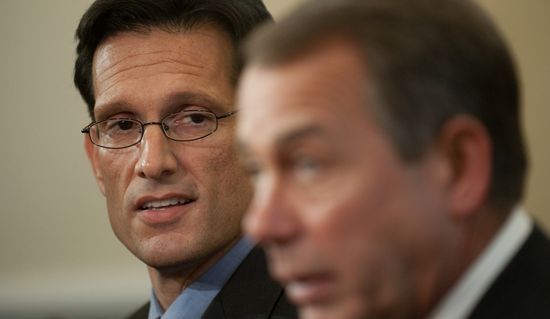
The Scandal Of Cantor And Netanyahu

CANTORJimWatson:Getty

It is not the first time that this kind of direct attack on the president's ability to conduct foreign policy has occurred under this administration. John McCain and Joe Lieberman have gone abroad to assure Israel that they will undermine their own president to advance the interests of a foreign country in a critical diplomatic discussion with the US on that country's soil. But Eric Cantor has gone one further, openly bragging about something he once described as a felony. Kevin Drum Steve Benen:

This is a legitimate scandal worthy of far more attention. When dealing with foreign policy and climate change, Republicans believe in trying to deliberately sabotage the position of the U.S. government. The same is true of U.S. policy towards Iran, and in the case of New START, possibly even U.S. policy towards Russia. Now it's true of U.S. policy towards Israel, too.

It's obviously not unreasonable for Americans to debate whether the Obama administration is pursuing the correct course on foreign policy, and I fully expect members of Congress from both parties to demand accountability of the White House. People can and should speak out when they disagree with the administration's approach to Israel, Iran, Russia, or any other country.

But Cantor's move is something altogether different. Just a few years after he suggested it was literally criminal for an American official to talk to a foreign leader and work against the sitting president, Cantor has done just that.

Where's the outrage?

Where indeed?

(Photo: Jim Watson/Getty.)

Neat Freak Arachnids

Ed Yong recounts how the spider mite Stigmaeopsis longus gets a little OCD with the cleaning:

[H]ygiene is paramount. For example, the colony’s members all use a toilet at the entrance of the nest, never defecating inside. They’re also fastidious cleaners and Miki Kanazawa from Hokkaido University has found that they scrub using the same substance that they build their homes with: silk.