Will Medicaid Take The Hit?

A reader writes:

I have had a sinking feeling about the future of Medicaid since the most recent election.  I am the parent of a child with a developmental disability who receives home care services via Medicaid.  We have always worked full time and own our home, so no we're not "welfare queens" seeking handouts.  We have to resort to Medicaid because there is nothing else available. 

Trust me, the private sector has no incentive to find ways to care for children like mine.

Cuts to Medicaid will result in more people like my daughter having to live in institutions, at a much higher cost to the public than home-based care.  Most elected officials are clueless about this; I know I've had to sit down with my current and prior state delegates to educate them since they had no idea. (This video from Virginia state delegate Patrick Hope discusses the downward spiral that would result from cuts to Medicaid.)

Since Sarah Palin reminds us so often that she has a child with a developmental disability, surely she will use her Mama Grizzly pulpit to educate the public about the dire economic, budgetary, and social costs that would result from cuts to Medicaid, right?  Riiiiight…
Beastweek, Ctd

TechCrunch's Erik Schonfeld is underwhelmed:

Combining the two news brands would be a disaster.

Colby Hall sees the logic:

[D]espite the hand-wringing of the death of traditional publishing, advertisers in print still pay dollars to the comparative online penny. This means that, even in the leanest of times, the ad revenue for Newsweek is far more robust than that of The Daily Beast (or any online property for that matter.)

The Politics Of Debt

Weigel's view:

[V]oters don't actually care about the debt. They care about whether they can get jobs, make investments, and get good services from government. And this is why Republicans are (so far) getting away with pledging to extend tax cuts that would worsen deficit projections — because they have a supply-side argument that says people can pay less money to create more jobs, and the debt will eventually take care of itself. History suggests that this isn't true (the Reagan deficits were curbed by Clinton spending cuts and tax increases), but it means no sacrifice, so voters want to hear it.

What amazes me is that voters want to hear it despite saying they also want serious attention to the debt, and despite the fact that this supply side nonsense has been debunked inside and out. Catherine Rampell gives an international perspective: 

A few months back I wrote about how some other countries have tried to realign the incentives of their politicians to force them to think about broader horizons. Does delegating fiscal responsibilities to unelected technocrats, who are not subject to the whims of angry voters, help? What about docking the pensions of retired politicians who voted for something fiscally foolish when they were in office?

Alas, the lesson from other countries seems to be that the best way to make politicians care about long-term problems is to collapse the long-term into the short-term. That is, have a crisis, in which that far-off fiscal doomsday is pushed forward to today.

And indeed, if you look at countries that have overhauled their political systems to promote long-term fiscal thinking, you’ll see that they seem to have done so either because a crisis was imminent, or one was fresh in their minds.

And the fiscal fragility revealed by the hideous debt now required to attend to a crisis like the financial collapse of 2008? It seems to have disappeared from Washington's collective mind. Do we really have to wrap fiscal sanity in the mantle of patriotism to have it stick? Or around cultural loathing of Obama? Can we not achieve long-term fiscal stability simply because it is clearly the most responsible thing to do?

Quote For The Day IV

"I think there is both a moral reason for being opposed to torture – and Britain doesn't sanction torture – but secondly I think there's also an effectiveness thing … if you look at the effect of Guantánamo Bay and other things like that, long-term that has actually helped to radicalise people and make our country and our world less safe. So I don't agree," – David Cameron, challenging George W. Bush's absurd claims that torture is legal and saves lives.

The British Experiment

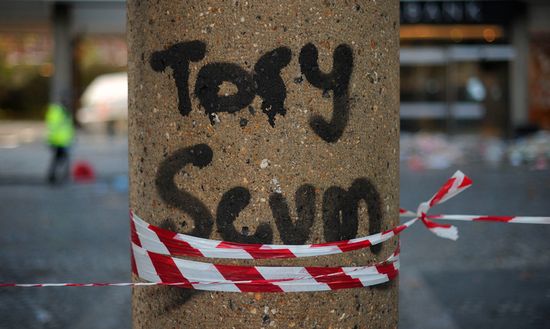
TORYSCUMCarlCourt:AFP:Getty

Wilkinson studies the politics of its outcome:

[I]f Mr Cameron's downsizing causes Britain's recovery to stall relative to America's, Mr Obama will have a ready example of the folly of fiscal discipline during recovery and the dangers of conservative government. I'll admit I'm rooting for the UK approach. It's what I'd bet on if forced to make a bet. But I wouldn't bet that much. However things turn out, folks on the wrong side of the bet will make a reasonable case that Britain and America are so different that few lessons can be drawn from the success or failure of Mr Cameron's approach. 

I sense a nervousness among Britain's Tories that they may have bitten off too much too soon.

Like Will, I have no idea which model will work best, but a country with a reserve currency has far more room for maneuver than an island economy that could be pummeled by the markets if it gets behind the debt cycle. Ireland is not a terribly encouraging example up till now of austerity leading to growth.

What does seem increasingly attractive is short-term ease and long term fiscal rigor. And that's what Obama's stimulus and the Simpson-Bowles report offer the US. Another reason for Obama to embrace Simpson-Bowles as the defining cause of his next two years.

(Photo: Graffiti is pictured on a pillar outside of the damaged 30 Millbank, a building housing the headquarters of the British Conservative Party, in London, on November 11, 2010. British Prime Minister David Cameron condemned as 'completely unacceptable' Thursday the actions of students who stormed his party's London headquarters in protest over plans to increase tuition fees. Fourteen people were injured and about 35 arrested after thousands of demonstrators besieged the 1960s office building near parliament, smashing their way through the glass frontage and wrecking the lobby. By Carl Court/AFP/Getty Images)

Quote For The Day

“I lit up right in front of Nick Clegg. I must have taken a good four or five pulls on the spliff before the guards realized what I was doing, and then I went quietly. They said they would put me in a cell under Big Ben, which I said sounds amazing, like the most expensive hotel in London, but then they decided to let me go when they realized I was quite keen to be arrested,” – Banksy's friend, Cartrain, making a spectacle of himself in the House of Commons visitors gallery.

Still one can forgive anyone who has also done this:

Cartrain's previous stunts include sneaking a fake exhibit into the British Museum. Last year artists including Banksy rallied to support him after he was arrested for taking a packet of pencils — valued at £500,000 — from Hirst's exhibition after the former Young British Artist's representatives threatened to sue Cartrain for making collages including photos of Hirst's work.