Make Us Thrifty, But Not Yet, Ctd

Derek Thompson is disappointed with his fellow liberals:

[W]hy is Matt [Yglesias] writing "the budget deficit isn't currently a problem, but it almost certainly will be in the future and that's when congress will act to deal with it." Wait until it's almost too late is not an ideal solution to any slow-burn crisis, whether it's climate or fiscal …

Tim Fernholz seems to share my principles about the budget without sharing my premise that the chairmen's plan is useful. "We need to get our long-term spending under control," he writes. "The longer we delay making sustainable budgeting decisions, the harder it becomes to make them." Totally! Tim has correctly described the necessity of the deficit commission. So why doesn't he love the deficit commission? Because even after raising Social Security taxes, and allowing tax revenue to reach historical highs, he would like more revenue. I would like more revenue, too. But that's a reason to engage with the report, not to lump it with Greek austerity.

What Will The GOP Cut? Ctd

A reader writes:

I'm flabbergasted by this comment from Kilgore: "Medicare beneficiaries are the very core of the GOP's political base at present; Medicaid beneficiaries decidedly are not."  Certainly, most Medicaid beneficiaries – poor women and children – are not the core Republican constituency.  But most Medicaid dollars are spent on the disabled and elderly. 

And, if Republicans in Washington are going to gut that portion of Medicaid, which is where they must to save any real money, they'll have another core constituency that's upset – Republican governors, who will be the ones being chased by elderly and disabled constituents denied access to acute and long-term care. Republicans in DC may want to go that route, but it's not likely to be a successful one, either financially or politically.

Another writes:

Medicaid (not Medicare) is by far the largest payer for nursing home care and long term care for the elderly, totaling around $140 billion in 2010.

Another:

Medicaid pays 40% of the bills for nursing home services, and over half of the nursing home beds in the US are occupied by Medicaid recipients. See this report (PDF) from the Kaiser Family Foundation for more facts about Medicaid.

Old people benefit about as much the poor, making extensive Medicaid cuts problematical for the party of old people.

Why Did You Vote? Ctd

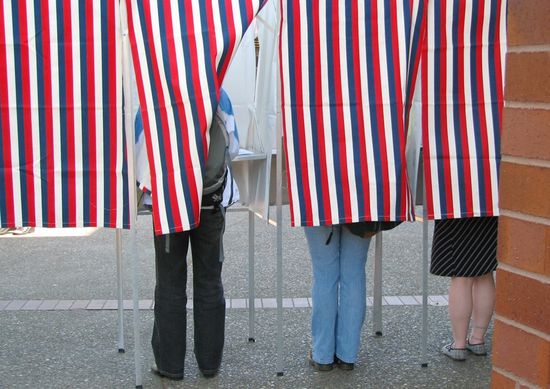
4505658206_40193a7301_o

A reader writes:

The question in the linked article specifically asks about presidential elections.  But my vote has a much greater impact on local and even state elections.  The correct question isn't "Why do we vote?", but "Why do we focus so much on national elections?" 

Not only is our vote much more important in local elections, local elections have a more directly felt impact on our quality of life.  I suspect part of the reason is that good local news sources are hard to find.  I'm lucky, as a San Diego resident, to have the absolutely fabulous non-profit rag Voice of San Diego to give focused, in-depth reporting on local issues.

Another writes:

I live in Fort Wayne, Indiana, and I have voted in many local races where the vote margin is less than 200 votes out of thousands cast. Earlier this month, my county council member lost her re-election bid by 29 votes in the unofficial tally out of more than 16,000 votes cast, and the woman who represents my city council district won by 12 votes out of about 9,000 votes cast three years ago. These are seats for the forms of government that are closest to the people and where it's very possible that your vote will make the difference. I am confident I know 29 people who didn't vote this year who could have influenced the outcome of an election.

It is irresponsible that the focus on elections is too often the races for president, governor or senator, and not the ability of voters to have a real difference on who leads their city government, county government or school boards.

Another:

Every vote changes the outcome of an election, primarily by affecting the size of the win or loss.  A candidate for city council who is elected by a vote of 500 to 475 will behave differently in office than a candidate who is elected by a vote of 500 to 20.  Were the votes of the 475 in the first example wasted, or did they have no impact?  Hardly.  Although their candidate didn't win, they shaped the winner's perception of the constituency, laid the groundwork for another campaign next time, informed each other of their existence, etc.

Another:

This study is such a silly premise in light of the number of races around the nation last week at all levels, where individual votes in the aggregate are making a difference between a win and a loss – some still undecided.  If most voters "won't change an election result", why the hell is Joe Miller suing to make sure that Murkowski's name is spelled correctly on every single write-in ballot in her favor?  If voters "won't change an election result", why are there laws in place about how close opponents can be before a run-off must happen or a mandated recount?

Another:

When I was still in college, I drove two hours to my hometown to vote for Gary Hart in the Democratic primary.  Hart only won a couple of precincts in New York, my hometown was one of them, and there he won by two votes.  In the end, my vote didn't really matter, but the closeness of the contest made an impression on me and I've voted in every primary and election ever since.

Another:

I vote because I don't think you have a right to complain about the outcome if you don't.

(Photo from the Lower Columbia College Flickr account, with the caption, "ASLCC Elections are held every May to elect new officers for the following school year.")

The Simpson-Bowles Breakthrough, Ctd

McArdles catches budget sleights of hand:

Looking at each program in isolation is, unsurprisingly, a favorite trick of people in budget meetings when cuts are on the table–emphasizing the downside of the cuts, while protesting that the expenditure is but a small part of the organization's overall spending.  Novice financial executives who fall for this soon realize their error:  almost everything is but a small part of the organization's overall spending, and yet if you don't cut some of it, you will still end up in bankruptcy.

The Daily Wrap

Today on the Dish, Andrew kept the spotlight on the Simpson-Bowles breakthrough, with complete analysis here, here, here, here, here, here, and here. Kilgore predicted the GOP will go after Medicaid, Cato thought the Tea Party could help trim the Pentagon budget, and Kevin D. Williamson fired back at NRO readers on why the deficit plan makes sense.

Andrew remained aghast at Bush's interviews and reviews of his book, and a Pentagon study group reported we could end DADT with minimal risk, and no special treatment. Drum discussed the GOP brain-drain, Damon Root defended federalism, and birthers loved to email absurd videos. Bernstein examined the GOP's lame horses, Douthat offered a second opinion, and Tom Jensen found a bright side for Palin. We examined inflation charts to check out Palin's grocery numbers, and the cookies were debunked. People like to vote even if their votes don't matter, but they didn't appreciate their politicians acting out of spite.

Iraq reached a new government agreement, and Goldblog reprimanded Bibi on borders. Poppy seeds cost a mother the first days with her newborn baby, the Cannabis Closet book was coming, and the war on drugs pushed people to buy chemically-laden "legal high" drugs. Fallows engaged his coal critics, and we might one day replace street lamps with glowing trees.

Barack wasn't Jimmy Carter, Bristol Palin sported a Tea Party t-shirt during dance rehearsals, and Old Spice got spoofed. Poem for Veterans Day here and six word memoir video here,VFYW here, best view in London here, MHB here, FOTD here, Moore award here, and vintage gay tumblr here.

–Z.P.

A Video For Veterans Day

Six word memoirs from Iraq and Afghanistan:

More here. Leah Carroll remembers her father's stuggle with PTSD:

I was born years after the last US soldier had officially left Vietnam, but, growing up, the specter of the war was constantly at my back. It rode with us in the car on bright days that might erupt into a sudden summer storm, turning my father's mood black and edgy because it reminded him of the jungle. It was ever present on the nights when my dad, drunk and brooding, sat me on his lap and recounted his killing of a Vietnamese teenager. The problem of lasting trauma is perhaps best stated in Lethal Warriors by General Mark Graham who says, "PTSD is like a hurricane. If you're in the path, it doesn't matter who you are, it hits you."

The New Iraqi Government, Ctd

Within 24 hours, one lurches from hope to this:

As voting was under way to re-elect President Jalal al-Talibani, members of the Iraqiya bloc, a Sunni-backed coalition that won the most seats in the March 7 election, tried and failed to force a vote on a series of demands. Among them were commitments to release detainees and to reverse the disqualification of three of its candidates on the grounds that they were loyalists of Saddam Hussein’s Baath Party. At that point, just as officials with the Obama administration were expressing their delight in a news briefing that Mr. Allawi will be part of a new Iraqi government—a result the United States had sought for five years — the Iraqiya bloc walked out.

That included Osama al-Nujaifi, who had just been elected the new speaker of Parliament, and Ayad Allawi, who had been Mr. Maliki’s chief rival for prime minister. “There’s still no guarantee from the other side that what they promised will be implemented,” said Jaber al-Jaberi, a top member in Iraqiya, before the start of the session…

After the walkout, parts of Iraqiya returned to the session, suggesting possible divisions within the bloc. With the diminished numbers, however, there were not enough votes to give Mr. Talabani the required two-thirds majority on the first round. A second round of voting, requiring only a simple majority, was to follow.

“From the start I knew this agreement wasn’t sustainable,” said Mahmoud Othman, a Kurdish lawmaker. In an arrangement that attempts to wrap every coalition into a power-sharing government, Mr. Othman said, “you expect problems.”