The Unreconstructed W

Bush defended waterboarding in his interview with Matt Lauer, while retaining his horror at Abu Ghraib. Adam Serwer notes the incoherence:

…why was torturing detainees at Gitmo an act of heroism, while torturing detainees at Abu Ghraib an act of moral depravity, a disgrace to America's good name? 

The answer seems obvious — in the case of Abu Ghraib, Americans, faced with visual evidence of torture, recoiled. Fortunately for Bush, the CIA destroyed the visual documentation of their torturous interrogations, and those responsible will never be held to account. But there's no genuine moral distinction here between what happened at Abu Ghraib and what happened at the black sites, or at Gitmo, that would justify being horrified by one and not the others. The lesson that was learned, by that administration and this one, is that the crime is worse than the cover-up. So cover it up.

What has struck me about the book so far – only from its reviews, some excerpts and the TV interview – is how utterly unchanged Bush is, how unreflective, defensive, and shut down he is to the core challenges of his presidency. How do you launch a war on false grounds that leads to the deaths of 150,000 civilians, destroys America's moral standing, and empowers America's enemy, Iran, and say you'd do it all again? How do you find Kanye West more disgusting than Abu Ghraib?

How do you become a human being so isolated from your own reality?
Chaffetz’s Threat

A reader writes:

Your quote from Jason Chaffetz is both encouraging and discouraging. I am glad to see someone in Congress – anyone – discuss the possibility of investigating the horrors of the torture regime.  However, when he says "they campaigned against me, so I don't mind going back at looking at them," he seems to be saying that he would simply ignore it if they had been friendlier to him. 

One on hand, I'm completely unsurprised at that implication. But on the other, it is completely disgusting and so emblematic of many issues plaguing our government. "I won't investigate your lawbreaking because you are my friend/colleague" and "I will go after you because you are my enemy," – it's the political game of merely scoring points for your team and ignoring any actual regard for the truth or the law.

Another writes:

I find it grotesque that this is how people in positions of power make decisions.  He mentions nothing about the law, the Constitution, or the president's oath of office.  Not even the good of the country, national interests, or America's reputation.  Only that they didn't help him obtain power, so he'd be willing to investigate them. Fucking pathetic.

Agreed.

Bush vs The Right

Matt Latimer reviews W's new book:

Many of the memoir's villains, complainers, and assorted troublemakers are conservative Republicans. For example, Bush chooses to depict Senate Republican leader Mitch McConnell—instead of any in a long line of congressional Democrats—as the person urging Bush to withdraw forces from Iraq, making the distinguished McConnell a member of the "cut-and-run" crowd. It is apparently McConnell who Bush defies with his courageous and counterintuitive decision to order a surge of forces into Iraq. Along with McConnell, Bush cites the usual boogeymen—Donald Rumsfeld, Dick Cheney, former Attorney General John Ashcroft—for any misjudgments in his administration…

Rather than extensively explain and defend his ideology, Bush seems to do the opposite.

Bush's greatest legislative achievements are things he worked on with Democrats—education reform with Ted Kennedy (about whom Bush is effusive with praise), a Medicare prescription-drug entitlement, large increases in aid to combat HIV and malaria in Africa. So intent is he to prove he is not a right-wing ideologue that he actually muses about reforming the entire political system to eliminate those on the political "extremes." He says his "preference" in 2008 was McCain, but if he has any problems with Obama whatsoever, they are not mentioned.

The GOP’s Lame Horses, Ctd

Jonathan Bernstein does some very early analysis:

The more I think about it, the more Perry, DeMint, and Barbour appear to me to be very serious contenders, although I wouldn't rule Romney, Palin, or Huck out.  Our of the second list…I can't quite see why any GOP faction picks Pawlenty over the other choices; the same basically goes for Thune, plus he has the disadvantage of votes to defend.  Christie?  Well, it's not quite clear yet how he plays if he's an actual candidate; truth is, he really belongs on the longshot list.  As for the other three: DeMint is a clear leader of the conservative wing of the conservative party, without straying (as far as I know) into the kind of territory that gets some of the candidates he endorses into trouble.  If they insist on supporting a factional candidate, and can agree on one, they may be able to pull it off, especially if Palin (whose Palin faction overlaps with the conservative faction) drops out well before Iowa.  Perry and Barbour, on the other hand, appear to me to be acceptable to every faction within the party, as well as being better positioned (through fundraising potential for Perry, and good personal relationship for Barbour) to cash in on it than others.

Of course, we're also talking about a party that cheered on O'Donnell and Angle and Buck and Miller, so perhaps they'll do something totally off the wall.  But that's how I see the field so far.

FW: The Birthers Live On

Justin Elliott tracks this ridiculous "Obama is a Muslim" video:

There is no evidence presented that this Egyptian interview ever happened. And the YouTube video itself (which was apparently put up not by Lipkin, but by one of his fans) could well be the product of a lone conspiracy theorist. Which makes it all the more remarkable that it has racked up 2.5 million views.

The referral data accompanying the video shows that it has been overwhelmingly viewed in the United States and has circulated primarily through email (the main referral domain is mail.yahoo.com), rather than, say, right-wing blogs. This is a true viral video.

The Landscape Of Morality In Economics

Interfluidity addresses it:

Individual human beings act against their material interests all the time, providing full employment for economists who endlessly study the "ultimatum game". Political choice combines diffuse personal costs with powerful moral signifiers. We should expect politics, including the politics that determines economic policy, to be dripping with moralism. And sure enough, it is! This doesn’t mean that policy outcomes are actually moral. (There’s a hypothesis we can falsify quickly.) But exhortations to policy that cannot survive in terms of moral framing are nullities.

The Republican Wonk Exodus, Ctd

Drum wants to understand why the GOP is losing the intellectual elite:

[M]y guess is that this is primarily a reaction to social conservatism. Students at top universities just can't stomach the anti-gay, anti-feminist, anti-civil rights, anti-religious-tolerance attitude of the current GOP. But Andresen's conjecture about "policy positions that do not make logical sense" may have something to it too. In the mid-70s, for example, liberal interest groups engaged in their own version of magical thinking by pushing hard for the passage of the Humphrey-Hawkins full employment act, which essentially tried to mandate low unemployment by fiat.

Jimmy Carter eventually managed to water it down into a purely symbolic piece of legislation, but the sheer spectacle of liberal lunacy on display for months on end probably turned off a lot of smart students. Liberals eventually learned their lesson on this score — overlearned it, in fact — but their place in the magical thinking department was immediately taken over by supply-side Republicans, who have gotten ever more hardened and ever balmier during the past couple of decades.

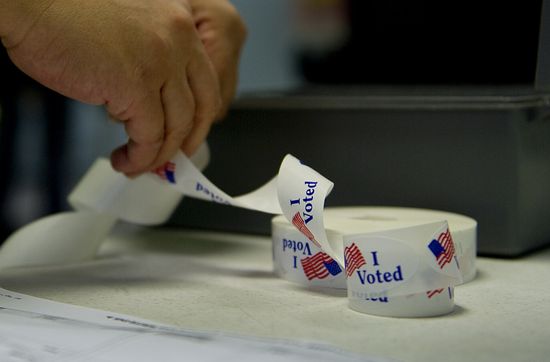
Why Did You Vote?

I_Voted_JimWatsonGetty

Ryan Enos and Anthony Fowler find that most people vote to "receive extrinsic benefits from voting that are unrelated to the chances that their vote will actually matter":

Americans vastly overestimate the chances that their vote will make a difference. Our median respondent felt that there is a 1 in 1000 chance that their vote could change the outcome of a Presidential election, missing the true chance by a factor of 10,000. However, this dramatic overestimation does not explain the prevalence of turnout, because those who actually vote know that this probability is low. Over 40% of regular voters know that the chances of a pivotal vote are less than 1 in a million. Amazingly, turnout is negatively correlated with the perceived chances that one vote will make a difference—meaning the less likely you are to think your vote will actually matter, the more likely you are to vote.

… If forced to think about it, most voters know that they won’t change an election result; but they don’t care. They benefit from voting, regardless of the electoral outcome. Voters enjoy wearing stickers, expressing their views, fulfilling their civic obligation, and earning the right to complain. For them, that’s reason enough.

 (Photo: Jim Watson/AFP/Getty Images)

What Will The GOP Cut?

Ed Kilgore thinks they will eventually take aim at Medicaid:

Medicare beneficiaries are the very core of the GOP's political base at present; Medicaid beneficiaries decidedly are not. Moreover, as I argued last year, for all the pundit hilarity about people receiving socialized health insurance via Medicare railing against socialized health insurance, many of these folk think of their coverage as an earned benefit, not as any form of government largesse. So there's nothing inherently implausible politically about the GOP just flatly defending Medicare (and for that matter, Social Security) while going after the lazy welfare bums under the age of 65. Some of you may have read Tom Edsall's recent dark vision of an impending era of scarcity wherein politics is dominated by generational and class battles over who gets what from government. Thanks to the central position of older white voters in the GOP, and of Medicare in the federal budget, this nasty scenario could arrive a lot faster than even Edsall has imagined.

The Daily Wrap

Today on the Dish, Andrew had hope for the Simpson-Bowles proposal to crack down on the debt, with more reax here. He took on Maureen Dowd (and her brother) about the Big Lie of the right, and readers rallied. Andrew expressed shock and dismay at the recent round of Israel's settlement rhetoric, violence raged on London campuses, Afghanistan has developed into a blitzkreig, and sectarian violence surged in Iraq. We rounded up reax to ending DADT, and the new threats to DOMA.

Palin served cookies at a school, but didn't want John Dickerson posting on her wall. This Alaska voter corrected the record on Miller vs. Murkowski, and this one lobbed the head off Limbaugh's twinkie distortion. Andrew rejected this reader's grocery list computations, and Ezra Klein dared the GOP to repeal the popular parts of healthcare reform. Nate Silver comforted the Dems about 2012, we gathered assessments of the GOP's lame horses, and Allahpundit wondered What Would Karl (Rove) Do about a Romney / Mitch Daniels square off.

Sprung danced circles around Krugman on the stimulus, we could learn from Pittsburgh's failures, and jobless claims bottomed out. Dave Roberts added his input to Fallows' coal debate, student stalker Andrew Shirvell could be Fox's new star, Clay Shirky tore down the paywall, and BloggingHeads rocked out. Readers defended Maddow on her partisan honesty, even policy wonks were fleeing the GOP, and Jonah Goldberg was sorry he popularized fascism.

Spam might be worth more than gold since at least you can eat it, and industrious readers shared their weed secrets. Arnold pandered to pot a couple of weeks too late, teenagers needed to know if a joint was similar to birth control, Nate Silver sized up pot's future, and this reader benefited from a foreskin graft (to a foot). Chart of the day here, quote for the day here, beard for the day here, VFYW here, MHB here, FOTD here, and beards? There's an app for that.

–Z.P.