If Krugman Were King

Andrew Sprung bats around K-Thug:

Krugman has implied elsewhere that the right-sized stimulus would have set the economy roaring back to life. To what degree is that credible? If Obama had asked for $1.2 trillion and got $950 billion, what's the math on the counterfactual? Unemployment at 8.3%?  And the effect of such a drop on the electorate? I confess it could be substantial. But there's an awful lot of what-ifs there, beginning with the premise that a substantially larger stimulus could have got through the Senate. And the narrative leaves out some externalities, such as the Euro sovereign debt crisis, which seemed to stop a decent-looking recovery in its tracks. Not to mention the credible possibility, forecast now by a growing number of economists and business leaders (e.g., here and here), that a substantial recovery may be on the horizon now.

Krugman's critique of the Obama administration has real bite. But neither he nor anyone else knows what would have been, what will be, what the full or long-term effect of the Recovery Act will be, or what the effect of a Krugman-designed stimulus (passed through the Congressional wringer) would have been. 
How To End DADT, Ctd

Adam Serwer opines:

During the Bush years, liberals complained about his "imperial presidency," and so the idea that Obama should simply end the policy by fiat would seem hypocritical. But the use of an executive order to end a policy a majority of Americans, including conservatives, want to end, is no more undemocratic than Republicans' use of procedural maneuvers to thwart an up or down vote. Republicans holding the legislative process, and the fundamental rights of gay and lesbian servicemembers, hostage to their own homophobic prejudices, would still be the greater act of tyranny.

Yglesias puts this debate in context:

Filibustering defense appropriations bills is politically risky. And to do it in order to support a hugely unpopular position on a related issue is a giant risk. It’d be one thing if 60% of the public was on the Republicans’ side about DADT. But it’s not. Instead this is a 70-30 issue that cuts against them.

But not only are they getting away with the filibuster, they’re turning their obstruction into a political winner by forcing the progressive community into circular firing squad mode. 


The Company We Keep

Steven Taylor is troubled by Gallup noting that "use of the death penalty has been declining worldwide, with most of the known executions now carried out in five countries — China, Iran, Iraq, Saudi Arabia, and the United States":

When dealing with issues of justice and human rights, that isn’t exactly the company I would think that the US would aspire to keep.  We are talking about three authoritarian regimes with questionable human rights records (China, Iran and Saudi Arabia), a pseudodemocracy in the context of an ongoing conflict (Iraq), and the country that sees itself as a beacon of liberty and democracy (the US).  One of these things is, theoretically, not like the others.  At a minimum this comparison ought to give us all pause for thought.

Spam And Time Machines

McArdle teases gold bugs:

The only scenario I can think of in which it makes sense to stockpile a lot of gold is one where you and your household goods are unexpectedly teleported into the sixteenth century. If you worry a lot about this, then by all means, stockpile gold. But you should also probably take the precaution of stockpiling antibiotics and how-to books on dentistry.

Drum is equally puzzled. He chuckles at this tweet by Nouriel Roubini:

Spam is a better hedge against inflation than gold: you can eat it and it lasts 1000 years. Gold is, as Keynes aptly said, a barbarous relic

Leonhardt notes that gold isn't anywhere near its record high once you adjust for inflation. His explanation for what is going on in the gold market:

The recent rise, as Nariman Behravesh of the research firm IHS Global Insight notes, has relatively little to do with inflation fears. “It’s not about inflation,” he said. “It’s a hedge against a weak dollar, not a hedge against inflation.”

Investors who hold a large amount of dollars — including central banks like China’s — understand that the dollar probably needs to fall in coming years, as today’s trade imbalances slowly shrink. So many of those investors are turning to gold.

Repeal What, Exactly?

Repeal_list

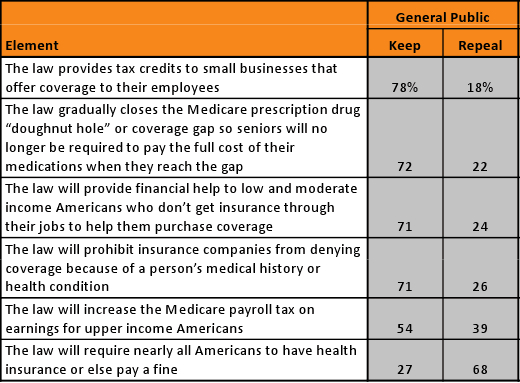
Ezra Klein posts the above chart from Kaiser and dares the GOP to overturn the popular parts of healthcare reform:

Everything from the subsidies to the increase in the Medicare tax is popular. The individual mandate isn't, and you might see the GOP focus on that, but tweaking the penalty there is a far cry from full repeal. Eventually, the GOP is going to stop being on the side of health-care repeal and find themselves on the side of allowing insurers to discriminate against the sick and seniors to fall into the doughnut hole, just as Democrats eventually found themselves on the side of the Cornhusker Kickback and $500 billion in Medicare cuts rather than health-care reform.

What will happen, David Frum predicts, is that the GOP will focus on the bill's unpopular elements but blink when it comes to repealing the legislation itself.

Miller vs Murkowski, Ctd

A reader writes:

I'm an Alaskan voter (who voted for Lisa Murkowski) and I am sick to death of columns like Applebaum's that made it sound like our choice was between (as you quoted it): "corrupt big spending Republicans" or the "shallow, hypocritical radicalism" of the Tea Party. Please. There were a lot of things in this campaign – a lot of them – that went far beyond: "will Lisa give us money vs. Joe says he won't."

The local news revelations about Miller were huge, especially his conduct at the North Star Borough and the fact that his campaign called former Mayor Whittaker a liar, until it was proven that Miller was in fact lying. What also didn't endear him to half the state: his suited-up security guards at the Anchorage school and the bizarre arrest of a journalist, his comments about emulating East Germany when it came to immigration and frankly, having Sarah Palin's support (she is not popular up here.) He also picked some strange fights with the Alaska Native groups which mystified everyone.

Murkowski is basically a moderate. She is pro-choice. She believes global warming exists and acknowledges that Alaska is already dealing with it. (This was one of the areas where Miller's rhetoric really was alarming as there are coastal villages disappearing right now and dealing with them can not be ignored.) Miller didn't even go into the bush to campaign – he was especially destroyed by the rural vote (which went for Tony Knowles in the last senatorial election).

I don't always agree with Murkowski (I'm actually a registered Democrat), but prior to this year when she foolishly shifted hard right for a few months, she has always been fairly moderate. She is responsive to her constituents and in the past has been willing to work with both sides of the aisle. If she wins this election, we think she will acknowledge the Democratic and Independent support she has received and return to her bipartisan roots. She knows how she has gotten to the place she is now and she has acknowledged that support more than once. She has already said she will not attempt to regain her former position in the GOP leadership.

Joe Miller basically freaked us all out. He came across as silly as Christine O'Donnell or Sharron Angle. My husband is a Republican, I'm a Democrat. His mother is a Rep. His father is a Rep. His step-mother is a Dem. We all voted for Lisa because we thought Scott McAdams was just way too inexperienced (we all hope he gets into state politics). But as to Joe Miller, frankly, he comes across as batshit crazy an there was no way in hell we trusted him.

And yes, Alaska does get a lot of federal money. The state also has a lot of federal land and it is incredibly expensive to live there. (The Lower 48 enjoys gas prices markedly cheaper then in Fairbanks, that's for sure.) We all thought the Bridge To Nowhere was lame, but I'm sure there are similar (though less famous) idiotic earmarks in other states. Everyone agrees that the system needs to change and Alaska needs to start thinking about renewable energy and other ways to become more self-sustaining. We get that, I promise.

So it would be great if everyone would acknowledge that Alaskan voters have brains in their heads and actually choose candidates based on something more than cash.

What 2010 Means For 2012

Nate Silver's two cents:

Democrats — if they are expecting to do better in 2012 than they did this time around — might actually be pleased that elections have become so strongly aligned to partisan orientation. They now have just 12 seats in which Mr. Obama won a minority of the vote to defend — whereas Republicans have 55 where he took the the majority instead. So if there is even a fairly modest shift back to Democrats in 2012, and the shift is again fairly uniform, they could be in a position to achieve quite a few gains.

Or, if the economy improves and — having facilitated a more even balance of power in Washington — the electorate becomes somewhat less angsty, the incumbent advantage could become stronger again, and the gains that Republicans made could prove to be relatively “sticky” — as they were, for instance, after 1994. 

The Daily Wrap

Today on the Dish, Andrew collapsed the Big Lie of the right, and Rush Limbaugh believed in the twinkie diet. Obama's Indonesian nanny was a tranny, and he used his trip to Asia to put Israel in its place, while Larison wondered what India on the UN Council would mean for Iran.

Sarah Palin still couldn't read the WSJ on grocery prices, and readers sounded off. Palin's Alaska heavily depended on federal funding, and we looked at the 2012 Tea leaves state by state. Romney's former sanity on healthcare has been destroyed by his ambition, Dylan Matthews doubted Hillary Clinton could have passed healthcare reform, and Frum proposed that eventually the GOP will realize it should have cut a deal on Obamacare. Douthat dissed the unprincipled moderates, Nils August Andresen charted the GOP's brain drain, and political scientists tracked Democrats' unpopularity.

Jack Shafer urged MSNBC to come out of the partisan closet, and Jason Mazzone pointed the way forward for Obama to end DADT, but Drum wasn't on board. Ryan Avent bet there'd be self-driving cars for his infant daughter to ride in 2026, and Americans overestimated the number of illegal immigrants in the U.S. FDR's innate leadership stemmed from his temperament, and readers insisted Mitch Daniels was pretty short. Johann Hari put Churchill's racism in perspective, and P.J. O'Rourke had sympathy but not empathy for politicians.

Andrew almost lost his lunch over this foreskin revelation, Serwer skewered The Walking Dead, and this writer was losing his words. This reader's father enjoyed his vaporizer over Christmas dinner, readers taught us all a lesson about illegal US plants, and many responded to the agnostic thread. This is how Michael Caine speaks, Yglesias award here, MHB here, FOTD here, VFYW here, and the VFYW contest #23 winner here.

–Z.P.

Coal Will Be With Us

James Fallows' new Atlantic cover story on the need for clean coal technologies deserves to be read in full. The basics:

Precisely because coal already plays such a major role in world power supplies, basic math means that it will inescapably do so for a very long time. For instance: through the past decade, the United States has talked about, passed regulations in favor of, and made technological breakthroughs in all fields of renewable energy. Between 1995 and 2008, the amount of electricity coming from solar power rose by two-thirds in the United States, and wind-generated electricity went up more than 15-fold. Yet over those same years, the amount of electricity generated by coal went up much faster, in absolute terms, than electricity generated from any other source. The journalist Robert Bryce has drawn on U.S. government figures to show that between 1995 and 2008, “the absolute increase in total electricity produced by coal was about 5.8 times as great as the increase from wind and 823 times as great as the increase from solar”—and this during the dawn of the green-energy era in America.

Power generated by the wind and sun increased significantly in America last year; but power generated by coal increased more than seven times as much. As Americans have read many times, Chinese companies are the world’s leaders in manufacturing solar panels, often using technology originally developed in the United States. Many of the panels are used inside China for its own rapidly growing solar-power system; still, solar energy accounts for about 1 percent of its total power supply. In his book PowerHungry, Bryce describes a visit to a single coal mine, the Cardinal Mine in western Kentucky, whose daily output supports three-quarters as much electricity generation as all the solar and wind facilities in the United States combined. David MacKay, of the physics department at Cambridge University in England, has compiled an encyclopedia of such energy-related comparisons, which is available for free download (under the misleadingly lowbrow title Sustainable Energy—Without the Hot Air). For instance: he calculates that if the windiest 10 percent of the entire British landmass were completely covered with wind turbines, they would produce power roughly equivalent to half of what Britons expend merely by driving each day.