Josh Marshall And The Weed, Ctd

In thinking through some of the less rational but still resilient arguments against legalizing marijuana, it occurs to me that the smoke itself is part of the problem. Its smell is unmistakable and it makes visible what for most drugs is invisible. Someone high on crystal meth can pass by unnoticed; ditto someone on coke. But anyone smoking pot in public immediately alters the atmosphere dramatically. It is this, perhaps, that worries or somehow unnerves many otherwise sympathetic to the reform. But there are pragmatic solutions to this, of course. A reader writes:

Perhaps the way to best satisfy Josh is to restrict the locations or settings where one can smoke pot.

Josh, or his dad, or anyone else, looks back fondly on the halycon days of university where they smoked too much, or at inappropriate times (before class!), and recall the rush of illicitness. And they may now say, "Perhaps that was too much" or "But only in my youth." But surely they must consider their earlier days of binge-drinking and waking up next to the toilet (or in someone else's bed!) just as scandalous and overindulgent – yet they see no problem with allowing the youth of today to legally do the exact same thing. Why prohibit one excess and not another?

One difference may be that alcohol  is legally confined to bars, restaurants, and the home. If we slightly curtail the location, we may be able to convince people that marijuana use will be like alcohol, not like smoking cigarettes. Then perhaps they'll stop worrying about walking through plumes of smoke at the playground or negotiating with perpetually stoned coworkers.

Another writes:

Not only is Josh Marshall clearly "not a libertarian", in your words, but he is also obviously not a black person.  According to Noel Brinkerhoff:

From 2006-2008, blacks were arrested for marijuana possession in California’s 25 largest cities at four, five, six, seven and even 12 times the rate of whites. For Latinos, the arrest rate was twice to three times that of whites in California’s 33 largest cities. In the city of Los Angeles, blacks were arrested for marijuana possession at seven times the rate of whites. In Pasadena, blacks make up 11% of the population, but 49% of the people arrested for possession of marijuana. In the state’s capital, Sacramento, blacks account for 14% of the population, but 51% marijuana arrests. […]

This is [despite] the fact that [African]-Americans do not use drugs at a perceivable higher rate than white Americans. – 8.2% of whites and 10.1% of blacks use illicit drugs.

So, pot is "de facto legal but closeted" for educated and relatively affluent white guys like Josh and his dad.  Its illegality had no real consequences but to mildly discourage them from continuing to use it, which looks now seems like a good thing in retrospect, so why change it? What a stunningly self-centered position.

Another:

There haven't been wars on nutmeg, but there have been many wars over nutmeg, which for years grew only on one small island, Run Island. This island was subjected to sieges and battles all in the name of a tiny spice that we now barely think about using as we halfheartedly sprinkle it over our coffee.

Perhaps, however, the wars that were fought over spice can give some perspective to the potential history of the War on Drugs, or specifically the War on Pot. Today, we view the spice wars as a historical oddity; it's quite funny to go grab a jar of turmeric or pepper and realize that people literally gave their lives over these spices which were of the highest value and used only by the rich. Hopefully in the future, people will be going to their cupboards, fridges, or humidors to grab some pot, giving a little chuckle over their ancestors who expended such ridiculous amount of money, brainpower, energy, effort, people power, and lives just trying to keep people from smoking a little herb.

More Fun With Window Views

Dish readers never cease to amaze; one just created a View From Your Window game that slowly zeroes in on your guess. The tech blog Switched picked up on it:

As much as Google has shrunk our world for the better, we fear the all-seeing G might, in the same motion, strip it of the wonders it holds. Then, we see something like this game. Giving you a Street View image, a gridded world map and fifty guesses, it asks you to pinpoint the spot it was taken, and remember the uniqueness of every vista and street corner.

The game appears to be in an early prototype phase, as it only contains a handful of windows from the weekly contest, but it's worth checking out. (If you're the creator of the game, we want to hear from you! Drop us a line at VFYWcontest@theatlantic.com)

Move Over, Ellen: Or Black Guys Can’t Dance

Barack and Michelle's appearance at a Diwali event gets remixed:

How the AP reported the scene:

He appeared to resist when students from Holy Name High School in Mumbai approached. Eventually, Obama gave in, got up and strutted his stuff, too. He jumped around a little and made awkward sawing movements with his arms.

Saying Goodbye To Personal Pronouns

Marc Ambinder takes off his blogging pajamas. He's going to be working for National Journal, a sister publication of The Atlantic:

Blogging is an ego-intensive process. Even in straight news stories, the format always requires you to put yourself into narrative. You are expected to not only have a point a view and reveal it, but be confident that it is the correct point of view.  There is nothing wrong with this. As much as a writer can fabricate a detachment, or a "view from nowhere," as Jay Rosen has put it, the writer can also also fabricate a view from somewhere. You can't really be a reporter without it.  I don't care whether people know how I feel about particular political issues; it's no secret where I stand on gay marriage, or on the science of climate change, and I wouldn't have it any other way.  What I hope I will find refreshing about the change of formats is that I will no longer be compelled to turn every piece of prose into a personal, conclusive argument, to try and fit it into a coherent framework that belongs to a web-based personality called "Marc Ambinder" that people read because it's "Marc Ambinder," rather than because it's good or interesting.

I will miss Ambers' personal voice. But I do see the point he is making here. There is a great joy in writing constantly in your own voice, taking your own stand, making your own points – online, in real time, with nowhere to hide. But there is also great solipsism if you are not careful, great strain – who doesn't want a few days of not having an opinion on something? – and the psychic corrosion of constant personal exposure.

Marc will now return to reporting the old-fashioned way. And the Dish will follow his work wherever he goes.

Getting Their Next War On

Butters and Benjamin Netanyahu are both itching for a new war on Iran – and, in Butters' case, not just against their nuclear program but their entire conventional military, i.e. full-scale not just pre-emptive but punitive war on a regime the US government opposes. On what grounds in international law or just war theory, one wonders? Meanwhile, Larison thinks I'm wrong to link the resolution of the Israeli-Palestinian conflict to the Israel-Iran grudge match:

Iran is not the threat hawks claim it is, and the more serious danger to Israel’s political future is the perpetuation of the occupation on account of demography and the ultimate unsustainability of a democratic government ruling over a subject majority. In other words, Israel’s government has mistakenly identified the minimal, deterrable threat as the urgent, immediate one, and treats the much more significant threat to its long-term survival as an acceptable, manageable situation.

The “linkage” argument essentially endorses this basic misunderstanding and tries to use it to dictate Israeli policy, when the right answer is to stop encouraging the Israeli government in the belief that Iran is an urgent, immediate threat that must be stopped and to discourage Israel very strongly from taking any arbitrary military action.

I take the point. I don't believe Iran's potential nuclear weapon capacity is an existential threat to the Jewish state; while the occupation of the West Bank surely is. I was presenting a way to persuade Israel of this, by noting that their interests align with the Sunni dictatorships and even Europe on Iran and yet they cannot really ally with them without ending the occupation. But since this is premised on the idea that the Israelis see containment and sanctions as enough – and they don't – it's probably not worth even trying to persuade them.

Iraq Surge Fail Update

As the government paralysis continues, Jihadists try to foment more sectarian war by attacking two Shiite shrines, aiming at Iranian religious tourists. They’re obviously trying to repeat their Samarra Mosque moment. Here’s hoping they don’t succeed. But how the current political situation in Iraq manages to prevent these Sunni extremist provocations – without prompting even more sectarian conflict – is beyond me.

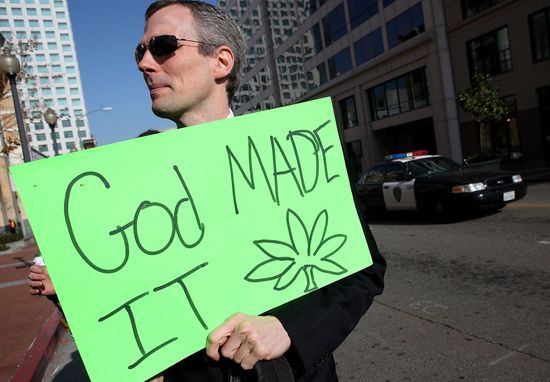
“God Made It”

GodMadeItJustinSullivanGetty

A reader writes:

In defending the legalization of pot, you rely very heavily on an appeal to nature: "My view – regardless of the arguments back and forth about the effects of marijuana – is simply that it is absurd for any government to prevent people from growing a naturally-occurring plant that requires no processing to provide humans with pleasure."

What does it matter whether or not marijuana is naturally-occurring?

It seems to me that what matters here is the drug's effect on individuals and society, not the purely accidental fact that the drug happens to come from a plant. If marijuana were made in a factory, would you be less in favor of its legalization? Suppose a method was discovered for efficiently producing THC in a lab – should this "synthetic pot" be any less legal than the grows-in-the-ground variety? Why? Or suppose that crack cocaine grew straight out of the ground – would this count as a reason to favor its legality? Or suppose a hypothetical plant that caused people to punch other people in the face. Would the fact that it's naturally occurring make you any more or less inclined to outlaw this plant?

My point, of course, is that the controlling issues in any drug debate are the pleasures and harms caused by the drug – not where the drug originates or how it's produced.

Another writes:

While I support the legalization of MJ, I wonder if you also think this applies to coca plants and opium poppies.  You can chew the leaves of coca plants directly for a buzz – should that be legal to grow?  Opium poppies need processing to produce opiates.  Does it make sense to legalize them and simply make the processing of them illegal?

The case for legalization rests on much firmer ground than the fact that this substance grows naturally. But I do find it interesting when a government tries to ban a resilient, naturally occurring weed that can grow in gardens – just because it can provide pleasure to human beings. And the fact that we have to come up with weird analogies – a plant that caused people to punch others in the face! – reinforces this point. And we do not ban poppies in America, even though some could be processed for opium. We do not ban poisonous mushrooms. We do not ban poison ivy, or inflict legal penalties for those who have it in their yards. I don't know of many crops, like hemp, that are also banned, even though their uses are manifold and were once integral to the US economy.

And yes, I do think that banning certain industrial or chemical procedures that try to turn naturally occurring substances into something more potent is the same thing as banning nature itself. There's something poetic about government's absurd over-reach when it reaches down to the very earth and declares itself master.

(Photo by Justin Sullivan/Getty Images)