
Reality Check: Taxes Edition

Taxes_GDP

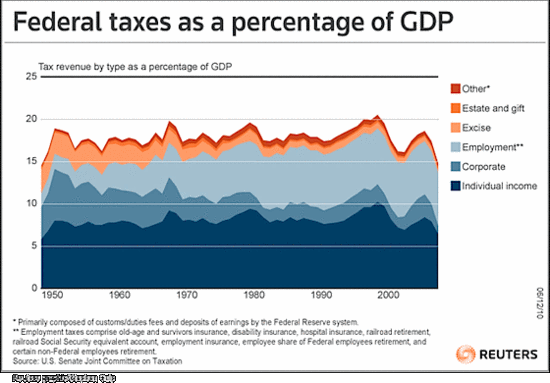
Felix Salmon provides important context for Bush tax cut debate:

  • Federal taxes are the lowest in 60 years, which gives you a pretty good idea of why America’s long-term debt ratios are a big problem. If the taxes reverted to somewhere near their historical mean, the problem would be solved at a stroke.
  • Income taxes, in particular, both personal and corporate, are low and falling. That trend is not sustainable.
  • Employment taxes, by contrast—the regressive bit of the fiscal structure—are bearing a large and increasing share of the brunt.

In One Case, The Possibility For Justice

Tim Lynch reports the happy news:

The Mississippi Supreme Court has ordered a new trial for Cory Maye.  

You may remember the story: Maye was at home one night when he thought he heard someone trying to break in.  He grabbed his gun and shot at them as they came crashing into his bedroom in the dark.  When the lights came on, it turned out that the intruders were from the police department.  With a police officer shot and killed, the case was twisted from self-defense into “murder.” 

When Radley Balko was researching his Cato report on no-knock drug raids, he discovered the travesty of Maye’s case and started writing about it.  His work attracted the attention of top lawyers at DC’s Covington and Burling, which entered the case pro bono on Maye’s behalf.  It has taken several years, but those lawyers have now secured a new trial for Cory Maye.

Congrats to the attorneys at Covington, Radley, and Cory Maye.

From the Dish too.

Happy Repeal Day

On the anniversary of Prohibition’s repeal, Jacob Grier reflects on tobacco:

The speakeasy has been replaced by the smoke-easy as bar owners hide ashtrays from sight from meddling health inspectors. Smoking bans have gone from California oddity to standard practice, creeping to ever more absurd extremes. Outdoor bans are increasingly common, extending to wide open beaches, parks, and golf courses. Dedicated cigar bars and tobacco shops are under fire. Even the home, the last refuge for many smokers, is no longer free from the government’s encroachment in some cities.

Though smoking remains legal, legislators are doing everything in their power to make it as expensive and unpleasant as possible. Smokers are an easy target for tax hikes and cigarette taxes now exceed any reasonable estimate of smoking’s social cost. Federal taxes on cigars may soon rise from five cents per stick to as high as three dollars and this year Congress came perilously close to explicitly forbidding certain types of cigarettes. Their only hangup was over whether to ban all tobacco flavorings or merely some of them.

Where Does Sexism Come From? Ctd

MalePriestsLeonNealGetty

A reader writes:

The interesting question to me is not "Did religion create sexism?" The question is, "Does religion perpetuate sexism?"  Much of human progress comes not from accepting the societal forms of male domination and violence that we inherited from our ancestors, but innovating ways to avoid them.

Another writes:

Perhaps the simplest explanation for the prevalence of sexism is a biological one. Until the mid part of the last century, reproduction was dangerous business for women.

Mortality due to complications during childbirth hovered at 10% (or higher) prior to the widespread availability of antibiotics.  In addition, ectopic pregnancies often killed women before they knew they were pregnant. (Thus the female characters who just lie down and die in 18th and 19th century novels.)  As much as anything, improved obstetric outcomes parallel the rise of women in society. It’s difficult to reliably provide for yourself if you come close to bleeding out with each child, or are permanently incontinent due to obstetric fistula.

Millennia ago women made a pact with men: Take care of me during and after childbirth, and of the children I leave behind, and I’ll abdicate control of my fate in society.  This was a valuable bargain for men because without it they had uncertain control over their reproductive fate. Now that reproduction isn’t Russian roulette for women, they don’t need male-provided resources and protection. What keeps male dominance in place is the institutionalization of male power in societies. A harbinger of its end is the growing number of single women having children via artificial insemination.

Another:

Ebert wrote, "Indeed, if we study other primates we see that their cultures are also male-dominant." Not true. Bonobos, perhaps our closest relations, live in a female-dominant society. 

Other primates have widely varying social structures. Gorillas have a family group-based culture, with one male and several females. Orangutans are highly solitary, with relatively strong bonds existing mainly between mother and offspring. Chimpanzees have the most similar social structure to our own, living in large groups where inter-sex competition is important. The idea that we see human culture reflected in our close relatives is a limited concept that we should be very suspicious of.

Another:

All religions do not view women as inferior! In fact, since its inception 167 years ago, by pronouncement of its Prophet-Founder, the Baha'i Faith has articulated the absolute equality of women and men. While the Baha'i Faith is not well known, it is the most persecuted faith in the Iranian regime, and one of the most wide-spread of religions.

Another:

The cultural historian William Irwin Thompson has an interesting hypothesis on where sexism came from: In an ultimate twist of fate, the women did it when they sexually selected for the strongest most possessive men who would protect them. These men, ironically, would be the ones who treated them as property to be owned and defended. See his "The Time Falling Bodies Take to Light: Mythology, Sexuality and the Origins of Culture."

Another:

I think you should involve Craig Barnes in this conversation: "In Search of the Lost Feminine: Decoding the Myths that Radically Reshaped Civilization".

A review of that book here.

(Photo: Pope Benedict XVI presides over a Mass at Westminster Cathedral during the third day of his State Visit on September 18, 2010 in London, England. By Leon Neal/WPA Pool/Getty Images.)
The Nuclear War That Wasn’t

It was a terrifyingly close call:

Liu Chenshan, the author of a series of articles that chronicle the five times China has faced a nuclear threat since 1949, wrote that the most serious threat came in 1969 at the height of a bitter border dispute between Moscow and Beijing that left more than one thousand people dead on both sides.

He said Soviet diplomats warned Washington of Moscow's plans "to wipe out the Chinese threat and get rid of this modern adventurer," with a nuclear strike, asking the US to remain neutral. But, he says, Washington told Moscow the United States would not stand idly by but launch its own nuclear attack against the Soviet Union if it attacked China, loosing nuclear missiles at 130 Soviet cities. The threat worked, he added, and made Moscow think twice, while forcing the two countries to regulate their border dispute at the negotiating table.

Just in case you were feeling complacent about North Korea.

The Tax Cut Game Of Chicken: The Chicken Wins?

Weigel previews the disappointment on the left:

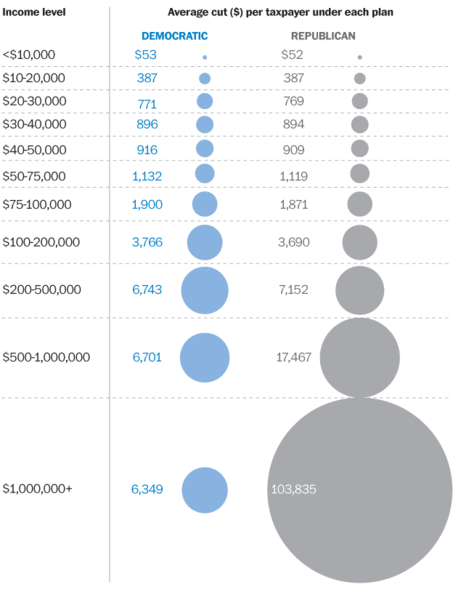
[Liberals] were promised by Obama — by every Democratic candidate, really — that the tax rates would be restored to pay for social programs. They thought they proved in the 1990s that these were fair tax rates under which the economy could grow wildly, and that Bush proved in the 2000s that lower marginal tax rates for the wealthy didn’t spur real economic growth. It was an important debate, and they won it. They have polls telling them they won it, and most Americans are find with restoring the top rates. And here’s Obama, about to throw the game, affirming the conservative line that tax cuts of any size at any time are good for the economy.

But he isn’t. He’s saying that he’d prefer to raise taxes on those earning more than $250,000 a year, but cannot in this political climate at this particular time. Nothing prevents Obama from sunsetting them in their entirety if he wins re-election on a sturdier economy. And nothing prevents him from campaigning on long-term debt reduction from now on, as a way to restore the confidence that can keep the recovery moving.