In sharp contrast to the government's report Friday that the U.S. unemployment rate increased to 9.8% in November from 9.6% in October, unemployment as measured by Gallup declined to 8.8% in November. This is down from 9.4% in October and 10.1% in September. Because Gallup's U.S. unemployment rate is not seasonally adjusted, some of the late October and November improvement is likely the result of retailers hiring for the Christmas holidays. The demographic data reveal that younger Americans and those with some college education are among those now finding work.
Still, this unadjusted measure may be a better indication of actual labor market conditions than the seasonally adjusted measure reported by the government. Seasonal adjustments are useful for economists to attempt to filter out seasonal effects from underlying data trends, but they are hard to calculate when the U.S. economy has been depressed for about three years.
Bernstein draws a distinction between the parties:
[M]ost Democratic constituency groups have real policy demands, and that they're very eager to have those demands fulfilled. My sense is that a lot of Republican constituency groups have more symbolic demands.
Therefore, at the end of the day, a lot of Republican constituency groups are willing to go along with an all-or-nothing strategy on most issues, while Democratic constituency groups are perfectly willing to bargain for as much as they can get. Look: if you want universal health care, you are probably willing to settle for moving from 80% coverage to 95% coverage (or whatever the actual numbers are). If you believe that government involvement in health care is unconstitutional, or immoral, or whatever, then there's not much to bargain over.
He acknowledges that this is "a generalization that doesn't always hold, and probably an exaggeration" but he still thinks "it accounts for some key differences." But another way of looking at this is that the GOP is a theological movement, while the Democrats are a political one. Theology is about reiterating timeless truths – tax cuts are always good, regardless of circumstances, data, math, economics, etc; America can do no wrong, even if we do; anything gay is bad; spending must be stopped, except for Medicare, defense and that bridge down the street; climate change is untrue because liberals accept it, etc. Politics is about solving immediate problems while bribing your supporters.
When you look at it this way, you see the difficulty in compromising. How does the Pope compromise with an accountant? Until one side ceases to be grounded in magical/theological thinking, it's theater.
The Urbanophile notes that the density of people with college degrees increased fastest in New York County over the last 10 years – and shares a staggering statistic:
Manhattan increased its density of people with college degrees by 7,500 people per square mile in the last decade. That’s just the increase in density of just people with college degrees. That’s more than the total population density of most cities in the United States.
Colorado is poised to prevent its bars from selling brew that is too low in alcohol. Aside from an age restriction, is there any compelling reason to regulate beer sales at all?
It has become a Sunday night ritual now: we watch “Sarah Palin’s Alaska” followed by “The Walking Dead”. The latter is much more believable as reality – but the former has its zombie charms.
What’s particularly awesome about SPA is that each episode is obviously crafted around a “Sarah’s-Just-So-Darn-Great” arc followed swiftly by the brutal murder of various life-forms. It helps to have some kind of Mormon-style family meme – last week was Track’s becoming a man, this week was Sarah bonding with Dad while shooting deer – combined with at least one scene gutting the innards out of something previously bright and beautiful. Last week, we saw Bristol holding the still-beating heart of a former halibut; this week, poor little Piper got to look at a caribou heart – “it reeks!” – as the Palins allegedly stocked up on protein for the winter.
But as with most Palin fantasies only gingerly related to planet earth, there are some discrepancies that even Palin’s control of the editing cannot quite remove. We are obviously supposed in the latest episode, for example, to imagine Sarah heading out with daddy Chuck every season for some huntin’, bein’ an expert at shootin’ a gun, revealin’ her years of expertise and training in the wild north as an all-round MILFy mama grizzly from the wilderness.
So why did her dad rather touchingly finish the trip by saying, “It’s been great to meet you again”? Why did she not know if the gun her dad gave her would kick back? Why did she then seem unable to shoot even close to the caribou when dutifully set up by her dad and his hunting side-kick? Who can say? Hilariously, she tried to show later in the same episode that her dad’s gun had to be off-kilter or she would have made the shot with no difficulty. And maybe she was right. Again: who can say? After a while, the suspension of disbelief kinda works. Which is why this show is so like her political career: you just have to drop all desire to have it make any sense and it’s relatively painless. If you relax, it hurts less.
A few other things that slip through the propaganda net. Her poor dad – at 72 – probably shouldn’t be striding through the undergrowth above the Arctic Circle in search of prey. He took a nasty fall trying to burnish his daughter’s NRA rep. Piper is as catty as her mom: she noticed that the caribou Sarah eventually shot was a relatively little one. And the woman who mans – yes, mans – the tiny outpost hundreds of miles above the Arctic Circle and lives alone for nine months of the year … well who could blame her for trying to get in one clumsy kiss with her idol before being abandoned to another year in darkness?
As I said, a series that reinvents the zombie genre with surprising freshness and human detail. Good times.
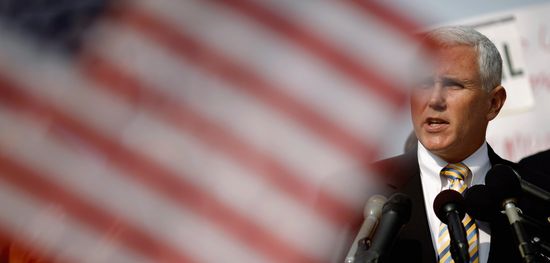
Allahpundit sees the logic of a Mike Pence run at the White House:
The guy who’s usually mentioned as the threat to Palin is Huckabee, of course, because they’d compete for social conservatives. But establishment Republicans dislike Huck almost as much as they do Sarahcuda, as he’s ever eager to remind us. So imagine for a moment that you’re Karl Rove, nervously weighing the possibility that one of those two will be the nominee. You can try to head them off by pushing Romney or Daniels or Thune, but then you run the risk of a pure “centrists vs. the base” primary — and because the base tends to be more motivated to turn out, they’d have the upper hand.
The alternative is to try to coopt part of the base by backing a compromise candidate instead, someone who might be more fiscally and/or socially conservative than the establishment would prefer but who would peel off base voters from Huck and Palin and would stand a better chance of appealing to centrists against Obama. That’s Pence. He’s got 10 years of legislative experience, he’s deeply respected by fiscal cons and social cons, he gives a good speech, and he’s less ostentatious about “values” than Huckabee is so he runs a smaller risk of alienating moderates in the general election.
Pence is considering running. Pence's extremism on almost all subjects does not seem to me to be an advantage over Palin, but it might square a couple of GOP circles. Still: this very white guy stomping on Sarah wouldn't be good optics either. And she'd win.
Several readers have objected to my view that tackling the long-term debt is obviously the biggest issue now on the table. What about unemployment, they understandably ask? Well, I'm not an economist, but it strikes me that the options for more aggressive spending to prop up demand (and thereby reduce unemployment) are limited (for both political and economic reasons). QE2, extension of the Bush tax cuts for a year or two, and continued unemployment benefits, with a little jawboning on the Chinese currency, is about as good as we're gonna get.
What we're missing is the long-term confidence to spend and invest. And showing that there is a light at the end of the Bush-Cheney debt tunnel would definitely help. Here's Christina Romer on this in the NYT:
The more genuine source of tax uncertainty is related to the government’s long-run budget deficits. Congressional Budget Officeprojections show that the current budget trajectory is grossly unsustainable. The tax changes required to balance the budget in the future could be modest or enormous, depending on what happens to spending.
Simply promising not to raise taxes wouldn’t be helpful. The American people are wise enough to understand that wishing won’t make the problem go away. The only way to resolve this fundamental uncertainty is to enact a credible long-run deficit reduction plan that shows what spending will be cut and what taxes will be raised, once the economy returns to full employment.
You can accept all of Ezra Klein's points on avoiding debt-hysteria, and still see the clear and powerful current economic reasons to address the future now, before it decides to address us.
A three-judge panel on the Ninth Circuit Court of Appeals in San Francisco will hear an oral argument today on California’s ban against same-sex marriage. In the November 2008 elections, California voters approved Proposition 8, an amendment to California’s Constitution that limits marriage to a man and a woman. The Court will decide if a lower court rightly struck down the voter-approved ban as unconstitutional. …
The oral argument will be divided into two hour-long sessions with a brief recess in between. In the first hour, the parties will address each appellant’s standing and any other procedural matters that may properly be raised. In the second hour, the parties will address the constitutionality of Proposition 8.
C-SPAN's schedule says that the oral arguments will be broadcast live from 1 pm to 3:30 pm ET.
"When ideas are interrupted and deconstructed, people jump to wild conclusions, since what we do is so difficult to put into context without the accompanying video," – James O'Keefe, the conservative activist and filmmaker whose edited ACORN videos caused viewers to jump to wild conclusions that weren't true.
 The Dish