The Drug Artist

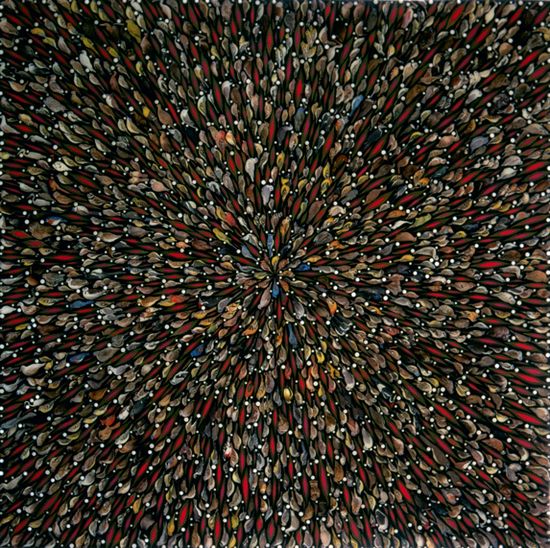
Tomaselli-Dead-Eyed-Bird-Blast

Paul Laster reviews Fred Tomaselli's retrospective at The Brooklyn Museum:

A practitioner of psychedelic dreams, artist Fred Tomaselli turns mindscapes into visual landscapes. Layering print media, marijuana leaves, pills, and paint under layers of resin, Tomaselli constructs networks of awe-inspiring elements that come together to form a transcendental vision of parts of the universe. …

Creating a touchstone for important global issues — from the war in Afghanistan to the discovery of underwater uranium in Bolivia — Tomaselli turns our mediated, consumer-saturated world into a marvelous play land, where we can  jump on a ride to the next realm.

(Image of Dead Eyed Bird Blast, by Fred Tomaselli, which includes hemp leaves, pills, photo collage, acrylic, and resin on wood panel.)

The Original Dirty Hippies

Utopia

Jason Zasky interviews Richard Francis about his history of “Fruitlands,"the utopian experiment led by Bronson Alcott—father of Louisa May Alcott, author of “Little Women”—and English Transcendentalist Charles Lane:

Their regime was to eat fruit and vegetables—preferably raw, though they did eat cooked potatoes. They washed in cold water and wouldn’t use any spices. They also wouldn’t use alcohol or tobacco, and wouldn’t use any animal products in their clothing. And they wouldn’t use cotton [because] it was the product of slavery, so they wore linen. It’s not surprising that they got cold, and that the community began to falter as winter came on.

(Photo from Detroit by Jason Tester via David Pescovitz)

Technology Before Politics?

Aileen Gallagher talks with sci-fi novelist William Gibson:

If you’re born now, your native culture is global, to an increasing extent. There are things that are unknowable for futurists of any stripe, be they science-fiction writing charlatans like myself or anthropologists in the employ of large automobile companies who are paid to figure out what people might want in ten years. One of the things that’s unknowable is how humanity will use any new technology. …

Technology trumps politics. Technology trumps religion. It just does. And that’s why we are where we are now. … This is not only what we do, it’s literally who we are as a species. We’ve become something other than what our ancestors were.

What They Least Want To Give Us

Linda Hirshman notes why the resistance to marriage equality and military service is so important to sustaining anti-gay stigma:

The right knows it can't make the state punish gays as sinners, for various constitutional reasons, so it is trying to make the state deny them the closest thing it has to consecration: the sacred bonds of warriors and the sanctity of marriage. …

It's a fight worth having, because the society rewards these secular symbols of goodness in countless unseen ways. Sure, military service is not a constitutional requirement for running for office, but it's a big leg up.

But what both do is imprint homosexuality with the core values of the right: marriage and service. Hence the cognitive dissonance. If being gay is the permanent "other", how can they also be the most admirable among "us"?

The Gift Of Animals

Says Cate MacDonald:

Animals have been given a much more significant role in the created order than just that of biological necessity in the natural economy. They have been imbued with relational capacity, a capacity that is both their own and reveals God’s. Like the rest of the natural world, they have impact, sometimes significant impact, on our souls.

Proactive Looking

Torture

Ian Crouch talks to Susie Linfield about her new book on photography, “The Cruel Radiance: Photography and Political Violence”:

There’s a whole school of criticism that argues that we shouldn’t look at photographs that were taken by Nazis: that these are photographs taken by the murderers, that the photographs themselves were meant to humiliate the victims, that they represent exploitation and cruelty. And, of course, all this is true. But photographs often say things that their makers do not intend, and some of these Nazi photographs reveal the suffering of the victims in very powerful and evocative ways.

They also reveal the cruelty of the perpetrators, which is something that I think we should look at. We shouldn’t be afraid that in looking at an exploitative photograph, we become the criminals: that’s a kind of magical thinking.

Where Does Sexism Come From?

Roger Ebert explores a point raised by last week's Hitchens / Blair debate, "Is it good for the world to consider women as an inferior form, as all religions do?" Ebert delves into the various religious examples, and offers a simple explanation:

I believe the world is patriarchal because men are bigger and stronger than women, and can beat them up. The earliest archeological evidence we have for human family development indicates patriarchies preceded written language. Indeed, if we study other primates we see that their cultures are also male-dominant, and presumably they've not arrived at this state after careful discussion.

Earlier this week, Yglesias flagged a related study:

We show that … societies with a tradition of plough agriculture tend to have the belief that the natural place for women is inside the home and the natural place for men is outside the home. Looking across countries, subnational districts, ethnic groups and individuals, we identify a link between historic plough-use and a number of outcomes today, including female labor force participation, female participation in politics, female ownership of firms, the sex ratio and self-expressed attitudes about the role of women in society.

Erik Voeten adds:

 These types of arguments challenge views that cultural differences about gender roles originate in religion or other value systems.

Partying In The East Village

4174968041_ec0f941da0_b

Sarah Laskow looks at nightlife as industry:

Academics have a word for what the neighborhood has become: a nightscape. Bars and restaurants were once peripheral to the main drag's primary economic drivers: supermarkets, coffeehouses, boutique shops, record stores. But in post-industrial cities, nightlife has grown into an industry in its own right. As in any industry, shop owners tend to cluster. A century ago, that meant the creation of a Garment District. Now it means the creation of a Party District.

There are a few of them of course. You'll hear similar complaints about the Meatpacking District, about areas of Fifth Avenue or Smith Street in Brooklyn, or the side streets of the Flatiron District. But the Party District below 14th street east of Third Avenue is the largest, the densest, and still growing. To hear the people who live further up near the Stuyvesant Town end of the East Village talk, the Party is spreading largely north, and somewhere around the summer of 2009, it wholly enveloped the stretch of Avenue A between the northwest corner of Tompkins Square Park and 14th Street.

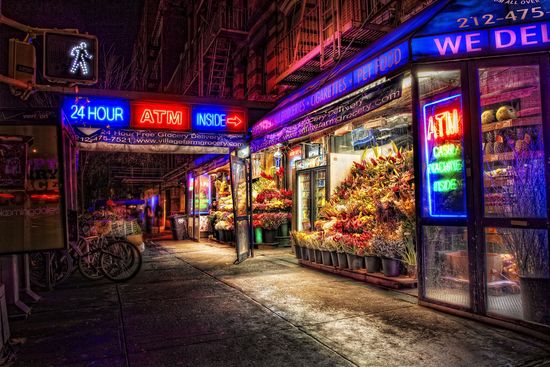
(Photo by Christopher Shoenbohm. His caption: "A typical local market in New York City. I liked this one because of their use of flourescent lights. This particular site is on 9th St and 2nd Avenue in the East Village. One of the great things about living in nyc is that you can walk to your local stores at any time of the day or night.)

Miss TSA Minus The T And A

Xray

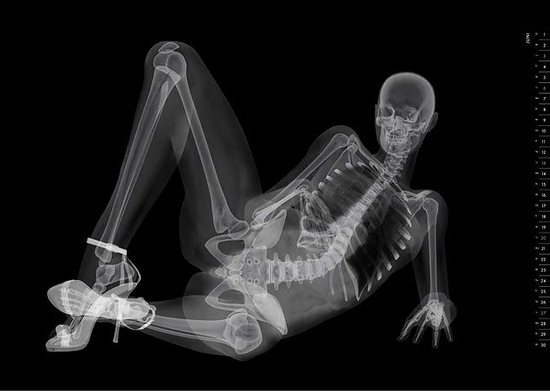
Chloe at Feministing analyzes a calendar now being sold in the wake of the TSA kerfluffle to make a larger point about supposedly sexy poses:

I appreciate these photos because they’re a reminder that, when you look at conventional definitions of “sexy” from a slightly different angle – in this case, from an angle that removes facial expression, hair, makeup, surrounding requisite beach or fur rug and leaves nothing but the body – those definitions start to look really ridiculous.

These poses are totally absurd, so unlikely to be struck during actual real-life sex, and this particular form of photography throws that into sharp relief.

Totes And New T-Shirts!

336-806

Yes, they're here – and at $16, much more affordable than the vintage, hand-printed Dish Ts. Check here for the design on the reverse and several new colors for the Ts, including this one (red and white now available too):

Of-no-party-or-clique

Many readers have had their jaws drop at the price of the regular Ts. We know, we know: $50 is a large amount for a t-shirt. And you feel that way until you see or wear the Rogues' Gallery clothes. I picked them because I wear them and love them – and know you will too. They are each hand-printed on vintage old t-shirts, that have a soft and yet robust texture, never shrink, and last forever. They're the most comfortable and durable t-shirts I have ever bought or worn – and I can't stop wearing them. I wanted Dish readers to have something classier and subtler than the usual mass market merchandise, even at the price of a higher cost. But the totes – and upcoming cheaper items – are much more accessible, even though they are also hand-printed.

Women readers have also asked if the unisex t-shirts work for them. Yes, they do – just pick a size one smaller than your usual in women's sizes. They're meant to be loose-fitting and hang beautifully on men and women of all shapes and sizes.

If you love the Dish and want to show it, have at it. If you're wondering what to get for Christmas for someone you know is a Dish-addict, you couldn't do better. And if you also want to support the Dish, and show your appreciation for the truly hard work that Patrick, Chris, Zoe and Conor do every day, the revenue from this will help support their work going forward.

The full shop is here. Merry merry. And please support the Dish in our first ever merchandising effort ever. We want to be around for another ten years and this added revenue stream is one way to help that happen.