Staying In Iraq, Diplomatically

Marc Lynch and John Nagl argue that we need to amp up our diplomatic efforts in Iraq:

America's contribution to dealing with these continuing problems [in Iraq] will be primarily political and diplomatic, not military. A commitment to drawing down military forces should not mean political disengagement. Iraq is as important to the interests of Iran, Turkey, Syria, Saudi Arabia and other regional players as it is to those of the US. Undoubtedly, those countries will continue to be deeply involved in Iraq whether or not Americans stay on the field.

Lynch goes into more detail at his blog.

Don’t Help Us Consume, Invest, Ctd

Yglesias doesn't buy Matt Continetti's division of government spending into investment and consumption. He argues that "the political convention is to use 'investment' to mean 'spending I favor' whereas 'out-of-control spending' means 'spending I oppose'":

Medicare is obviously a heavy subsidy for old people’s consumption of health care services. But that, in turn, constitutes a heavy subsidy for medical-related R&D spending. America has the world’s most bloated health care sector but we’re also world leaders in pharmaceuticals, biotech, medical equipment, etc., and I doubt this is a coincidence. Any kind of in-kind social welfare provision is in part a form of industrial policy. In the classic Milton Friedman critique of the welfare state, this is a problem. But in the Continetti/Brooks/Salam reformulation of the critique, it ought to look more like a feature. I wouldn’t swing 100% to the “just send money” side of the argument, but on the whole I think Friedman has the better of the argument.

Brazil Recognizes Palestine

It's a powerful endorsement of a new nation state in the Middle East, based on the 1967 borders – and a recognition, perhaps, that negotiating with the Israelis is about as fruitless as negotiating with Republicans. I hope the current talks can gain momentum, but if Netanyahu really digs in and settlements continue, I suspect more and more countries will start doing this. And if the Obama administration's patience runs out, I see no reason why the US shouldn't too.

Another Republican Vote For DADT Repeal

Collins is onboard. That makes 60 votes, enough to override a filibuster, provided all of the Democrats can be kept in line. But Collin's vote comes with a big caveat, as Allahpundit notes:

Collins, at least, is sticking by the GOP’s plan to vote no on everything until a deal is reached on the Bush tax cuts. Brown’s statement doesn’t address the subject, but since he also signed the Republican pledge to make the tax cuts top priority, presumably he’s on the same page. Until something happens on taxes, this is all meaningless. Which brings us to the second qualifier: Will there be any time left in the lame duck to address DADT even after a deal on taxes is reached?

Shut Up And Sing: Justin Bieber

A reader writes:

I hope the contest isn't closed, because the New Artist of the Year might have something to say about it. "Pray" is like a best-of compilation of everything sanctimonious, self-righteous and smug from all the other nominees, but the heaping dollop of Bieber is sure to push it over the finish line.

It’s so, like, awesome that he’s visited so many sick kids!

The Spousal Diaspora, Ctd

A reader writes:

Kudos on following up on this from the perspective of the impact that DOMA has on couples with differing citizenships.  However, have you considered the impact on military same-sex couples as well?

Military spouses face enormous challenges and pressures that very often go unrecognized.  Of course, there's the worry and uncertainty when your husband or wife is deployed to a combat zone overseas.  But even when your spouse is at home, there are still training exercises and schools he or she must attend which will effectively mean that you will be on your own for weeks or even months at a time. Beyond this, there's the normal rhythm of military life, with servicemembers moved to new duty stations, either at home or abroad, every few years.  Usually, this means that the entire family packs up and moves, severing friendships, ending civilian jobs, taking kids out of school and so on.

To its enormous credit, the military has created extensive support for military families, from unit level family support groups (where civilian spouses provide support to each other) to assistance with job placement to complete medical coverage for spouses and children to access to chaplains.  When it comes time to move, the service branch will pick up the tab for moving the entire family, and will ensure that it provides decent housing for that family at the new duty station.

Needless to say, none of these supports are available to same-sex couples (and likely wouldn't be even with the repeal of DADT, because of DOMA).  As a result, in order to make a long-term relationship work, a same-sex couple must go to very great expense moving the civilian partner each time the military partner has a permanent change of station.  There will be no assistance with either housing or employment.  There will be no moral support of any kind.  The civilian partner will be left entirely on his or her own.

In my own case, I knew exactly how impossible it would have been for me to carry on a long term relationship and a career in the Army.  Yes, there are a few people who make it work, but it's incredibly hard when the relationship is constantly buffeted by the stresses of military life.  It takes a truly extraordinary person to be the same-sex partner of an active duty member of the military.  And so I generally carried on by myself – married to my career, as it were.

Repealing DADT alone won't fix this problem; at most it might allow same-sex partners access to family support groups.  If gay men and lesbians are to be fully welcomed into the military, their families will need to be welcomed as well.  That will require repeal of DOMA.

The Spy Sherwood Piece

By popular demand, my 1988 piece on the then-budding young Rhodes Scholar who has now ascended to be head of ABC News. This time, much more legible:

Current Rhodes Scholar Benjamin B. Sherwood II's nervous eyes and carefully goofy warmth suggest a lifetime of manic achievement. Simultaneously elusive (at Oxford he would only give me an off?the?record interview) and overbearing ("Let's do lunch sometime; I’ve been looking forward to meeting you"),  he is perhaps the archetypal Rhodes scholar, the ultimate in a long line of centerless resume featherers. This is his story ….

Ben, now 24, had his eye on the Rhodes from an early age. The son of a well-connected Beverly Hills lawyer, he was educated at the Harvard school in Los Angeles – southern California’s premiere prep school – and grew up in the shadow of his equally driven elder sister, who won a Rhodes in 1981. According to a friend, his parents actually paid slightly older  children to play with their offspring as a way to inculcate social precocity and thus, perhaps, speed up their fellowship preparation. (Mrs. Sherwood confided to a family friend that she intended to write a book, "How to Raise a Rhodes Scholar.") By the time he entered Harvard College with the class of 1985, Ben was for primed for résumé battle in the big leagues; already he stood out among his peers. As a 1986 Los Angeles Times interview put it just after he won the Rhodes, "Ben Sherwood… has had to work hard to fit in with others his own age while darting in and out of a more adult world, that tended to find his enthusiasm quite charming.” Yes, that is the word: enthusiasm. "He never lost his excitement about learning something new,” remembers an older former employer.

But as the Times hinted, Ben's enthusiasm had provoked some teasing from classmates. 'It was a common bond among my classmates at Harvard, hating Ben Sherwood," notes one of his more affectionate former friends. "Ben is one of the most hated people alive," agrees Clark Freshman, a Harvard classmate and, as a Marshall scholar, a fellow Oxonian. "It's bizarre. People actually make an effort to dislike him." Others put it more gently: 'When you think Ben Sherwood, you think funny stories, you think asshole, you think 'Thank God I'm not him,' " says a friend.

But through it all, Ben has held steady. "I'm reluctant to make waves when sitting in a group of classmates when one person says something I disagree with," Ben ventured to the Times. "And Machiavelli, who is widely misunderstood, said that in the long run it's not very important to be popular, because popularity is fleeting, but respect is permanent." Some say that Ben himself is widely misunderstood, that his enthusiasm can encompass a humorous sense of fun, To the Times he confided shyly that he plays chess with a computer; has tried sumo wrestling in Japan; speaks French, Russian end Chinese (well, a summer course at Andover); and won a disco-dancing competition with his grandmother. He also has a penchant for magic tricks and mime.

None of this, mind you, has anything to do with endearing himself to the overweeningly well-rounded men and women who make up the Rhodes Selection Committees. At the Harvard Crimson Ben’s enthusiasm quickly came to the fore: as a freshman he immediately declared his intention to be its president (the paper’s equivalent of editor in chief) and wrote more stories to qualify for a position on the paper in his first semester than any other freshman. Once he'd acquired the nominal title of editor (like every other reporter who makes the staff), he wrote only a handful more pieces. Why the sudden withering of his journalistic passion? "He realized he didn't need the Crimson," explains a fellow editor, "and he had his active three moments for his resume."

Indeed, a miraculous series of prestigious internships followed: two stints working for the Los Angeles Times in its Washington and Paris bureaus, each of which was completely unconnected with his family's close friend, publisher Tom Johnson; a summer at CBS in New York (among the references on his résumé have been Walter Cronkite and Don Rather, and featured prominently on his Oxford wall is a photo of Ben hugging Diane Sawyer on the CBS Evening News set); and the time spent covering the Jesse Helms – James Hunt 1984 Senate race for the Raleigh News and Observer.

Fellow reporters at the Times still remember Ben's enthusiasm. "He was a young man going on 65," one of them recently said. "He really worked his buns off." Ben boasted to a close friend afterward, "I walked in and asked how many articles [someone else had] written as a summer intern. They said five. So I said 'Right, I’ll write more, then.' And I did." Back at Harvard, Ben's enthusiasm subsequently fastened on rugby. Asked why he had a sudden interest in this obscure British sport, he explained that it was "to lock up my Rhodes.” Although he was on the team, his closest friend at the time cannot recall him playing a single game. (His teammates valued his contribution so much that at their annual cookout they chose to strip him nude and funnel beer down his throat? a ritual Ben apparently took as an affectionate form of hazing.)

Academically, Ben soldiered for a solid A? average, and by his junior year there was only one obstacle between him and the Rhodes: another supremely enthusiastic man in his class from Los Angeles who would be formidable competition for the Harvard endorsement for the southwestern district. Fired with competitive spirit, Ben decided to take a year off to discover himself. Working for the United Nations for three months on the Thailand ? Cambodia border was a burden for the Beverly Hills prodigy, but he bore it well (happily, it also fulfilled the Rhodes's community-service requirement). He reminisced to the Times, "I had the distinct impression [my friends] expected me to come back from this experience and reject the country club and the house and the family and the servants and the Hollywood Bowl. I could have done that. And it would have been outrageous. …When I look at poor people, I don't feel guilty that I have what I have. Nor does any sense of guilt necessarily motivate me to give immunizations to Khmer Rouge babies on the border in Thailand. What does motivate me to do things is a sense of duty."

And enthusiasm. "I guess it was kind of funny being on the Thai?Cambodia border with him and discussing strategies for getting fellowships," says another relief worker (according to this source, the border was crawling with resume?padders). When Ben returned to Cambridge in the fall of 1985, he took a refugee?camp sign to a store to have it framed. It hung on his wall next to the Diane Sawyer photo. Ben was so sure he would make the cut and get a Rhodes interview that he is rumored to have made his plane reservations to California a month in advance.

In the winter of 1985, when Ben finally won the Rhodes, latent anti-Sherwood sentiment erupted in a splurge of telephone wailing. One classmate had to renege on his promise to commit suicide if Ben got the Rhodes. "I remember people calling one another up when he got it and saying, 'My God! There's no justice in the world!’ " recalls a schoolmate. "People were dumbfounded,' an acquaintance says, "not simply because he got the Rhodes but because he planned and executed getting the Rhodes. He'd devoted his life to it. When he got it, we lost all hope." At the Harvard reception for the Marshall and Rhodes scholars, Ben leaned over to a friend and whispered the classic contemporary assertion of self?dramatizing hubris. "Imagine," he said, "if a bomb fell on this place tonight."

Since then, friends say, his enthusiasm has been tempered by a new mellowness. Well, perhaps. Last summer he worked in Washington at the World Bank. Now, in contemplating his return to the United States from Oxford, he has been studying circulation figures of various newspapers to target the right reentry point. Let's see? which newspaper has produced the most Pulitzer prize winners?
Understanding John McCain

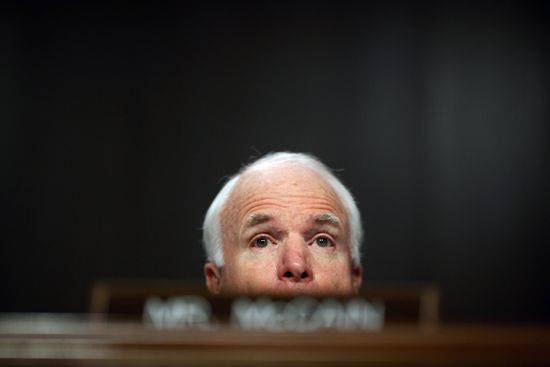
MCCAINChipSomodevilla:Getty

Fallows' readers try to parse the bitter career end of the Arizona senator.

I wish I understood McCain. I thought I did once, but it seems increasingly clear that he is a man of near-suicidal vanity and misjudgment (remember suspending his entire campaign to deal with Lehman Brothers, or the insanely reckless selection of an unvetted Palin) and defined by grudges. Much of his shift to the center in 2000 and after was, it now seems obvious, an attempt to sabotage the man who defeated him, George W. Bush. His conduct in the last two years seems very similar with respect to Obama, despite Obama's early attempts to persuade and coopt him.

He's not homophobic. Very close members of his staff have been gay. His longtime chief-of-staff, Mark Buse, was and is openly gay. But perhaps buried in this psyche is something generational. McCain grew up in a world where homosexuality was never spoken of, and subsequently tolerated with radioactive discretion. Gays were objects of pity and sometimes personal affection – but never seen as full equals. And the notion of a core American icon – the American soldier – being equated with gayness – in the open – is something perhaps beyond his amygdala to process.

The alternative explanation for his recent behavior is fathomless cynicism and hollowness. It's important to remember how this torture victim, in 2006, agreed to acquiesce to the CIA using the same torture techniques once used on him on other prisoners.

The reason? Rove threatened him with full-scale opposition to his nomination in 2008 if he persisted in opposing torture, and Rove, for good measure, wanted to use torture as a key wedge issue in the 2006 mid-terms. I don't know how a torture victim can subsequently support the same thing being done to others. I don't know he sleeps at night knowing that he is responsible for tying human beings up for hours on end in excruciating stress positions – especially when he knows firsthand how horrifying this is. But I do know that such a man has lost his soul in the process.

And that is why this week is not the first time that I have felt a great deal of contempt for him. But it's also personal this time – because I know so many servicemembers who serve and have served with great honor, even with the knife of DADT stuck firmly in their backs. By possibly being the one man insisting on keeping that knife in them and twisting it, he has gone from being contemptible to being despicable, an enemy of the American soldier he is so proud publicly to support.

(Photo: Chip Somodevilla/Getty.)