A Journey, Not An Escape, Ctd

by Chris Bodenner

A reader writes:

I'm happy to see the debut of the (yet-to-be-named?) "Mushrooms Closet." I was an avid reader of "The Cannabis Closet" and bought the book, mostly to show my support. This kind of reality-based dialogue is invaluable for the cause of sanity during this pivotal moment in the drug war.

I hope I'm not being nongermane, but for me to write about psilocybin, I also need to write about LSD, because they are inextricably linked for me. I realize LSD isn't natural like mushrooms, but save for that one facet: the way these two drugs fit into my experience (and, frankly, society) is very similar. I'll try to spare you my life story, but my formative years were key to my later drug use.

I grew up in a tiny Nebraska town, and although there was pot there, I never had the opportunity to try it. (I probably could have gotten ahold of meth more easily.) Instead I spent high school engrossed in every activity I could possibly squeeze in: band, drama, sports, speech, and relentlessly preparing for college — getting ready for "the real world."

Well, in college, shit got real. On the first day, my new roommate pulled out his little wooden box. We spent the night giggling and I was hooked. I know they say pot's not addictive, and generally I agree, but for the next year and a half I got stoned several times daily, choosing it over class, studying, exercise, family, activities, and worst of all, my girlfriend. I lost her and my full-ride scholarship, I went on academic probation and nearly flunked out, and I almost had a nervous breakdown.

Is this because of marijuana? Of course not. These were my own decisions, caused by naiveté, laziness and fear. Pot simply helped me not think about them.

Shortly after my first marijuana experience, I tried LSD and mushrooms. I skipped class a couple of times to day-trip (4/20 anyone?), but in contrast to pot, the most endearing quality of these hallucinogens is what I once heard called "the progress-checker." While I now love the occasional joint for relaxation, it took me far too long to realize that I shouldn't make decisions while high. The opposite is true of hallucinogens. Trips were the most lucid and honest evaluations of my life during those two years. In fact, I can attribute at least in part my eventual modest success in college to the times I realized with horror while tripping how badly I was screwing up my life. Pot is for checking out; hallucinogens are for checking in. Way in. I was forced to think about school, about family, about my life. It was terrifying, but in the way I imagine therapy can be.

Your contributor mentioned the journey. During a (good) trip, the vastness and beauty of the individual journey is simply staggering. Acid is the only time I have actually wept with joy; it is also the only time I was convinced I was about to die and accepted my fate. They helped me through the existential muck – I made peace with impermanence and insignificance. Hallucinogens helped make me who I am: They opened my eyes to the intricate depths and fantastic surrealism of nature (psilocybin while hiking the Zion Narrows – I'm an atheist but that's the closest I've been to god); they've helped forge deep, permanent friendships through shared, unique and utterly insane experiences.

Not to mention the staggeringly beautiful visuals. I will never forget a young Sean Connery speaking plainly to me from his James Bond poster on the wall, or a brick wall flapping in the breeze.

Sometimes I think the world would be a better place if everybody would trip hard just once.
The Elite Personified

by Conor Friedersdorf

Meet Susan Nagel, the young woman who has it all:

Miss Nagel’s talents, unusual for a socialite, have been on rather dizzying display: published articles, a scholarly paper, nationally syndicated op-ed pieces, awards, advocacy work for sustainable organic agriculture and social justice. An expert shooter in trap, skeet and clay, she was a blue-ribbon winner of a small-bore rifle competition.

By the time of her 2009 graduation from Nightingale-Bamford, the private all-girls school on the Upper East Side, Miss Nagel had founded Model United Nations and history clubs, a travel Web site for teenagers, playintraffic.com, and another site, americansformadison.org, intended to raise awareness of her hero, the founding father James Madison, and win him a federal monument.

Along the way, Miss Nagel befriended some prominent historians and at 17, became the youngest registered lobbyist on Capitol Hill. She is currently a sophomore at Johns Hopkins, double-majoring in international relations and history, with a minor in voice (a coloratura soprano, she recently recorded a CD of operatic arias).

The whole article goes on that way.

Rather than pretending that we know this young woman – a Style Section profile has several purposes, and showing us a whole person isn't one of them – let's discuss her as if she's a character in a novel we're reading. She is intelligent, poised, physically attractive, hardworking, and priveleged.

But don't you worry for her?

She is cast as the meritocratic elite's most accomplished overachiever. And I'll tell you why I worry especially about someone like that. With age, everyone realizes that life isn't as simple as it once appeared. Career and Marriage are transformed from abstract hopes into concrete decisions. Every one that is made closes off other possibilities. And every so often, we take stock of life, pondering its purpose, what it is that makes us happy, our responsibilities to others, whether meaning can be found in our work, etc.

Being raised on the Upper East Side, studying at elite schools, and winning blue ribbons in small-bore rifle competitions – or if you prefer, being part of the meritocratic elite generally – insufficiently prepares young people for these questions. Instead, the world of prep schools and top tier colleges traffic in a perverse illusion: that building a perfect resume is the same thing as building a perfect life.

I'd advise everyone in that world to remember that resume building should always be treated as a means, not an end; that impressive careers are not a guarantor of happiness or meaning; and that since every subculture has its pathologies, you're probably not doing things right unless the other people in your world are at least slightly uncomfortable with some way in which you're challenging its assumptions.

Dusting Off Old Gift Cards

by Patrick Appel

Lifehacker has tips:

In the event your card has already expired, you're not necessarily out of luck. If it's a ten-year-old gift card you might want to bid your final farewells and do more to remember in the future, but if it's a more recent expiration you can generally call the vendor for an extension. Customer service representatives want to be able to help if they can, so if you're nice you're likely to yield better results. I worked in a form of technical support awhile back and can vouch for this. Pretty much everyone on our team would go out of our way to help people who were kind to us. The moment someone was rude, angry, or approached us with a feeling of entitlement we'd do the bare minimum. If I learned anything from that job, it's that being kind to your customer service representative can go a very long way.

(Hat tip: Jackson)

What 20 Inches Of Snow Does To Air Travel

by Patrick Appel

Nate Silver notes that 800+ flights have been cancelled at New York's La Guardia airport:

Pick a random weekday in February, and you can find a seat on any of roughly 125 nonstop flights from one of the two major Chicago-area airports to one of the three large ones in New York.

But if you were planning on flying this week, you’d better hope that you’ve already booked your tickets. As of just after midnight on Tuesday morning, just 3 of these 125 non-stops showed any availability on Tuesday, according to searches at Kayak.com and Southwest.com. No nonstop flights of any kind — and only a handful of indirect routings — had seats remaining for Wednesday. Thursday wasn’t much better: only 6 flights were still available, and none were cheaper than $935 for one-way travel.

Dwindling Democracy

by Zoë Pollock

As Paul Woodward points out, you know it's bad when for Israel when, on top of Thomas Friedman and David Remnick, even Jeffrey Goldberg seems to have lost hope:

I will admit here that my assumption has usually been that Israelis, when they finally realize the choice before them (many have already, of course, but many more haven't, it seems), will choose democracy, and somehow extract themselves from the management of the lives of West Bank Palestinians. But I've had a couple of conversations this week with people, in Jerusalem and out of Jerusalem, that suggest to me that democracy is something less than a religious value for wide swaths of Israeli Jewish society.

I'm speaking here of four groups, each ascendant to varying degrees: The haredim, the ultra-Orthodox Jews, whose community continues to grow at a rapid clip; the working-class religious Sephardim — Jews from Arab countries, mainly — whose interests are represented in the Knesset by the obscurantist rabbis of the Shas Party; the settler movement, which still seems to get whatever it needs in order to grow; and the million or so recent immigrants from Russia, who support, in distressing numbers, the Putin-like Avigdor Lieberman, Israel's foreign minister and leader of the "Israel is Our Home" party.

Let's just say, as a hypothetical, that one day in the near future, Prime Minister Lieberman's government (don't laugh, it's not funny) proposes a bill that echoes the recent call by some rabbis to discourage Jews from selling their homes to Arabs. Or let's say that Lieberman's government annexes swaths of the West Bank in order to take in Jewish settlements, but announces summarily that the Arabs in the annexed territory are in fact citizens of Jordan, and can vote there if they want to, but they won't be voting in Israel. What happens then? Do the courts come to the rescue? I hope so. Do the Israeli people come to the rescue? I'm not entirely sure.

Free To Move About The Country

by Conor Friedersdorf

The tag line may belong to Southwest Airlines, but a large part of the credit is owed to a deceased Cornell University professor:

ROCHESTER, N.Y. — Alfred E. Kahn, who presided over the historic deregulation of the airline industry during the Carter administration, paving the way for JetBlue and other low-cost carriers, died Monday. He was 93. A leading scholar on public-utility deregulation, Kahn led the move to deregulate U.S. airlines as chief of the now-defunct Civil Aeronautics Board in 1977-78. The board had to give its approval before airlines could fly specific routes or change fares.

By letting airlines instead of the government decide routes and fares, Kahn is credited above anyone else with enabling a dramatic drop in airline fares and a boom in air travel over the last 30 years. Deregulation opened the way for such carriers as People Express and JetBlue, and allowed low-cost Southwest Airlines — which had up until then operated only within Texas, outside of CAB's reach — to expand nationwide. But the move also contributed over the years to the death of such storied names as Pan American and the erosion of inflight amenities.

It's an impressive legacy. May he rest in peace.

Accidents Of History

by Conor Friedersdorf

Matthew Continetti plucks a fascinating anecdote from a decades old newspaper:

On December 13, 1931, there was a traffic accident in New York City. A man exited a cab on the Upper East Side and was crossing Fifth Avenue when he was hit by a car traveling around 35 miles an hour. The force of the impact threw the man to the pavement. He struck his head. Two of his ribs were cracked. A crowd formed around him; one of the witnesses hailed a taxi to take the man to the hospital. When he was admitted to Lenox Hill the doctors noted that he was bruised and battered but would make a full recovery. He had cheated death.

The patient remained in the doctors’ care for eight days. While he was there the driver who had struck him visited. The patient made it clear that the accident had been his own fault; the driver, an unemployed mechanic, had nothing to fear. The incident had occurred because the patient, an Englishman, had looked left as he crossed the street when he should have looked right. The grateful driver left the hospital carrying an autographed copy of the patient’s latest book. The New York Times wrote about the meeting the next day. The headline read, “Churchill Greets Driver Who Hit Him.”

Lucky he lived.

A Poem For Tuesday

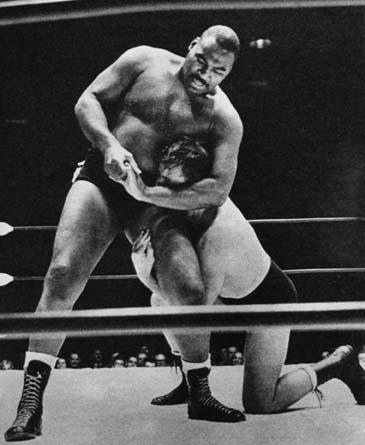
Big_Daddy_Wrestling_medium

by Zoë Pollock

"Say Good-bye to Big Daddy" by Randall Jarrell appeared in The Atlantic Monthly in 1967:

Big Daddy Lipscomb, who used to help them up

After he'd pulled them down, so that ''the children

Won't think Big Daddy's mean''; Big Daddy Lipscomb,

Who stood unmoved among the blockers, like the Rock

Of Gibralter in a life insurance ad,

Until the ball carrier came, and Daddy got him;

Big Daddy Lipscomb, being carried down an aisle

Of women by Night Train Lane, John Henry Johnson,

And Lenny Moore; Big Daddy, his three ex-wives,

His fiancee, and the grandfather who raised him

Going to his grave in five big Cadillacs;

Big Daddy, who found football easy enough, life hard enough

To — after his last night cruising Baltimore

In his yellow Cadillac — to die of heroin;

Big Daddy, who was scared, he said: ''I've been scared

Most of my life. You wouldn't think so to look at me.

It gets so bad I cry myself to sleep — '' his size

Embarrassed him, so that he was helped by smaller men

And hurt by smaller men; Big Daddy Lipscomb

Has helped to his feet the last ball carrier, Death.

The big black man in the television set

Whom the viewers stared at — sometimes, almost were —

Is a blur now; when we get up to adjust the set,

It's not the set, but a NETWORK DIFFICULTY.

The world won't be the same without Big Daddy.

Or else it will be.

(Image of Eugene "Big Daddy" Lipscomb via Behind The Steel Curtain)

Quote For The Day

by Zoë Pollock

"It's a grave mistake in publishing, whether you're talking about Internet or print publication, to try to play to a limited repertoire of established reader interests. A few years ago, Bill Gates was boasting that we'll soon have sensors which will turn on the music that we like or show on the walls the paintings we like when we walk into a room. How boring! The hell with our preexisting likes; let's expand ourselves intellectually." – Denis Dutton, founder of Arts & Letters Daily, who died today, speaking in a 2000 interview with Salon.

Arts & Letters is a stellar example of how a well-curated site (and the mind behind it) can be a constant source of surprise and delight. He'll be missed.

A Manifesto Against Borrowing

by Conor Friedersdorf

Jacques Attali issues the warning:

The power of sovereign states can foster a sense of impunity that encourages excessive debt. In the past, sovereign states have sometimes rid themselves of creditors by simply driving them out (as they did repeatedly with Europe’s Jews), by tormenting them, or by simply refusing to pay. When modern states borrow from a range of anonymous investors on global markets, sovereign immunity protects their assets against seizure—China cannot seize the White House as collateral for U.S. Treasury debt. But creditors can still negotiate, even with sovereign debtors.

When a state loses the market’s confidence, the threat of a financial cutoff is a jolt back to reality. Just ask Greece, as its leaders scramble to reduce its public deficit as quickly as possible. The West needs to wake up now, shake off the yoke of public debt, and take the path of liberty. That path is long and difficult. It means balancing budgets and stabilizing the financial sector. But the great reward will be a return to confidence and growth—for those who put in the effort, and for those with the audacity to see it through.

One reason that the United States cannot get spending under control is the difficulty of convincing ourselves that we could suffer the same fate as Greece. It doesn't seem possible – and I say that as someone who very much thinks that it is.