Kudos On NoKo

Matt Yglesias is handing them out:

One structural problem in the world is that they don’t hand out medals for the wars you don’t fight, and the terrible potential consequences of roads you don’t travel down don’t wind up making the headlines. Consequently, policymakers who manage to face-down tricky situations without getting huge numbers of people killed end up overrated.

So I’d like to say that best on what I’ve read in recent news coverage and also what I’ve seen in the WikiLeaks cables, the governments of South Korea and the United States of America seem to have been doing a bang-up job for the past several years of managing a difficult situation.

It’s not as emotionally satisfying as being John McCain and randomly musing about “regime change” and it’s not going to “solve” the problem, but it’s protecting the relevant interests at a reasonable cost. And that, at the end of the day, is the job policymakers are supposed to do. It would be nice if the North Koreans weren’t so bizarre and it would be nice if the PRC were more cooperative and it would be nice if the Bush administration hadn’t blundered so badly in its first four years in office. But you have to work in the real people, and people dealt a bunch of bad options seem to me to be making the best of it.

“Salvation By Latex”?

George Weigel explains why Pope Benedict's remarks on condoms as a least-worst evil in some circumstances is not really a major doctrinal or pastoral shift on the question. I don't think he's wrong technically, and he's right about how some of the press have a hard time distinguishing between comments in an interview and an authoritative teaching from the Magisterium. Nonetheless, what I saw in Benedict's comments was a pastoral judgment on a specific case, where condom use could be a sign of a turn toward responsibility and greater respect for another human being.

This pastoral exception to dogmatic rules is, in fact, what the Catholic church often makes, on the ground, between priest and parishioner, aid worker and patient, parent and child. I wish in many ways that the actual, pragmatic humane work the church does could shine through past the more closed-minded diktats of the Vatican. But that too is as much the press's fault as the church's. When was the last time you read a story of a Catholic priest or religious nursing someone with AIDS or HIV?

Stuck At The Bottom, Ctd

Despite the dismal jobs report, Ryan Avent is hopeful:

November numbers may be an aberration. September's job losses were revised down to 24,000 in this report, while October's job gains were revised upward, from 151,000 to 172,000. Through November, weekly data on initial jobless claims showed significant improvement. And of course, many other indicators have been flashing positive signs in recent weeks.

It's likely, then, that the November figures will be revised up in future months to show a better performance more in keeping with broader trends. And it's important to remember that monthly data are noisy. America's labour markets have yet to generate job growth sufficient to bring down the unemployment rate. But the pace of recovery has been improving. There is good reason to suspect that when all is said and done this report will appear as a blip marring a strengthening upward employment trend. All the same, policymakers in Washington weighing whether to extend unemployment benefits and tax cuts should heed the obvious weakness in labour markets. They can and should make sure that November's number remains an anomaly.


The Tax Cut Game Of Chicken, Ctd

The House Democrats voted yesterday to extend the "middle class" Bush tax cuts. The Senate Democrats appear likely to do the same, although they risk being filibustered by Republicans, who want an extension of all tax cuts for all income levels. Economist Mom puts the debate in context:

What a juxtaposition to have President Obama’s deficit-reduction commission release its final report while the Administration “negotiates” with Congress on whether all of the Bush tax cuts, or just most of them, should be permanently extended (and deficit financed).  The media has been reporting that whether the bulk of the Bush tax cuts will be extended or not is not the issue–it is whether the upper-bracket ones benefitting only the rich will be included as well, and what constitutes “rich.”  (That floor may be moving up all the way to $1 million.)

Let’s remember that the permanent extension of “just” the “middle-class” Bush tax cuts, as President Obama has proposed, would add about $2.2 trillion to the debt over the next ten years–without interest costs and without the associated extension of Alternative Minimum Tax relief.  Such extension would preserve the full value of Bush tax cuts for 97-98 percent of households while continuing to give the largest dollar value of tax cuts to those above the $250,000 threshold.  (That’s because those in the upper tax brackets have income that passes entirely through the lower brackets.)  Extending the upper bracket cuts along with the rest would raise the ten-year cost to close to $3 trillion (again, without interest).  So the Administration and Congress are debating over whether we should commit to over $2 trillion, versus closer to $3 trillion, in deficit-financed Bush tax cuts.

I have rarely been more depressed by the political leadership in this country. At a time when everyone knows we need to be dealing with the debt, we are adding massively to it, because the Democrats and the president seem incapable of making the case for anything, and because the GOP is as ideological as it is politically autistic.

Don’t Help Us Consume, Invest

That's what Matthew Continetti wants government to do:

I think we need to distinguish between a government that finances long-term investment and a government that finances present consumption. Hamilton, the Whigs, Lincoln, and TR sought to improve American infrastructure and level the playing field so that young men of talent could overturn entrenched market incumbents. Growth was the result. Yet the American welfare state, as presently composed, is devoted almost entirely to present consumption in the form of Social Security, Medicare, Medicaid, and interest on the debt. The money spent on education, R&D, and infrastructure is a pittance by comparison. The one place where we actually do massively invest in (global) public goods is defense. But of course that's where everyone wants to cut.

We need to deemphasize consumption and focus on investment. I think that Obama, in his heart, would like to do just that—as David Brooks pointed out, Obama's "New Foundation" speech, while disturbing in its rhetoric of a fundamental break from past decades of American history, was about an economy of investors rather than consumers.

But the president is also trapped, as he and his party seek to protect, and in some cases expand, the welfare state as it exists today.

The Base’s Faves

6a0133f4f7f710970b013489b306ef970c-500wi

If you wonder why thoughtful, constructive conservatism is seemingly nowhere to be seen, check out conservativehome's poll of over a thousand GOP activists as to their favorite pundit stars. Money quote:

Worryingly, columnists often regarded as among the most thoughtful conservatives did not fare well. David Brooks of the New York Times only mustered a mention from 1.3% of the panel (14 people). Ross Douthat, also at the NYT, won just four votes and Mike Gerson, Washington Post writer and former speechwriter to President Bush, gets just three mentions.

Notice that only one, George Will, is not a Fox News employee. And he has adjusted to adopt some of the FNC's top obsessions: that Obama is a socialist and that climate change is a hoax.

Stuck At The Bottom

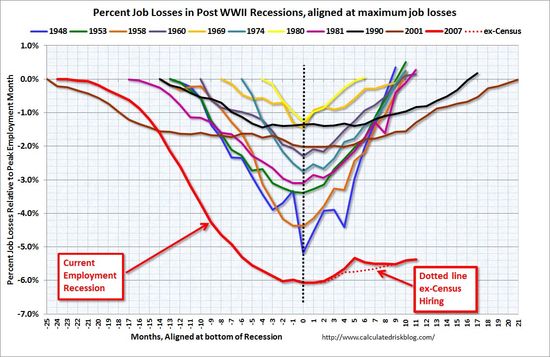
Employment_RecessionsAligned_Nov

Ezra Klein's take on the jobs report:

It's not that these numbers are catastrophic: They're worse than October but better than September. They're just evidence that the labor market's recovery hasn't taken hold yet — and that is catastrophic.

Leonhardt is equally gloomy:

What’s causing this? No one knows, to be honest. But the most likely suspect is the same one that has been hurting the economy for much of this year. Financial crises do terrible damage, and the economic aftershocks from them tend to last longer and be worse than people initially expect.

Today’s report is another argument in favor of the Federal Reserve’s attempts to reduce long-term interest rates, through its so-called quantitative easing program. It’s also an argument for making sure that any extension of the Bush tax cuts includes measures that are more likely to create jobs, such as business tax cuts, a payroll tax cut and an extension of unemployment benefits.

Chart from Calculated Risk.

28 Percent

Andrew Koppelman notes how far we've come as a country:

With Illinois’s passage of the civil unions bill, more than a quarter of the population of the United States – to be precise, a bit over 28% – now lives in a jurisdiction that recognizes same-sex marriage or its functional equivalent. It is only a bit over a decade since the Vermont Supreme Court ruled on December 20, 1999 that same-sex couples have the right to all the same rights and benefits as opposite-sex spouses. The same-sex marriage movement continues to be one of the most rapidly successful movements in American history.

The Shamelessness Of John McCain, Ctd


The Daily Show With Jon Stewart Mon – Thurs 11p / 10c
Gaypocalypse Now
www.thedailyshow.com
Daily Show Full Episodes Political Humor The Daily Show on Facebook

Fred Kaplan calls out McCain, and others like him:

The evidence, the polling data of service men and women, the testimony of senior officers, the everyday experiences of living and fighting, the imperatives of national security, as well as the obvious moral standards of contemporary life—all point to, at the very least, a shift in the burden of proof on whether DADT should be repealed. It’s no longer valid, and it’s clearly a pretense, to call for further studies, further surveys, closer questioning. If McCain and the others oppose repeal, they have to come up with some new reason—or fall back on the oldest, most unpalatable reason—why.

Meanwhile, Mark Blumenthal dismembers McCain’s attempt to dispute the survey’s methodology.

Wikileaks Quote Of The Day

From this cable:

[Israeli] General Baidatz argued that it would take Iran one year to obtain a nuclear weapon and two and a half years to build an arsenal of three weapons. By 2012 Iran would be able to build one weapon within weeks and an arsenal within six months. (COMMENT: It is unclear if the Israelis firmly believe this or are using worst-case estimates to raise greater urgency from the United States).