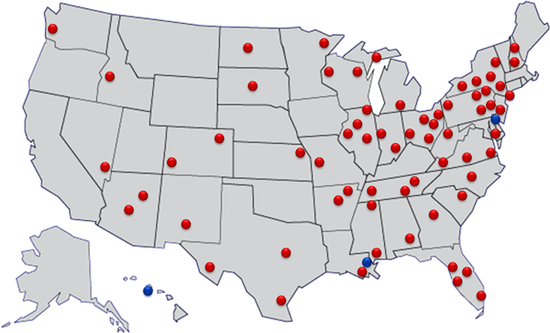
The West vs The GOP

Republican_Gains

Remember when the GOP was the party of Nixon and Reagan, both Californians? That was before the Dixie cuckoo took over the nest. Larry Sabato takes a closer look at the GOP 2010 wave: 

The Pacific states of California, Oregon, and Washington have become a Blue sandbar that can withstand even a Republican tsunami. Strong GOP candidates for Governor in Oregon and California were defeated. Credible Republican Senate contenders in California and Washington could not oust Democratic incumbents. With 53 House berths, not a single Golden State seat changed party hands.

Back in 1994, the last GOP landslide year, Republicans picked up three seats in California. The story is worse for Republicans in Washington State, which was ground zero for the GOP in 1994, when the party won six House seats and held their Senate seat too. All the state’s House seats save one were impervious to a Red tide this time around.

Regional polarization is once again a fixture in American politics, even in years that are overwhelmingly tilted to one party. 

Palin’s Babies

Pop culture was a big influence on baby names this year. Guess who that includes:

The names Quinn (and Finn) from “Glee,” Betty from “Mad Men” and Demi and Tiana of Disney princess fame didn’t crack the top 100, but they’re rising fast. …And so are the widely publicized names of former Alaska Gov. Sarah Palin’s daughters: Bristol, Willow and Piper. (But Palin’s sons’ names, Track and Trig? Not so much.)

Missing The Forest For The Aussie

Will Wilkinson takes my rather resigned view of the Wikileaks Rubicon:

…the debate over WikiLeaks has proceeded as if the matter might conclude with the eradication of these kinds of data dumps—as if this is a temporary glitch in the system that can be fixed; as if this is a nuisance that can be made to go away with the application of sufficient government gusto. But I don't think the matter can end this way. Just as technology has made it easier for governments and corporations to snoop ever more invasively into the private lives of individuals, it has also made it easier for individuals, working alone or together, to root through and make off with the secret files of governments and corporations. WikiLeaks is simply an early manifestation of what I predict will be a more-or-less permanent feature of contemporary life, and a more-or-less permanent constraint on strategies of secret-keeping. 

…To continue to focus on these questions is to miss the forest for the texture of the bark on a single elm. If we take the inevitability of future large leaks for granted, then I think the debate must eventually centre on the things that will determine the supply of leakers and leaks. Some of us wish to encourage in individuals the sense of justice which would embolden them to challenge the institutions that control our fate by bringing their secrets to light. Some of us wish to encourage in individuals ever greater fealty and submission to corporations and the state in order to protect the privileges and prerogatives of the powerful, lest their erosion threaten what David Brooks calls "the fragile community"—our current, comfortable dispensation.

Mine Our Data!

Or let us. That's Michael Agger's request for Facebook:

It would be helpful for transportation planners to know the places where people complain the most about traffic. Educators could see the data and sentiment analysis around how a community feels about its local schools. The writer Marshall Kirkpatrick at readwriteweb.com has called for Facebook to open up its data for research. He points to the fact that the discriminatory practice of redlining was discovered "when both U.S. Census information and real estate mortgage loan information were made available for bulk analysis." And he rightly speculates that "patterns of comparable importance" could be found in Facebook's enormous social graph.

Facebook's challenge is to leverage that social graph in a way that doesn't alienate us all. The site analyzes us for the benefit of its advertisers but offers only limited peaks at what its engineers are capable of.

Is The Pill To Blame For Declining Fertility?

New York Magazine makes the case. Phoebe offers a different explanation:

The unfortunate fact of female sexuality in our society is that too-young is very quickly followed by too-old – to conceive, or even to attract many men in the first place. 'You're not allowed to date, young lady' (from conservatives) or 'You're too young to settle down' (from liberals) segues almost instantaneously into 'What, no boyfriend?' The elusive window-of-opportunity – not the Pill, not the tendency of 20-somethings in crappy relationships to end those relationships – is the problem.

Solutions? Since the biological clock is unlikely to budge, it's clear we have to look, at least in part, at the younger end of the spectrum.

As it stands, all long-term romantic commitments begun prior to age 30 are viewed as having rushed into things. Without reverting to a system where women are stigmatized for not having settled down by 21, we could shift to one in which 23-year-old couples wouldn't be treated like experimenting middle-schoolers. I wouldn't suggest encouraging those who wouldn't do so otherwise to marry or similar at 20. I would suggest removing the stigma that says that to be well-educated and impressive and so on, you have to find 'that special someone' at 29-and-a-half, marry at 31, and reproduce before (horrors!) 35. I'd instead encourage the happy couples 18-25 that exist anyway not to end their relationships simply because 'there's so much more to experience.'

Democrats And The Dream Act

Bryan Curtis talks to Congressman Luis Gutierrez:

The DREAM Act, Gutiérrez says, is for now his final legislative maneuver. He’s finished waiting for the mythical 60th vote to materialize in the Senate. No, when the lame duck ends, Gutiérrez and his movement allies will ask for a divorce—from the Democratic Party, from the entire lawmaking process. To hear Gutiérrez tell it, Hispanic leaders are about to stage a full-tilt campaign of direct action, like the African-American civil-rights movement of the 1960s. There will be protests, marches, sit-ins—what César Chávez might have called going rogue. The movement will operate autonomously, no longer beholden to wavering Democrats, filibustering Republicans, and—perhaps most tantalizingly—no longer beholden to Barack Obama.

I sense a similar mood in the gay rights movement too. Mickey Kaus and Bob Wright discuss the legislation here. Conor pushes back on Mickey:

Illegal immigration is a bad thing partly because it is ruinous for social equality. Kaus of all people is surely sympathetic to this argument — it’s unhealthy for a large proportion of people in a society to persist as second class citizens, unable to fully participate in civic life, vulnerable to harassment, less likely to assimilate, etc. Kaus is also unwilling to advocate mass deportations and aware that they aren’t going to happen whatever he thinks. He ought to therefore be friendly to the idea of reducing the number of illegal immigrants (and increasing social equality) through a combination of targeted deportations (the criminals), attrition (the folks who can’t find a job after workplace enforcement is tightened) and targeted amnesties. Dream Act beneficiaries are the most sympathetic class imaginable for a targeted amnesty.