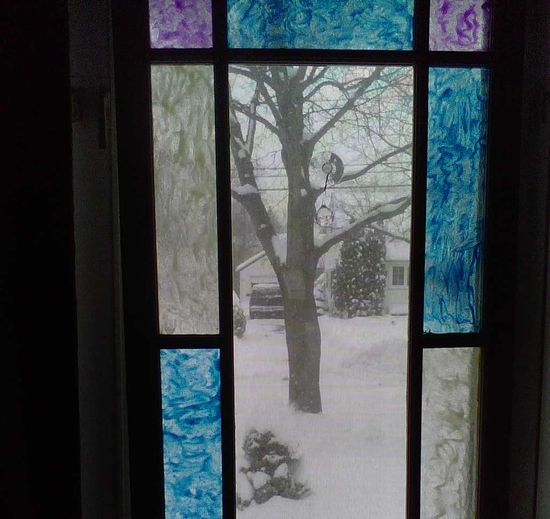
Rochester, New York, 12 pm
Rochester, New York, 12 pm
by Zoë Pollock
Catherine Lacey uncovers the perfect holiday sentiment, from a letter Rilke wrote to Rodin:
I have often asked myself whether those days on which we are forced to be indolent are not just the ones we pass in profoundest activity? Whether all our doing, when it comes later, is not only the last reverberation of a great movement which takes place in us on those days of inaction…
by Zoë Pollock
Jamie Hale reports that drinking eight 8 oz glasses of water a day may not be necessary. The roots of the myth?
[Physician Heinz] Valtin thinks that the notion may have started in 1945 when the Food and Nutrition Board of the National Research Council recommended approximately “1 milliliter of water for each calorie of food,” which would amount to roughly 2 to 2.5 quarts per day (64 to 80 ounces).
In its next sentence the board stated, “[M]ost of this quantity is contained in prepared foods.” But that last sentence seems to have been missed, so that the recommendation was erroneously interpreted as how much water a person should drink each day.
Andrew Haynes offers some nice cocktail conversation fodder for the holidays:
[The reindeer] goes to great lengths to search out the hallucinogenic fly agaric mushroom (Amanita muscaria) — the one with the white-spotted red cap that garden gnomes like to sit on. Eating the toadstool makes reindeer behave in a drunken fashion, running about aimlessly and making strange noises. Head-twitching is also common.
Fly agaric is found across the northern hemisphere and has long been used by mankind for its psychotropic properties. But its use can be dangerous because it also contains toxic substances. Reindeer seem to metabolise these toxic elements without harm, while the main psychoactive constituents remain unmetabolised and are excreted in the urine. Reindeer herders in Europe and Asia long ago learnt to collect the reindeer urine for use as a comparatively safe source of the hallucinogen.
(Hat tip: David Pescovitz)
Joe MacLeod wishes you the best on The Holidays:
It is The Holidays! If you are Sick, please Get Well. If you are Sad, please get Happy. They sell it in bottles all over the place! If you are Unemployed, I hope in this order: 1.) You get a Job, 2.) You can collect on those extended Unemployment Benefits, because wow, there sure were some Serious and True Anti-The Holidays em-effers out there who were Scroogin’ it up big time, all year long, and they are even some of the type of people who would “Merry-Christmas-In-The-War-On-Christmas-So-Get-It-Right-It-Is-The-CHRISTmas-I-Am-Wishing-On-You” to you, right to your underemployed face, while they are still bitching about the Taxes, you know? This is like, the one Time of Year when people make an effort to be positive and Of Good Cheer, and there’s these goddamn “War on Christmas” Grinches who get all prickly if you say “The Holidays” and not their Jesus one. YOU ARE TAKING A POSITIVE TIME OF YEAR AND BEING ALL “THE PARTY OF HELL NO” TO IT. Quit it! Ultimately to them I still say a Happy The Holidays, Jesus Christmas, whatever floats their goddamn boat to the Party of Tea, but they need to get in touch with being Human Beings and the teachings of Jesus The Chris. In Theory. Anyway.
by Zoë Pollock
Liz Coleville weighs in on why it's usually not men:
[T]he study also found that women and men see cooking in profoundly different terms: most women see it as a "sensual" act—something that "gives pleasure," whereas men see it as "a performance and an activity at which they can impress." Sounds familiar. See: other activities, other rooms.
by Zoë Pollock
Bill Gibron reviews the holiday's most bizarre film:
Rare Exports is the best unholy Christmas creation ever. … It’s the perfect combination of old world superstition and new age satire. Buried in between the torn apart animal carcasses, musty slaughterhouses, homemade wolf traps, and sparse, Spartan living condition is still a child’s vivid imagination – only this time, the visions aren’t of candy and kindness, but of a horned demon with elf-like minions that may or may not resemble anorexic old men. Rare Exports wants to argue that the real meaning of Santa was always as an underage cautionary tale, a coal in the stocking vs. presents by the fire kind of behavioral modification.
by Zoë Pollock
Smithsonian reprints an oldie but goodie about the sordid history of snowmen:
Some of these early postcards show snowmen being bludgeoned by two-by-fours and stomped on by tots. There are examples of snowmen being held up by gunpoint by little girls and stabbed with brooms. At one point, a snowman is dragged into a studio and forced to pose with kittens—while not violent, it was certainly humiliating. …
To add insult to injury, the snowman somehow became a spokesperson for any product of an embarrassing sort, appearing in ads for every personal hygiene problem imaginable: dandruff, gas, hangovers, constipation, and bad breath Add this all up and you have a Frosty with a pretty shaken psyche. We literally built him up only so we could, apparently, knock him down and use him as a piñata. It’s no wonder the snowman turned to booze.
While no one knows for sure when exactly the snowman began smoking a pipe and drinking hard liquor, it may have started as early as 1890…
by Chris Bodenner
Santa celebrates after a long night:

 The Dish