Think Of Old Friends At Midnight

by Conor Friedersdorf

Peggy Noonan sure can write:

"Auld Lang Syne"—the phrase can be translated as "long, long ago," or "old long since," but I like "old times past"—is a song that asks a question, a tender little question that has to do with the nature of being alive, of being a person on a journey in the world. It not only asks, it gives an answer.

It was written, or written down, by Robert Burns, lyric poet and Bard of Scotland. In 1788 he sent a copy of the poem to the Scots Musical Museum, with the words: "The following song, an old song, of the olden times, has never been in print." Burns was interested in the culture of Scotland, and collected old folk tales and poems. He said he got this one "from an old man"—no one knows who—and wrote it down. Being a writer, Burns revised and compressed. He found the phrase auld lang syne "exceedingly expressive" and thought whoever first wrote the poem "heaven inspired." The song spread throughout Scotland, where it was sung to mark the end of the old year, and soon to the English-speaking world, where it's sung to mark the new.

The question it asks is clear: Should those we knew and loved be forgotten and never thought of? Should old times past be forgotten? No, says the song, they shouldn't be. We'll remember those times and those people, we'll toast them now and always, we'll keep them close. "We'll take a cup of kindness yet."

May all Dish readers be raising a glass or kissing someone you love to ring in 2011.

Reality Check

by Patrick Appel

Doing a better job than I did, Kevin Drum explains the composition of the electorate: 

[A]bout 40% of the American population self-IDs as conservative, compared to only 20% who self-ID as liberal. You can argue all day long about what people really mean when they tell pollsters they're conservative, and you can argue all day long that liberals need to do something to change this instead of simply accepting it, but for any politician running for national office in the here and now, this is just the lay of the land. A hardcore conservative with hardcore conservative beliefs can count on a pretty big base of support right from the start, while a hardcore liberal candidate can count on bupkis. Conservative Republicans can win. Liberal Democrats generally can't unless they're running in very liberal congressional districts. If you're looking for a reason why liberal politicians tend to compromise more, you really don't have to look much further than this.

The 2010 Daily Dish Awards

Hewitt-2010

Click the following links to vote for the 2010 Malkin AwardMoore AwardYglesias AwardHewitt Award, Von Hoffmann AwardMental Health Break Of The Year, and Face Of The Year. Also – for the first time -  Chart Of The Year and Hathos Alert are on the ballot. The Shut Up And Sing finalists have likewise been announced; it's now up to you to pick the worst pop song designed to reflect a profound moral conscience. I.e. the smuggest, most pretentious pop song in history.

Among the various contenders for the prizes, a roster of the big names in political and cultural discourse: Sarah Palin, Rush Limbaugh, Kos, Justin Bieber, Bill Donohue, Jim Manzi, Glenn Reynolds, Sean Penn, Bryan Fischer, Keith Olbermann, Bristol Palin And The Situation, Larry Kudlow and … Andrew Sullivan.

We're giving readers a week to pick the winners for these prestigious prizes. The polls will close on the first of the year. You picked many of the entries; we just marshalled the very best/worst for your selection.

Vote early. Vote often.

The Daily Dish Awards Glossary

Click here to vote for the 2010 Malkin Award!

Click here to vote for the 2010 Yglesias Award!

Click here to vote for the 2010 Moore Award!

Click here to vote for the 2010 Chart Of The Year!

Click here to vote for the 2010 Hewitt Award!

Click here to vote for the 2010 Face Of The Year!

Click here to vote for the 2010 Von Hoffmann Award!

Click here to vote for the 2010 Hathos Alert!

Click here to vote for the Pretentious Pop Song In History!

Click here to vote for the 2010 Mental Health Break Of The Year!

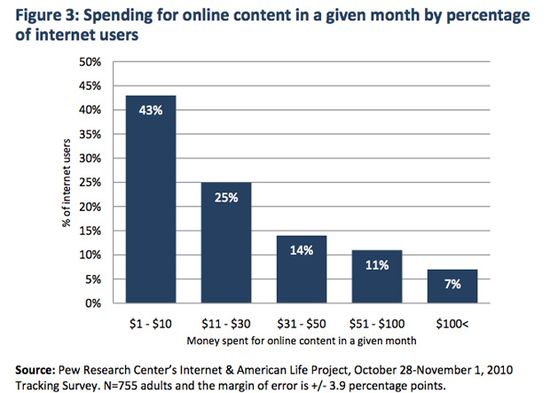
Chart Of The Day

Pew

by Zoë Pollock

Austin Carr looks at the bright side of Thursday's Pew Report (pdf):

Though figures are still low and users too frugal, the rate of consumer purchases is growing remarkably fast. It's been nine years since the iPod's release, and already music downloads have shot up to the most popular user purchase. In just three years since the Kindle came out, e-books have stretched to 10% of users and ballooned to a billion-dollar market. And in only two years since Apple's app store went live, smartphone and tablet apps are now purchased by a fifth of all Internet users.

The 2011 Disconnect

by Zoë Pollock

Robert Reich offers up some grim New Year's predictions:

The Dow Jones Industrial Average is rising because of foreign sales. General Motors is now making more cars in China than in the US, and two-thirds of its total sales are coming from abroad. When it went public last month it boasted that soon almost half its cars will be made around the world where labor is less than $15 an hour. …

Corporate America is in a V-shaped recovery. That's great news for investors and everyone whose savings are mainly in stocks and bonds. It's also great news for executives and Wall Street traders, whose pay is linked to stock prices. All can expect a banner 2011.

But most American workers are trapped in an L-shaped recovery. That's bad news for the Main Streets and small businesses in 2011. It's also a bad omen for home prices and sales, and everyone whose savings are mainly in their homes.

Is Housing Still Falling?

by Patrick Appel

Ryan Avent counters Gary Schilling:

Dynamics in housing markets aren't supportive of strong growth. But neither are they worsening. Defaults may have peaked. Total REO inventory is high, but it has been higher. It's easy to imagine continued collapse in some local markets, where supply and demand remain very out of whack. But it's more difficult to see where a national crash might originate.

Fish For Fertility, Beans For Money

by Zoë Pollock

Annette Foglino rounds up the luckiest foods for the New Year:

[O]ur Congressional slang “pork barrel” echoes a time when Americans stored salted pork in wooden barrels and the amount of meat indicated the state of the family’s circumstances. In folklore the pig is considered an animal of progress because it moves forward while rooting around for food. Chickens and turkeys scratch backward and are believed by some people to represent setbacks and struggle in the coming year, making them an unpopular choice for a New Year’s Day dinner.


Question Of The Week: “Ziggy Stardust and the Spiders from Mars”

by Conor Friedersdorf

A reader writes:

I was surprised to realize this at first, but the concert film Ziggy Stardust and the Spiders from Mars was definitely the most important single media experience for me. I was raised by very socially liberal parents who were all about being an individual and acknowledging and embracing diversity in many senses, and I went to a school that was much the same way. I had thought I understood that idea pretty well.  But the fact is that while the rhetoric was expansive and the intentions very good, the people I was around and the world I lived in consisted of a pretty clearly defined box. My peers and I were meant to grow up to be successful professionals who were socially liberal and infinitely accepting of others, but fairly conservative in behavior and identification.

Against this backdrop, the effect Ziggy had on me was the real, visceral, stunning realization that different people really are different in more ways that I had ever imagined, and that there were so many more dimensions of "difference" than I had thought. It turned the whole concept of "we are all the same inside" on its head – to greater positive effect, for me. The experience allowed me to consider diversity in people without the political edge of Diversity that I was being educated about in school (and don't get me wrong – I'm still very glad I got that education). It also introduced me to the idea of actively constructing an identity on the outside as well as the inside–the ways in which managing one's appearance can be a form of true self-expression. Finally, it helped me realize that creating an identity doesn't need to be a massive undertaking of permanence – carefully assembling components that must never change (so you must be very, very sure about everything you choose to become) over the course of a lifetime; rather, it can be more like an artistic or academic career. You build something, enjoy it, live in it for a while, and move on. There's a through-line, but not an edifice.

Similarly, though I didn't realize it at the time, this revelation about how much I not only liked, but identified "different" people or ways of being and presenting oneself – though I couldn't have articulated that at the time – was huge. While my parents are wonderful, loving, intelligent, and progressive people, they live in a very specific world, and as their only child I could all too easily have grown up as their caricature. I think Ziggy Stardust did a great deal to help open the door to another path. The person I might have grown up to be today would not have a tattoo, would not have the same interests and ambitions, and would be a hell of a lot snobbier. She would not be comfortable with the slightly fluid aspects of her gender identity. She would probably have been horrified at the summer I spent in Damascus getting all kinds of dirty and making some risky choices – the best summer of my life – and she would certainly be less kind to herself.