Gridlock Ahead

by Patrick Appel

Weigel rejects the notion that Democrats' lame duck victories foreshadow a bipartisan 112th congress:

Anyone who thinks the Democratic wins of the lame duck bode well for future wins is not paying attention. The reason Democrats are able to pass START, DADT, etc in the lame duck is that they are not particularly controversial bills. They are all popular, and they would have passed in September if Democrats had managed time better. The agenda shifts on a dime when the new Congress comes in.

Parlez-Vous Français? Ctd

by Conor Friedersdorf

A reader writes:

Studying European languages teaches us about Europe, about the West, about the languages of the West – about ourselves.  This isn't chauvinism, or at least, it doesn't have to be – rather, it is merely venturing into new fields that, nevertheless, share our cultural substratum.  We can put down roots more quickly there… Cross-cultural communication is an important goal of language study, but it isn't the only one.  There are reasons other than strict, direct utility for learning a language.

Says another:

French is not just the language of France and Belgium (and maybe when you think about it, Quebec). It was the language of the ruling classes of England for centuries. Much of the writing of the thinkers of the Enlightenment wrote in French (or German, sometimes English). It was in France–reading those French works, even meeting some of the writers and conversing with them–that Thomas Jefferson and Ben Franklin developed and refined the political beliefs that led them to become founding fathers of our country. Today French is the lingua franca of much of Africa and the Caribbean. It will even get you further in the Eastern Bloc and parts of the Middle East than English.

Which isn't to say French is booming, or even really that global anymore. But it used to be, and anyone who wants to fully understand our history and the texts that shaped Western Civilization needs to know how to read it.

I must concede that this reader is correct:

People learn French because it is beautiful.  This is sufficient purpose.

Here's another one:

Depending on what you do for a living, French is still important because of its widespread use as a lingua franca in Asia and Africa. Even though the number of speakers is quite low—and, indeed, it's shocking to find out how low the number of native French speakers in African countries where French is the sole official language—it's an auxiliary language along the same lines as English: People may not speak it at home, they may not go to it when they watch movies, but they use it at work and they use it for news. (The Dutch excel at English, but they still watch their crappy locally produced sitcoms in droves when they're off the clock.) French, English, Spanish and Portuguese don't have the numbers but they do have a reach that Chinese and Russian simply don't. And, believe me, the Russians tried. A lot.

Unlike Chinese, French, English, Spanish and Portuguese also use the Roman alphabet which makes their widespread adoption MUCH simpler for a variety of reasons, not least of all because virtually all sub-Saharan African languages and a good number of Asian languages (e.g., Hmong) have adopted versions of the Roman alphabet for their native orthography. And, again unlike Chinese, the big Western languages are neither tonal nor have many tricky phonemes, meaning
pronunciation is often considerably more forgiving.
Dissent Of The Day

by Conor Friedersdorf

A reader writes:

I for one have heard more '12 speculation in the last month than I would care to read in the whole of the year 2012. How can we criticize politicians for stalling, pushing small political advantages and hyping the next election (when their party will make gains again), when that's half of what's getting talked about on the Dish right now?

Is it just so much easier and more fun to shoot the shit about 2012 possibilities? By doing this, are we effectively telling our political leaders that we care more about winning and losing than about actual government?

Towards A Sane Immigration Policy

by Patrick Appel

In the wake of the DREAM Act's failure, David Frum advocates for more high-skilled immigration:

If we chose our immigrants differently, immigration would upgrade the average skill level of the U.S. population. (As is, 31% of immigrants have not completed high school.) If we chose our immigrants differently, they could contribute more in taxes than they require in benefits. (As is, immigrants are 50% more likely to be poor than the native-born.)

Back in the 1950s and 1960s, immigrants arrived with higher skills and soon gained higher incomes than the native born. That's how immigration still works in Canada and Australia. Their immigration systems are race-neutral and favor prospective immigrants who arrive with language skills, advanced degrees or capital to invest.


Venturing Into Pakistan

by Conor Friedersdorf

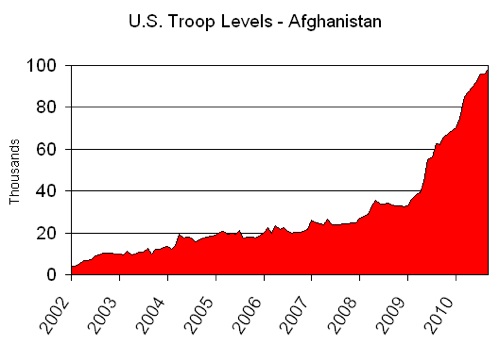
Afghan chart
David Boaz passes along that chart, and remarks upon it:

Now it’s true that when candidate Barack Obama vowed, “I will bring this war to an end in 2009,” he was talking about Iraq. In July 2008 he suggested that he would send two more brigades — about 8000 troops — to Afghanistan. He has far exceeded that, and we can only wonder whether the voters who responded to his antiwar message anticipated that he would increase the number of troops in Afghanistan by almost as much as he reduced the number in Iraq.

What troubles me aren't troop levels inside Afghanistan so much as the expansion of the war beyond its borders:

Senior American military commanders in Afghanistan are pushing for an expanded campaign of Special Operations ground raids across the border into Pakistan’s tribal areas, a risky strategy reflecting the growing frustration with Pakistan’s efforts to root out militants there. The proposal, described by American officials in Washington and Afghanistan, would escalate military activities inside Pakistan, where the movement of American forces has been largely prohibited because of fears of provoking a backlash.

The plan has not yet been approved, but military and political leaders say a renewed sense of urgency has taken hold, as the deadline approaches for the Obama administration to begin withdrawing its forces from Afghanistan. Even with the risks, military commanders say that using American Special Operations troops could bring an intelligence windfall, if militants were captured, brought back across the border into Afghanistan and interrogated. The Americans are known to have made no more than a handful of forays across the border into Pakistan, in operations that have infuriated Pakistani officials. Now, American military officers appear confident that a shift in policy could allow for more routine incursions.

Desperate for an unlikely triumph in Afghanistan, we're risking the catastrophic destabilization of its nuclear neighbor, and likely adding to the chance that we'll be attacked by Pakistani terrorists. And Congress has nothing to say about this because they've meekly ceded their war powers to the executive branch.

Why Not Call The ACA “Obamacare”? Ctd

by Patrick Appel

Steve Benen weighs in:

I'd say Republicans started using "Obamacare" as some kind of slur as a way of undermining the president's standing. They knew they could help tear down support for health care reform, but by attaching the president's name to it, maybe they could help tear him down, too. Remember, fairly early on in the process, Sen. Jim DeMint (R-S.C.) declared, "If we're able to stop Obama on this, it will be his Waterloo."

But in time, use of the phrase evolved. The point wasn't just about the president, per se, but about convincing the public that the initiative was what Republicans said it was: a top-down, government imposed scheme. "Obamacare" is necessarily loaded to convey an idea — that policymakers were replacing a dysfunctional mess with one in which Americans would receive their care from the president, or at a minimum, through a process the president directs.

Dish reader e-mails, which made some of the same points, here.


Turning Out The Gay Vote

by Patrick Appel

Mark Thompson argues that gay rights issues should help politicians who support them. This makes sense to me:

[T]he notion that gay rights are issues that tend to help Democrats more than Republicans should be intuitively true.  By and large, civil rights for gays have no conceivable adverse effects on anyone, no matter what the Maggie Gallaghers of the world claim.  But the lack of equal civil rights for gays has an obvious, direct, and appalling effect on a specific element of the electorate.  People, whatever their political worldview, show up to vote primarily because of things that they care about, things that they think will directly affect them.  In the case of gay rights, that means 3-4 percent of the electorate, and (to a lesser extent) the close friends and families thereof.  Even amongst social conservatives, few are going to be so consumed by their hatred of civil rights for gays as to make it the primary or decisive factor in their showing up to the polls to pull the lever for the guy with the (R) next to his name.

Knowing someone who is gay increases support for gay rights. As the closet disappears, the friends and family effect Thompson talks about will only grow stronger. 

Willful Ignorance

by Patrick Appel

Ta-Nehisi contemplates Haley Barbour's memory of the 1960s:

Short of a desire to not know, there is no excuse to proceed into the 21st century in this blind matter. This morning I was listening to James McPherson on the radio. He very casually noted that at the outset of the Civil War, some 60 percent of South Carolina's population was enslaved. A century and a half later, there are still those who would raise a glass and dance to this. And there are others who would so very much just like to not know.

The War On Santa

by Patrick Appel

Chait posits that Christian traditionalists can't have it both ways on Christmas:

The problem is that religious/cultural conservatives want two things changed about the way our culture observes Christmas. They want the holiday to be more religious ("Jesus is the reason for the season") and they want it to be observed more universally ("Christmas is our national holiday.") You can't do both. 

… if you want Christmas to be totally pervasive, as many Christians desire, as opposed to merely almost-totally-pervasive, then its religiosity needs to be underplayed. Or if you want to return it to its role as a holiday about Jesus, then it has to be something other than "our national holiday."