Could We Punish Those Who Wrongly Classify?

by Conor Friedersdorf

Glenn Greenwald is rightfully upset by the fact that the United States is guarding official secrets ever more closely, even as it pries into the lives of its citizens in unprecedented ways:

That's the mindset of the U.S. Government:  everything it does of any significance can and should be shielded from public view; anyone who shines light on what it does is an Enemy who must be destroyed; but nothing you do should be beyond its monitoring and storing eyes.  And what's most remarkable about this — though, given the full-scale bipartisan consensus over it, not surprising — is how eagerly submissive much of the citizenry is to this imbalance…

But the imbalance has become so extreme — the Government now watches much of the citizenry behind a fully opaque one-way mirror — that the dangers should be obvious.  And this is all supposed to be the other way around:  it's government officials who are supposed to operate out in the open, while ordinary citizens are entitled to privacy.  Yet we've reversed that dynamic almost completely.

One thing I'd like to see going forward is for government officials to be punished whenever it is discovered that they improperly classified documents when doing so wasn't appropriate. As it stands, the incentive is to just label everything as a state secret. But if doing so costs people their jobs, or forced them to pay hefty fines, or in extreme cases resulted in their being jailed, suddenly the harmful act of making secret government behavior that citizens are entitled to know about would occur a lot less frequently.

Even better would be if all classified documents were subject to randomized review by a panel of judges so that perpetrators of secrecy abuse would always need to fear that they might be caught. Perhaps I am missing some problem with what I'm proposing? Call it a tentative suggestion pending reader comments.

Chart Of The Day

Working_families
by Patrick Appel

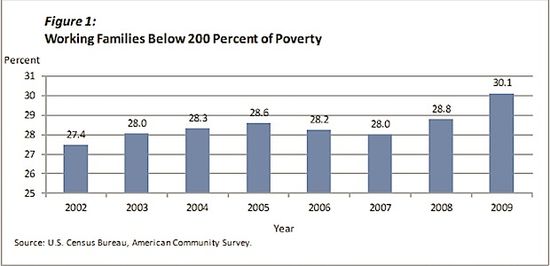
Via Felix Salmon, who puts the bar graph in context:

The baseline here — 200% of the poverty level — might sound high enough to be comfortable, but it isn’t: we’re talking a total household income of $36,620 for a family of three, or $44,100 for a family of four. … If the unemployment problem risks becoming politically invisible, then the plight of the working poor was never visible in the first place. 

Megan takes issue with the Y axis of the chart beginning at 25. But the fact that working families below 200 percent of poverty haven't increased all that much in recent years enforces Salmon's point about the invisibility of the working poor.

The Atlantic Archives: Juxtapositions

by Conor Friedersdorf

In Cornelia Comer's 1911 piece, "A Letter to the Rising Generation," the reader is commended to seek out “a certain volume of memoir that gives a picture of New England life in the first half of the nineteenth century.” It tells of a “delightful lady” who is plain-living, high-thinking, and purposeful in going about her day:

Before the age of twenty she had read ‘all the authors on metaphysics and ethics that were best known, and throughout life she kept eagerly in touch with the thought of the day. this did not interfere with her domestic concerns, as they did not narrow her social life. If she arose at 4 A.M. to sweep the parlors, calling the domestics and the family at six, it was that she might find some time for reading during the morning, and for entertaining her friends in the evening, as she habitually did some three times a week. She managed a large house and a large family, and her wit, cultivation, and energy enriched life for everybody who knew her. She had no higher aim than to light and warm the neighborhood where God had placed her. She and her sisters had never dreamed of a life of ease, or of freedom from care, as anything to be desired. On the contrary, they gloried in responsibility… with all the intensity of simple and healthy natures.

That day is gone, not to return, but its informing spirit can be recaptured and applied to other conditions as a solvent. If that were done, I think the Golden Age might come again, even here and now.

Almost a century later, Caitlin Flanagan wrote an essay that proves an interesting companion piece:


De-cluttering a household is a task that appeals strongly to today's professional-class woman. It's different from actual housework, because it doesn't have to be done every day; in fact, if the systems one implements are truly first-rate, they may stay in place for years. More appealing, the work requires a series of executive-level decisions. Scrubbing the toilet bowl is a bit of nastiness that can be fobbed off on anyone poor and luckless enough to qualify for no better employment; but only the woman of the house can determine which finger paintings ought to be saved for posterity, which expensive possessions ought to be jettisoned in the name of sleekness and efficiency.

A generation ago peaceful cohabitation with a certain amount of clutter was possible, because so many other aspects of home life were ordered and regular. Perhaps only those of us old enough to have grown up in houses in which the old ways were observed—in which dinner was eaten in the dining room, and care was taken not to track dirt on good carpets, and wet towels were not left to sour—know what is missing from so many homes today. The current upper-middle-class practice of outsourcing even the most intimate tasks may free up valuable time for an important deposition, but it by no means raises the caliber of one's home life. My children attend a rather soigné Los Angeles preschool whose élan was recently jeopardized by a recent outbreak of head lice. Parents were given brochures from a service that takes care of the problem in one's home. This seemed a more attractive prospect than spending a morning combing for nits. But on reflection, having someone come to my home to delouse my children seemed perilously close to having someone (presumably not the same person) come in and service my husband on nights when I'd rather put on my flannel nightie and watch Dateline NBC…

What's missing from so many affluent American households is the one thing you can't buy—the presence of someone who cares deeply and principally about that home and the people who live in it; who is willing to spend a significant portion of each day thinking about what those people are going to eat and what clothes they will need for which occasions; who knows when it's time to turn the mattresses and when the baby needs to be taken out for a bit of fresh air and sunshine. Because I have no desire to be burned in effigy by the National Organization for Women, I am impelled to say that this is work Mom or Dad could do, but in my experience women seem more willing to do it.


That I quote these essays doesn't imply any opinion whatever on my part about the merits of their arguments. What I do wish is that I could eavesdrop on a conversation between Comer and Flanagan.

Face Of The Day

Train_Station_Ben Stansall_Getty_Image
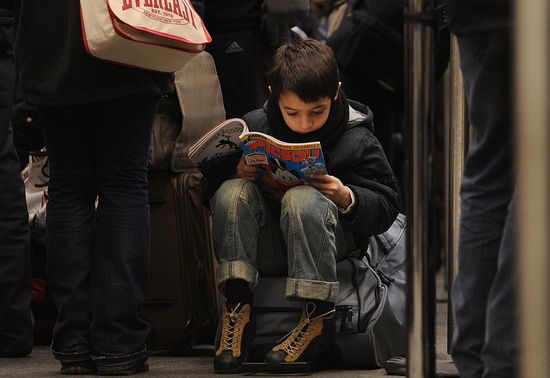
A young traveller reads a French comic (Picsou) as he sits in a queue at the Eurostar train terminal, at St Pancras International station in London, on December 21, 2010. Thousands of angry travellers forced to sleep in airports and train stations across Europe faced more misery Tuesday as fresh snowfalls paralysed transport systems just days before Christmas. London Heathrow, Europe's busiest airport, was only operating about a third of its normal schedule during a fourth day of disruption, while Frankfurt halted all flights after a new blanketing of snow. By Ben Stansall/AFP/Getty Images.

Anonymity And Urban Life, Ctd

A series of reader reactions:

Even taking ancient examples aside, from where does this idea that the city is the place of anonymity rather than the rural country come? I've lived in both rural and urban areas, and it seems to me that, no matter how hard you try to get away from people in the city, you are always reminded of their existence. You can never be fully anonymous, because you always run the risk of running into somebody you know. The photograph is only gives documented proof for the Gossip Girl to work her magic. Otherwise, she would just slowly spread rumors among your personal community.

The hermit in the city is an illusion and a fantasy. In a city, you are interdependent with your fellow citizens. The rural space allows for a household, removed from the cares and concerns of your "neighbors" who could be miles away from you. By living in the country, you can "unplug" from the wider community, if you so choose. The Internet, in this case, is like an enormous city.  The illusory comfort of anonymity you point to in the early Internet Age is the very same illusion that has lead some people to think that they could possibly be anonymous in the city. The only way to remain nameless is to unplug entirely.

Another:

The key is social norms. Small town social norms tend to reinforce knowing what your neighbors are doing – the Internet simply gives people already following established social norms additional avenues through which to discover details about (most being self-divulged) people they already know. On the other hand, city dwellers – who often know few of their closest neighbors – have little incentive to searching out the personal information of those around them. Besides things like sex offender registries, it's hard to imaging neighbors combing the Internet for information about one another in a major metropolitan area. In fact, it is unlikely that they would even know a name to search for without getting it at random off a mailbox.

So, in short – it's all about social norms. The Internet itself is not the factor since access isn't restricted enough to impact the urban disproportionately. People are likely to continue to behave in accepted normative patterns – so if that means getting into your neighbor's business, that's what people will do – and utilize the facilitatory power of social networks, public records, etc. If, on the other hand, the social norm is live-and-let-live, the likelihood that the Internet would change that is unlikely.

I agree that social norms are ultimately as important as the technology available to us – but it seems to me that norms about privacy and anonymity are changing very rapidly, both online and off.

Three more below the fold:

For me, the question isn't whether the internet has ended the anonymity of city life, but whether the internet has altered the meaning of anonymity itself. With facebook ("look at me!"), and twitter ("hear me think!"), and foursquare ("here I am!"), and all our new ways of seeing and speaking and interacting, we also now have a radically altered ability of creating a persona, or more likely, multiple personas, which will be broadcast whether we wish it or not, out into the stream of our lives.

How we craft those masks, or how we choose not to, is a massive experiment that has only just begun in earnest. That I may be less able to be a random stranger on the street (in a bar, at a club, buying sex toys, having an affair, smoking weed) without my grandmother finding out, is only a small part of the equation. And yes, it is still remarkably possible to remain anonymous in the city should you choose–it is just now an active, rather than a passive choice. Now, one must decide who they imagine themselves to be when they are online, versus elsewhere, and how the juxtaposition of those personae will affect themselves, and others.

To be anonymous in the internet age isn't to be a shadowy grey-suited figure on the corner of Broadway in a Dashiell Hammett story; it is to be untrappable by the confining definitions that others put on you, and instead to shape an illusion you may control of what they see–or what they don't. I know longer know quite what anonymity means in a world where I might see anyone, chat with anyone, but still not actually know who they are. In some ways, online activity provides an experience more akin to celebrity than to small town exposure: everyone knows of you, but very few know you. And no one knows for certain (pace, Andy Kaufman) who on earth you really are.

Yet another:

Besides my academic work, I also tend bar one night a week (in a saloon in the same neighborhood . . . ).  A year or so ago, this young 20-something woman was being very nosy: What's your name, do you own the bar, is this your only job, really grilling me.  I kept dodging, not giving straight answers, and her date (somewhat older, maybe 35) kept giving me this sympathetic "Sorry, man," look.  Finally, I told her that my other job was working on a website dedicated to maintaining your private life in the Internet Era.  She squealed that this was So Cool! and asked me for the URL.  I told her it was private and she couldn't have it.  She didn't understand, but her date did, and I wandered off to the other end of the bar with some of my anonymity intact.

And last but not least:

I live in Pittsburgh, the ultimate "big small town." It's large enough to have good cultural life, sports teams, and opportunities, but it's not so big that it's impersonal.  On top of that, people tend to either leave Pittsburgh or stay forever.  True anonymity is difficult once you've lived and worked here for a while. I'm constantly running into former co-workers, old neighbors, fellow professional society members, ex-classmates, etc.  New job?  One co-worker coached my son's kindergarten soccer team, another worked with my dad back in the day.  My kid joins a sports team?  The coach knows my mom because both work at the same hospital.  New neighbors?  One was my sister's friend in elementary school.  And so on.  Nobody in my family holds a high-status job or is particularly well-connected, either.  We've just been around long enough to develop a dense web of social connections.    

I actually like this.  It makes me feel as if I'm a member of a community, not a lone, anonymous, replaceable resident.  The local culture fosters making connections with other people.  Non-Pittsburghers often comment about how friendly and polite the natives are, and I think this sense of interconnection has a lot to do with it.   There's undoubtably self-selection going on as well.  People who enjoy being impolitely anonymous may simply move elsewhere!  Same goes for those who want to reinvent themselves and make a clean break with their past.

Social media is turning the world into Pittsburgh.  It's allowed people to build and maintain the sort of connections that Pittsburghers get from living in a small city for a long time.  Sure, digital connections may not be as strong as the face-to-face variety, but they seem to be as dense and interlocking.  I think it's good for people to maintain positive ties with people from their past.   The big difference is that you it's harder to leave town because your digital reputation lingers forever.  Your past is not really past on the Internet.  Turn around, and it's there grinning at you in all its digital glory, asking you to Friend it or follow it on Twitter.  It can help you get a job, or cause you to lose one.  This persistence is what bothers me about the online social world.  In real life, people tend to forget or gloss over the embarrassing details.  On the Internet, they don't.  

Anonymity and privacy now have to be internalized.  I belong to online communities and use Facebook, but I hold social media at arm's length and do not post a tremendous amount of personal information there.   I also try not to pry into my neighbors' private lives (digital or otherwise) but sometimes I can't avoid finding out Too Much Information.
Why The Anti-START Campaign Matters

by Patrick Appel

Contra Bernstein, Larison argues that Republican resistance to START is highly unusual:

A distinction needs to be made between Senate Republicans, who have typically supported Republican Presidents’ arms control treaties in the past and have now gone into opposition, and conservative activists and hard-line former officials who are opposed to arms control as such (e.g., John Bolton, Richard Perle, etc.). There was opposition to the treaties negotiated by Reagan and Bush from conservative activists and lower-level officials, but the difference this time is that those lower-level former officials are now treated as authorities by Senate Republicans when they were previously overruled or dismissed. 

Read the whole thing.

Paying The Experienced Hand Less

by Patrick Appel

Dan Ariely talks to a locksmith:

He was tipped better when he was an apprentice and it took him longer to pick a lock, even though he would oftentimes break the lock! Now that it takes him only a moment, his customers complain that he is overcharging and they don’t tip him. What this tells is that consumers don’t value goods and services solely by their utility, benefit from the service, but also a sense of fairness relating to how much effort was exerted.

Another Reason To Hate Airport Malls

by Patrick Appel

Clive Irving calls Heathrow, which has experienced massive travel delays due to bad weather, "the perfect choke point to cripple the world’s air traffic." He gives some background on how the airport became "a shopper’s honey trap." And explains how "management of British airports was privatized and turned over to a company called the British Airports Authority." Irving blames Ferrovial, the owner of British Airports Authority, for caring more about shopping than flying:

While Ferrovial was loading up the Heathrow stores with all their Christmas goodies it hadn’t bothered to check whether it had enough plows to deal with two runways if, by chance, it happened to snow. Or enough de-icing fluid to get the airplanes out of the gates. Or anything else fundamental to fitness of mission. The cost of that negligence is almost incalculable.