“Butt Drag” Ctd

by Conor Friedersdorf

The story: a high school boy uses a move wrestling coaches taught him, and is charged with sexual battery.

Here's how The Advocate describes it:

Preston Hill, a Buchanan High School student from Clovis, Calif., was punished for his use of the "butt drag," in which a wrestler grabs his opponent's butt cheeks and places his finger in the opponent's anus for leverage, according to the Fresno Bee. Hill's trial before the Fresno County Superior Court begins Thursday.  Hill's father said coaches taught his son the "butt drag" when he was in middle school and that it was a common move.

The Dish linked the NYT account before without comment.

YouTube videos like this one persuade me that the "butt drag" is indeed a widely known and officially sanctioned move. I'm uninterested in commenting directly on the case against Preston Hill; I have no idea what actually happened. But it spurred me to ponder this truth: athletes from the high school level right on up engage in behavior inside locker rooms and on the field or court or rink – or hell, even among friends – that would be prosecuted vociferously if they happened in a different context.

I think back to high school. One guy on the football team was known for quietly creeping behind other guys sitting on the long wooden benches in the locker room and dangling his penis over their shoulders, provoking all sorts of laughter as the object of the prank slowly noticed what was going on. In college, I once visited a friend at another school, where it was common for guys to say to someone else, "Oh man, my watch is broken." You'd naturally glance down, where that very same body part would be stretched over their wrist in what they called a fleshy band. The fraternity guys found this to be hilarious.

As someone who groaned good naturedly upon being unwittingly shown "the broken watch," I can confidently say both that being tricked to look upon it isn't exactly pleasant, and that I'd hate for a guy enamored of the prank to be charged with indecent exposure and placed on  a sex offender resgistry for having done it at age 20 or 21. The tricky thing about this sort of humor is that it can get much more serious. High school friends told me about hazing they witnessed during college that ought to be against the law and prosecuted. Pomona College once expelled a fraternity from campus for the predictable acts with a sheep.

Folks who don't play sports are presumably ignorant about what goes on underwater during water polo games, the pranks played in football locker rooms, the fact that male soccer players in competitive leagues inevitably get their testicles grabbed, or the truth that collegiate runners tend at one time or another to streak through campus or around the track. As a high school tennis player and a college participant only in intramural inner-tube water polo, I was somewhat removed from this culture. So I'll confine my remarks to these observations: this stuff is common in every high school and college campus in America; and whether or not they begin to be prosecuted as crimes, I'd prefer, as a future parent, that participating kids aren't tried as sex offenders and placed on registries intended to warn us about very different sorts of proclivities, even if the more serious transgressions are sanctioned.

Anything Obama Supports = Bad, Ctd

by Patrick Appel

Jonathan Bernstein defends Republican Senators:

I see no reason to attribute conservative opposition to New START to anything other than conservative opposition to all treaties.

But Republicans don't oppose all treaties. From yesterday's NYT:

The down-to-the-wire suspense is unusual in the annals of arms control votes in the Senate. Most such treaties that reached the floor won by overwhelming margins if not unanimously. The rare arms control treaties to fail were generally never brought to a vote, with one exception being the Comprehensive Nuclear Test-Ban Treaty, which Mr. Kyl helped defeat in 1999.

Larison is worth reading on this question.

Interview With A Conscientious Objector

by Conor Friedersdorf

It's up now at Slate. Here's the introduction:

After the terrorist attacks of Sept. 11, 2001, a 13-year-old kid named Josh Stieber vowed that as soon as he was old enough, he would join the military. His goal: to help protect his country and spread its values of freedom and democracy around the world. With the war still on when he graduated from high school, Stieber enlisted in 2006 and was deployed to Baghdad in 2007. A devout Christian and a staunch political conservative, Stieber became troubled by the gap between the values he was told the military embodied and those he experienced on the ground. Partway through his deployment, he realized that his perspective had changed so drastically that he would rather go to prison than remain in the military. Instead, he learned about, applied for, and obtained Conscientious Objector status.

I'd be particularly interested to hear what our military readers think of the piece and its characterizations.


Could Newt Win?

by Patrick Appel

Bernstein mirrors my thinking on the subject:

Newt Gingrich as someone with a chance to win the nomination?  As a presidential candidate, he's basically Sarah Palin without the enthusiastic supporters … He's probably, as Dinauer says, just scamming as usual.  It's also possible he's deluded himself into believing he's a serious candidate for the nomination.  Either way, there's no reason the rest of us should share the pretense.

Joyner is still betting on Romney.

Anonymity And Urban Life, Ctd

by Conor Friedersdorf

One common response to my inquiry – Does the Internet age portend the end of cities as a place where anonymity is an option?is that lots of people go through life offline, and that people can choose to avoid tools like Facebook and Twitter. Though there is truth in both of these criticisms, I'd like to challenge them, though I concede that anonymity can be preserved by someone who takes extraordinary measures to do so.

For the rest of us, a few examples that better get at the near future I envision:

– Over the Thanksgiving Holiday, I met a guy in his early thirties who was one of the few people in his friend group who wasn't on Facebook. Initially, this merely meant that his presence on the site was limited to being tagged in photographs taken at group dinners or during flag football games or other gatherings. Eventually, his friends created a Facebook page on his behalf. I am not sure whether this is because they tired of having to contact him separately to facilitate party invitations or to rope him in on conversations, or it was due to a simple rebellion against his eccentricty. Perhaps he could have the page removed if he wishes. In any case, he faces substantial social pressure to be on Facebook, and even if he continues to opt out, his photographs and references to him will continue to appear on the site, sometimes publicly.

– Some readers may be aware of Hollaback!, a movement that encourages women to take pictures of men who harass them on the street:

Street harassment is one of the most pervasive forms of gender-based violence and one of the least legislated against. Comments from “You’d look good on me” to groping, flashing and assault are a daily, global reality for women and LGBTQ individuals. But it is rarely reported, and it’s culturally accepted as ‘the price you pay’ for being a woman or for being gay. At Hollaback!, we don’t buy it.

We believe that everyone has a right to feel safe and confident without being objectified. Sexual harassment is a gateway crime that creates a cultural environment that makes gender-based violence OK. There exists a clear legal framework to reproach sexual harassment and abuse in the home and at work, but when it comes to the streets—all bets are off. This gap isn’t because street harassment hurts any less, it’s because there hasn’t been a solution. Until now. The explosion of mobile technology has given us an unprecedented opportunity to end street harassment—and with it, the opportunity to take on one of the final new frontiers for women’s rights around the word.

This is, by my lights, an example of one way that ending or radically decreasing urban anonymity would improve society.

– In California awhile back, a woman was caught cheating on her husband when a red light camera snapped her photograph in a car with another guy and automatically mailed the ticket to the address where the vehicle was registered.

– A reader writes:

The implications of the ubiquity of people’s online virtual identities, and their ready discoverability, is already recognized as a major problem in the witness protection program. It used to be if some mobster testified against his crew, you could give him a new name and social security number and drop him in Hawaii or North Dakota, and that was the end of it. Now, however, people are expected to have these “data trails” that cover their entire life: credit histories, social media accounts, photos, cell phone activities, and so on. Anyone who is, say, 35 and doesn’t have these things stands our like a digital sore thumb. But how are you supposed to create a “past” for this new identity? Major issue. Similar problems apply to creating fake identities for potential undercover operatives, whether domestic or international.

People in witness protection are an extreme case. The everyday corrolary is that when everyone is on Facebook, not being on it begins to seem suspicious. A perfectly upstanding person who merely wants to protect their privacy might avoid social networks with the best of intentions. Then one day they'll meet someone in a bar or at the airport, and exchange phone numbers in hopes of meeting up for a future date. "Or just friend me on Facebook." "Oh, I'm not online." "Really? Nowhere? Why?" "Oh, I just like to guard my privacy." Tell me part of you wouldn't wonder (if you were from a generation and socio-economic subculture where Facebook is as common as it is for these hypothetical people) if something was amiss. The choice to abstain from social networks is nevertheless there. But it grows ever more budernsome as ever fewer people exercise it.

– And perhaps costly. When last in New York City, I wandered into a bar in the Weswt Village that encouraged patrons to check in on Foursquare upon entering. We're not far from the day when discounts are given to people who interact with a brick and mortar business by finding it on Yelp or recommending it on Twitter. The Internet economy is increasingly driven by selling our privacy to middle men who pass it along to marketers.

– Finally, facial recognition seems like the real game-changer. Imagine a New York City politician who wants to run against a war or the construction of a mosque at Ground Zero or some other event that brought people out into the streets to protest. She gathers up a bunch of news photographs and cell phone images posted to Flickr. It's run through software that matches it with other tagged and untagged photos online. The identities of various attendees are determined with a reasonably degree of accuracy. And they're targeted for campaign advertisements, or solicited for donations. (Obviously, darker scenarios can be conjured too – although who needs Big Brother when people check in on Foursquare upon arriving at a riot!)

An Ignorance Test

by Patrick Appel

Scott Adams devises one:

Imagine an objective standard for deciding who is entitled to have an opinion on a topic. All we need is some sort of wiki (user created website) where the basic facts on any debate can be assembled in the form of an ever-evolving multiple choice test. When you find yourself in a debate with someone who hasn't yet passed the test on that topic with a score of 100%, you declare yourself the winner by virtue of being better informed, assuming you scored 100%.

If both of you have taken the test and scored less than 100%, you declare yourselves "not entitled to your opinions" and walk away. If each of you scored 100% then you are, by my definition, entitled to your opinion.

Examples here.

Why Government Waste Can Never Be Fully Eliminated

by Patrick Appel

Last week Will Wilkinson contemplated the inevitability of regulatory capture. Douthat expands on Will's argument:

[T]he welfare state gets “captured” by the teachers who benefit from uncompetitive workplaces, the public-sector unions who benefit from inflated salaries and gold-plated benefits, the doctors and hospitals who benefit when the government subsidizes unnecessary treatment, the pharmaceutical companies who benefit when the government subsidizes their drugs, the lawyers and lobbyists who benefit from the complexities of the estate tax, the mortgage lenders and real estate brokers who benefit from the home-mortgage deduction, and so on and so forth.

Note that none of these groups have turned the programs in question completely away from their intended ends: The public schools still educates America’s children, Medicare still pays for seniors’ health care, California’s prisons still hod inmates and the trains in New York still carry people to work, the estate tax still collects money that can be redistributed to the poor, the home-mortgage deduction still (God help us!) encourages middle-class homebuying. This kind of commonplace “capture” isn’t a pure and obvious betrayal of liberal purposes — it’s just a corruption of the process, a skimming off the top, a layer of interest-group involvement that distorts programs and makes them vastly more expensive without wrecking them entirely. 

The Barbour Of Yazoo City

by Conor Friedersdorf

IS HALEY BARBOUR a racist? In a recent profile he spoke fondly of a group that defended segregation, in the wake of which a loathesome and juvenile quip he made 28 years ago has also been unearthed. Does this mean that he's a racist? I don't know, nor does anyone else, what is in Mr Barbour's heart, and I don't care to speculate.

– J.F. at Democracy in America

I'll punt on the question too. But I've got an observation about race, the conservative movement, and its political fortunes: the strange place we find ourselves is that being accused of racism can actually help a Republican candidate these days. Jonathan Chait gets it: "His past is not racist enough to disqualify him, but it is murky enough to spur the liberal media to raise questions. And thus Barbour will be in the position of being the white conservative attacked by liberals for his alleged racism… it will surely make Republicans rally to Barbour."

How did we get here?

Over the years, social norms in America have shifted such that being labaled a racist is tremensoulsy damaging to one's social standing and career prospects. On the whole, that's a good thing. We ought to abhor racists. But an unintended consequence is that false accusations of racism can be used to cynically accrue power. Compared to actual instances of racism, this sort of thing doesn't occur very often.

There are, however, high profile attempts that grab our attention, perpetrated by people who fake hate crimes or else by hustlers like Mike Nifong. There are also more localized instances that don't make national headlines, but that skewer the impressions of people at a given classroom or office. These are invariably the most read stories on the Web sites of the local newspaper, if it makes the news. Lots of white people fear that they're going to be wrongly labeled racist, and it provokes the same anxiety experienced when people fear, without particular reason to do so, that they're going to be attacked by a shark or have their identity stolen or that they're suffering from the deadly disease they came across on Web M.D. Some of these people are right! But mostly, they're needlessly worried by something that's unlikely but scary because the consequences can destroy life as you know it.

In recent years, conservatives have discovered the power that accrues to race hustlers. How else to explain that Rush Limbaugh makes more false accusations of racism these days than the aged Al Sharpton. Or that Andrew Breitbart labeled an NAACP audience racist based on a short, abridged video clip, even as he claims to find frivolous accusations of racism among the most offensive things imaginable.

Even more problematic is the victim game the right has discovered. It's perfectly appropriate for conservatives to object when their ideological opponents cynically or nonsensically use race as a  cudgel. I've forcefully defended folks when that's happened: here's an example where I spoke up for a Tea Party rally. But I've lately been alarmed by instances when conservative figures, attune to the backlash among the rank and file when folks are accused of racism, seem intent on provoking the charge.

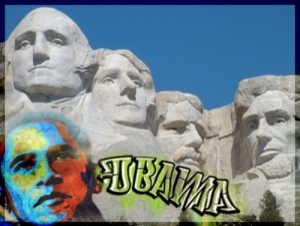
Rush Limbaugh is most guilty of this behavior. He's a tremendously intelligent man. And what does he think is going to happen when he broadcasts a satire about "Barack The Magic Negro" or insists that in Barack Obama's America it's okay to beat up white kids on busses, or when he publishes on his Web site this image:

Mount Rushmore

By now, Rush Limbaugh wants nothing more than for his ideological enemies to accuse him of racism, because it allows him to play the victim. He's not so different from people who fake hate crimes. In both instances, the idea is that by seeming put upon, in fact or reality, a community will rally to your defense, and you'll accruse power or catharsis as a result. Or to return to Haley Barbour, what did he think would happen when he praised a group that favored segregation? Did he miss the whole Trent Lott episode? Was he unaware that the Council of Conservative Citizens is a controversial, obviously racist group? Matt Yglesias demonstrates that Barbour damn well knew exactly what sort of controversy would be stoked.

Listen up, conservatives. People like Rush Limbaugh and Haley Barbour are using you in the worst way. They know that by stoking the right kind of racial controversy, they'll benefit among the hard right audience and GOP primary voters respectively – that being accused of racism by liberals can be a boon so long as you have plausible deniability, and that plenty of folks on the right will rally to your defense. Stop incentivizing them so! Both men are smart enough to avoid these sorts of dustups, which do grave damage to the image of the right, if they wanted to do so. Instead they willfully stoke these racial controversies. And time and again, even perfectly respectable conservative journalists unwittingly act as their tools.

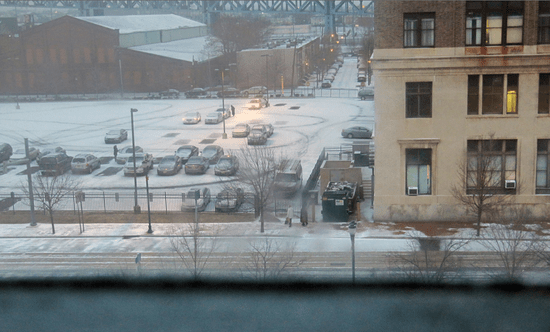
The View From Your Window Contest: Winner #29

Vfyw-contest_12-18

by Chris Bodenner

A reader writes:

The boarded-up factory building and aging steel bridge say either Rust Belt or parts of New England to me, and those tapered tubular steel stop light posts have become very popular in the Northeast in the past few years.  I haven’t been able to pinpoint the that bridge or building via Google maps so I just going to go with my gut and say Harrisburg, PA.

Another writes:

This view is one I’m pretty sure I have seen many times in the past three years.  It is on the rapid line (i.e. the train/rail system) in Cleveland, Ohio.  It could be either the blue or green line, as they both go on the same tracks in the same area.  The gray skies and snow, are of course, an obvious indicator of the Cleveland winter.  The bridge goes over the Cuyahoga river.  I just moved to Chicago about a month ago for more opportunities, both economically and for fun, so this photo made me a little homesick.

Another:

My first try at this. It’s an industrial city in the northeastern US, and it looks like Bethlehem, PA, looking toward part of what’s left of the steel plant we used to call “Beth Steel.”  I grew up in Allentown, in the next city over (to which Billy Joel incorrectly attributed some of Bethlehem’s “iron or coke, chromium steel.”) By the way, the town’s name is pronounced “BETH-lum,” in two syllables.  That’s how you can pick the Pennsylvania natives from the devout out-of-towners.

Another:

Is it a different angle on the recent window view from Lawrence, Massachusetts?

Another:

I found a cool website within a couple of minutes (bridgehunter.com) and was certain this would lead to the answer in short order.  But at my self-imposed 15 minute limit I had only started to figure out the difference between decked, through-, and camel-backed trusses – and was really no closer to a match among the 20,905 truss bridges they have posted. So it’s back to intuition.  Things that suggest Portland, Oregon include the light coating of slushy snow (I think they got some recently, a rare occasion), nicer street lamps, and the possible light rail tracks on the foreground street.  The air conditioners make me wonder, as does the age of the building.  If it’s near the light rail, how about Burnside or Steel Bridge taken from the eastern side of the Willamette.  I don’t think either are painted light blue, but my time’s up …

Another:

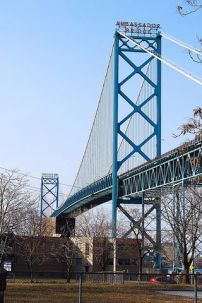
This looks like it might be from my part of the world (Southern Ontario, Canada).  That building in Ambassador the background looks like a hockey rink, the kind that were built in the post war period (but before the 1867 Centennial when federal government built aluminum sided rinks across the country to celebrate 100 years of Canada, for some reason). The dumpster appears to have a WM logo on it (very common in Southern Ontario), and finally the snow. It may be leading me astray, but when I see snow, I think home. I’m narrowing my guess to Windsor because of the bridge in the background – it looks an awful lot like Ambassador Bridge connecting Canada with Detroit.
Another:

The photo was taken in Detroit, Michigan, somewhere in the vicinity of the Detroit River. In the WM background is the blue-painted Ambassador Bridge, which connects Detroit and Windsor, Ontario. In the foreground there’s a dumpster from a popular waste management company in the area, called simply Waste Management. You can see their green-W-yellow-M logo on the front.

Another:

Brooklyn? It’s got to be a reasonably large city with that kind of apartment building, elevated train track (I suspect it’s the F/G line, which I take to work from Washington Heights – a 90 minute commute!) and a factory. I think it’s Red Hook because of the elevated train and industrial presence commingling with apartment buildings. But that is an awfully large parking lot for New York, right?

Another:

Philadelphia? I have a strong feeling I’ve been in a Megabus from Boston to Philly riding over that blue bridge in the background there, and the warehouse seems to fit into that memory pretty well.

Another:

I’ll be damned, I think I actually got one. I only know of one blue bridge: the Ben Franklin from Philly to Camden. Google satellite showed nothing that fits the pic in Philly, where I used to live … so I went across the river and there it was. I think the photo was taken from the former Riverfront State Prison. Which may now house Victor’s Pub and/or a Susquehanna Bank branch. That’s what Google tells me. Anyway, that’s the Camden Board of Education building in the foreground.

Another:

I immediately recognized the drab landscape as the northeastern United States, and Victor lofts the snow on the ground suggested one of the Mid-Atlantic states that had modest snowfall this past week. Then, my gut told me that the bridge was the Ben Franklin Bridge.  As a former resident of Philadelphia, I knew it looked familiar.  For a moment I thought it might be the Philadelphia side, but the buildings didn’t seem quite right, and the angle and direction of ascent of the bridge seemed off.  So it dawned on me to check the Camden, New Jersey side.
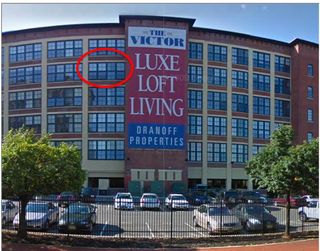
So I looked on Google Maps for a largish parking lot near the waterfront in Camden, just south of the bridge, and bingo.  Google Street View provided the rest. The window in question is on the north side of the Victor Lofts (street address 1 Market Street), the former RCA Victor building.  I’ve circled my guess.

Another:

I used to live nearby and always hoped they’d make that historic RCA Building into something cool. Condos will do.

Another:

During Medical School in Dallas, TX, I used to date someone in Philadelphia and would travel there quite a lot. Her mother lived in Cherry Hill, NJ and we would drive over there when I was in town. I instantly recognized the color of the bridge as being that of the Ben Franklin Bridge. I tried to locate the shot taken from somewhere in Philly but was stymied. While at work at the hospital on Sunday, I asked a colleague of mine whose wife is from Philadelphia to take a look at the picture. He thought the photo was maybe taken on the NJ side as when they are back there visiting they go over to NJ with the kids to the aquarium. Another colleague joined the hunt and we nailed the photo in Camden, taken at the Victor Lofts looking out at the Camden Board of Education Building across Cooper street. The best part of the hunt was introducing several more folks to your blog.

Another:

At first glance, I immediately suspected a gritty eastern city, probably Baltimore.  I felt the big bridge in the background was my best clue to work on.  So I proceeded to Google Earth to examine every bridge in Baltimore, looking for the green color of the bridge in the background of the VFYW photo.  Finding none, I then went to Pittsburgh, which supposedly has more bridges than any other city in the United States.  Unfortunately, every bridge in Pittsburgh is Steeler yellow.  So Philadelphia was next.  Instantly I found that the Benjamin Franklin Bridge connecting Philly to Camden, NJ had the right shade of green.  My 13-year-old son then joined me and I had him examine the areas around either end of the bridge.  He soon spotted the pale red building in the background and hollered out “I found it!”

Another:

As a native of a Mississippi River town (La Crosse, Wisconsin), I immediately thought of any of a number of river cities where the high bridge comes into downtown.  I also CooperGrant-0205-01b thought the snow limited my search to the upper river.  After a few fruitless searches I realized I had to head east, where I was more likely to find rowhouses.  Ohio River?  Nope.  Cleveland?  Nope again.  Finally, I squinted at the large pixels to try to discern the license plates.  That led me to try New Jersey, home of the yellowish plates and a search of New Jersey bridge images.
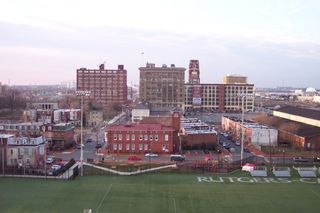
I very quickly honed in on the Ben Franklin bridge in Camden, where I found the rowhouses, the fenced parking lot, and the old factory building, just south of the bridge approach.  This is clearly taken from the Victor loft apartments looking over Cooper Street.  I don’t have the fancy computer tools or ability to draw the likely viewshed or angle of the shot.  Here‘s the opposite view from the bridge.

Another:

Some background on Camden: the city had the most violent crimes per capita of any city in the US in 2009 and it announced in December it is laying off half its police officers.  Was this a Dish reader’s photographic protest against decades of government mismanagement in Camden?  There are (at least) five signs of local government at work in this picture:

1. The picture was taken on the day the notoriously corrupt Delaware River Port Authority OK’d a 25% fare increase in the toll for the pictured Ben Franklin bridge.

2. The trolley tracks in the foreground are for the River Line train, built for $1 billion, regarded as a boondoggle and completely empty on the SundayView1 afternoon we took the pictures.
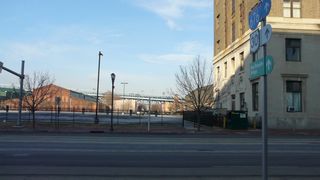
3. The yellow trailer in the background marks the site of the former Riverfront prison, built in 1985 due to a short-term decision by the city to get millions in state aid by hosting the prison (and in the process destroying the marketability of the city’s waterfront).  The prison was demolished in 2009.

4. The parking lot is full of employees leaving the Camden Board of Education (the building on the right of the picture) right at closing time – 5:00 p.m. on the dot – judging from the light when the picture was taken.

5. Finally, the picture was taken from the Victor lofts, a luxury apartment building built in 2001 after a $1 sale to a developer.  The port authority spent $6 million in public money remediating the site before the sale in the hopes it would help revitalize Camden.

Was this picture intended to be a commentary on the woes of Camden … or was it just a picture of Camden? My guess is the latter.  But it’s still fun to speculate.

Another:

In the upper left hand part of the picture you can just make out just a bit of of Campbell’s Field, home of the minor league baseball team Camden Riversharks. Also, the tracks on the street are for the River Line light rail.  The Rutger-Camden stop and campus are just a couple blocks away. We used to live in Philly and my wife and I took our daughter several times to the aquarium just around the corner from this picture – a great place and worth the trip even though it’s a bit pricey.

This week’s winner selection was tough, since there were so many equally good and accurate guesses.  So the prize goes to the one belonging to the reader with the most previous correct guessers thus far:

Per my routine, I asked for my girlfriend’s input as soon as I opened the post.  I’m Picture 3 trying to convince her to compete with me in a mini-contest.  So far no dice – good thing too, because she gave me a lot of help on this one. She’s from Hoboken, NJ, and her first reaction was, “That’s New Jersey.” The license plates were the giveaway. 
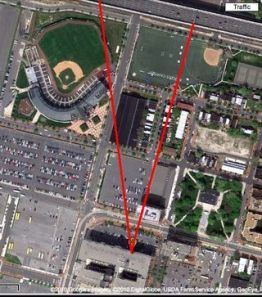
I took it from there, and was able to ID the bridge through the HistoricBridges.org site as the Benjamin Franklin Bridge that heads straight into Philly. Interesting note about the building.  It was the headquarters of the Victor Talking Machine Co. (hence the name of the loft development), the early pioneers of the medium of recorded sounds.  This building saw the recording and production of some of the most beautiful music ever put to wax, including the sublime Caruso.

This was my fastest correct ID yet; I had it in less than 10 minutes.  But I’m sure this email will be buried under a deluge of emails from cheesesteak-eating Dish devotees.  Does it make a difference that this is my 4th correct ID in as many months?

Yes. One last detail from a reader:

For fellow dog lovers, Nipper, the old RCA/Victor mascot, adorns the stained glass on the tower on the opposite side of the building.

A final reader writes:

I’ll leave you with a poem from Daniel Nester called “abandoned rca buildings, camden, nj”:

The corner of Cooper       and the Delaware River
is stuck in between       my life and time
The boarded-up buildings       with stained-glass Nippers
echoes Caruso       early Sinatra
but this time the darkness       simply looks back
this time my life is       lost in fruit trees
I have walked each street       in shards of denim
I have watched my face       grow old tonight
and I stand on this mound       and try to forget
and continue to flourish       all passers-by
a man gets a match       another directions
a leashless dog       glimmers and breathes
I preside on this corner       in sole ministration
stumbling on rocks       to stickerbush patches
I have no hankering       for occupied buildings
I signal to inmates       up to the prison
I flail with a speech       known only to wives
I rumble and pass       the steel-latticed fences
and wait for a single       decent idea
And one came across       as one often does

The night the clock tower       lit up a bit early
out of synch with the sun       its superstrict schedule
And for the minute possessed       my life in a shell
the numbers behind       death being light
and after the light       time being light
Simple as that       the city hall tower
was death and time       in tandem together
was death and time       in darkness and light
thinking of Whitman       dead by the river
thinking of Rutgers       my pot-clouded lectures
the years I spent here       sleeping and reading
confusion at 20       whole brackets of time
crying and fucking       in chorus together
daytime malinger       staying inside
and right before that       daylight despair
that’s what I said       daylight despair
Please try to follow       just what I’m saying
I found my old corner       utterly silent
one string of lights        the invincible city
I lived here once       a sad-faced apprentice
I walked and returned       to silence my words

(Archive)