Redrawing The Lines

by Patrick Appel

The Census numbers are out and there isn't much good news for Congressional Democrats. Weigel's redistricting analysis:

This is about as bad as it could get for Democrats, and as good as it could get for Republicans. The next GOP presidential candidate gets six free electoral votes from South Carolina, Texas, Utah. The Democratic caucus in the House is about to see internal warfare in the rust belt and northeast, as their members are forced into Thunderdome battle for the diminished number of seats. Only in Illinois, I think, will the Democrats be able to create a map that hurts the GOP's newly elected members and takes back a seat or two.

Nate Silver looks at the big picture:

Essentially all of the fastest-growing districts are in inland areas south of the Mason-Dixon line, or are west of the Continental Divide. Many are in areas that demographers describe as ‘exurbs’: newly developing areas that are located relatively far — perhaps a 30- or 60-minute drive — from cities like Phoenix, Dallas, Houston, Las Vegas, Charlotte or Atlanta, and that attract an upscale mix of commuters, families and retirees. Although most major American cities are no longer losing population — on the contrary, at least 20 of the 25 largest cities are likely to have gained population in the 2010 Census compared with 2000 — they are not growing as fast as the exurbs, and therefore stand to lose proportionally, because the number of seats in Congress is fixed. 

The People’s Values Triumphed

by Conor Friedersdorf

Apoplectic about the repeal of DADT, Patrick Buchanan writes:

Remarkable. The least respected of American institutions, Congress, with an approval rating of 13 percent, is imposing its cultural and moral values on the most respected of American institutions, the U.S. military.

He neglects to mention that 67 percent of Americans support the ability of gays and lesbians to serve open in the military. More remarkably, the passage above reveals him to be disdainful of the very notion that the people's elected representatives should impose their will on the military. Before reading his column I'd have thought it unfair to suggest that some DADT advocates would rather challenge civilian control of the military than see gays serve openly. Perhaps I was right all along, and Mr. Buchanan temporarily took leave of his senses.

Should Newspapers Sugar Coat The World?

by Conor Friedersdorf

There's been a lot of controversy surrounding this New York Times "Vows" column, wherein we're told the story of a couple that met while they were both married with kids, decided that they were soul mates, and divorced so that they could wed one another. As Phoebe commented, "It was a straight-up case of grass-is-greener – a fine reason to end a relationship at 17, but a truly upsetting one in a case like this."

This followup post by Kathryn Jean Lopez interests me:

The bride in yesterday's now-(in)famous New York Times wedding announcement comments: “We are really proud of our family and proud of the way we’ve handled this situation over the past year. There was nothing in the story we were ashamed of.” Is the Times equally proud of its attempt to take all meaning from the word "vows"?

And for anyone wondering why in the heck the couple would let the Times feature them: They did it for the children. She tells Forbes: “We did this because we just wanted one honest account of how this happened for our sakes and for our kids’ sakes.”

In publishing the column, The NY Times certainly highlighted a marriage that violates prevailing social norms. But these sorts of relationships, where someone basically trades in their spouse for a new flame, simply are part of American society, however much we might lament that fact. And a newspaper's role is to tell us about the world as it is. Inplicit in Lopez's criticism is that its editors should make moral judgments about recent unions and highlight only those that aren't deemed unseemly. Perhaps she is thinking that stories like this one undermine the norm of "till death do us part."

Whatever one thinks about whether newspapers should deliberately shape a society's norms by ignoring certain facts, it's interesting to observe that editors and reporters allowing their moral judgments to shape coverage is precisely the sort of bias that Lopez objects to in other contexts. Her take on the vows column suggests she doesn't merely want a newspaper that neutrality isn't her desired end so much as editors who actively shape coverage in accordance her notions of traditional morality.

And I think her attitude is very common among conservatives, who complained for decades about bias in media, and when given the opportunity proceeded to embrace not the least biased new outlets, but the ones that skewed most heavily in their own ideological direction. This is a shame, because some of the old conservative critiques of bias and information bubbles were really quite good.

Who’s Against START, And Why?

by Patrick Appel

P.M. Carpenter calls out the naked partisanship of the GOP:

Had this precise treaty been up for Senate ratification four years ago, they would have hailed it as a Bushian triumph of Talleyrandian proportions; Reagan vindicated, Metternich invoked — and Senate Democrats, en masse, and like adults, would have peeplessly ratified the necessary thing.

Yet the hardcore-base-pandering nakedness of the GOP leadership's breath-holding resistance to Start screams for no further clarity when one ponders this simple juxtaposition: on the pro-treaty side, there are former GOP Secretaries of State Henry Kissinger and James Baker, as well as George H.W. Bush's former national security adviser, Brent Scowcroft; on the other, anti-treaty side, there are — all alone — the … tea party types.

 Greg Sargent counts noses:

The current whip count has seven GOP Senators now supporting New START, which puts the treaty within two votes of the two-thirds it needs for ratification. What's more, senators Judd Gregg and Bob Corker seem to be strongly leaning towards Yes.

In other words, the White House may be on the verge of getting the treaty ratified around the opposition of John McCain and Jon Kyl. Hard to overstate what a massive rebuke that would represent, particularly for McCain, who just suffered another major, high-profile defeat with the repeal of don't ask don't tell.

Brian Beutler says "it's all but certain that the Democrats will be able to ratify the new START treaty before the end of the week."

DADT: Now What? Ctd

by Patrick Appel

Mark Thompson does some reporting:

There's talk of up to 18 months for the Army and Marines [to follow through with repeal], less for the Air Force and Navy. But such a lengthy time frame is not likely to win approval from Defense Secretary Robert Gates and Adm. Mike Mullen, chairman of the Joint Chiefs, who championed repeal.

But it will take months. The services have to draft training and communications plans to educate the force, rig personnel policies to accommodate the change, and figure out how benefits will be adjusted. Once they have everything in line, the Pentagon will declare it is ready to allow gays to serve — and then there will be a final 60-day period before they do.

Can Jury Nullification End The War On Drugs?

by Conor Friedersdorf

Check out this remarkable story from Missoula, Montana:

A funny thing happened on the way to a trial in Missoula County District Court last week. Jurors – well, potential jurors – staged a revolt. They took the law into their own hands, as it were, and made it clear they weren’t about to convict anybody for having a couple of buds of marijuana. Never mind that the defendant in question also faced a felony charge of criminal distribution of dangerous drugs. The tiny amount of marijuana police found while searching Touray Cornell’s home on April 23 became a huge issue for some members of the jury panel. No, they said, one after the other. No way would they convict somebody for having a 16th of an ounce…

District Judge Dusty Deschamps took a quick poll as to who might agree. Of the 27 potential jurors before him, maybe five raised their hands. A couple of others had already been excused because of their philosophical objections. “I thought, ‘Geez, I don’t know if we can seat a jury,’ ” said Deschamps, who called a recess. And he didn’t. During the recess, Paul and defense attorney Martin Elison worked out a plea agreement.

Here's a quote from the plea memorandum that his attorney filed:

Public opinion, as revealed by the reaction of a substantial portion of the members of the jury called to try the charges on Dec. 16, 2010, is not supportive of the state’s marijuana law and appeared to prevent any conviction from being obtained simply because an unbiased jury did not appear available under any circumstances.

Jason Kuznicki reacts at The League of Ordinary Gentlemen:

If more potential jurors start turning down nonviolent drug cases, our drug laws will change.

More on the subject here. And see this story about New Jersey's shameful behavior with regard to medical marijuana.

Why Not Call The ACA “Obamacare”?

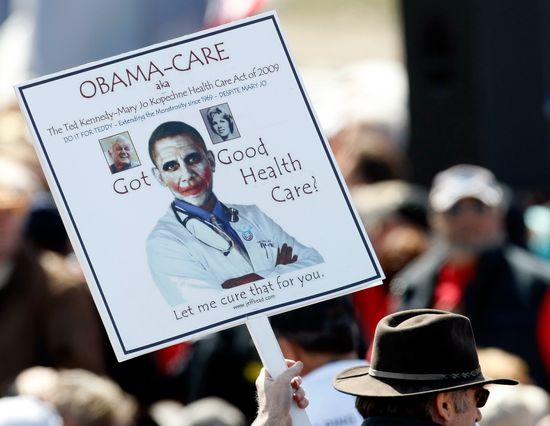
Obamacare_Getty
by Patrick Appel

Aaron Carroll's two cents:

The more specific reason I don’t use “Obamacare” is that it implies that the law is the work of one man.  It wasn’t passed by fiat.  It was created by three committees in the House, two more in the Senate, was voted on by a majority of Representatives and a heck of a lot of Senators before being altered in reconciliation.  Then it was signed by the President.  President Obama neither gets all the blame nor all the credit.  It’s not his and his alone.  It’s the Affordable Care Act, the ACA, or the PPACA.

A reader's additional reasons:

1) The use of the shorthand Obamacare is useful in polarizing the electorate about it. Do you hate Obama? How do you feel about Obamacare? How many people are really going to answer yes to the first then "Well, it's not ideal, but it probably does more good than harm" to the second?

2) It creates a false equivalence. Unlike Medicare which made a whole new government run program, the Affordable Care Act works to modify the existing system to better serve Americans, unless you consider the creation of exchanges for people to buy private insurance from a real expansion of government reach. The Medicare comparison is one that is used by opponents of the bill to help label it as large, sweeping, and expensive for individuals, business and America, when it is anything but that. It also glosses over fairly nicely that this isn't some singular program but a complex tweaking of many facets of insurance in America.

3) It's just part of a larger trend in terrible naming conventions. If we have a scandal associated with the Affordable Car Act, it will inevitably be called Obamacaregate. We didn't call Medicare Part D "Bushcare" without confusing everyone, and we don't call the Afghanistan war Bushnam so everyone could know in one word that it's an expensive pointless war started by Bush. Or maybe instead if we invade Yemen or Iran we should call those Obamastan for the same reason.

Another reader:

One of the big complaints a lot of liberals had about the health care reform bill was that Obama wasn't doing enough to guide Congress in shaping the bill. A lot of people thought that his lack of leadership on the issue drew out the debate significantly, and resulted in a weaker bill overall than what he might have gotten if he'd pushed a plan aggressively from day one. Granted, once the bill was largely shaped he came out strong to push for it; but calling the bill Obamacare seems like a misnomer at best, and an attempt to place the blame for the ugly process that shaped it solely at Obama's feet at worst.

By far the most common reason:

Has "Obamacare" ever been used without a sneer?  It was created as a way for Fox news to use the name Obama as a slur. It has almost never been used non-judgmentally.  Just about the as often as "conservatives" say "liberal" and mean something nice, do they say "Obamacare" and mean something non-judgemental. 

Along the same lines:

It strikes me that such personalized sobriquets are almost automatically pejorative. Was social security Rooseveltcare, or the civil rights successes of the 60s Johnsonism? On the other hand, what about Hoovervilles?

Another:

The simple answer is that it was originated and meant to conjure up the negative image of a one-man HMO, a quote "government takeover of healthcare" that Frank Luntz consistantly urged Fox News and GOP officials to use when discussing the legislation before it was even drafted.  The level of dishonesty is as disturbing as it is effective.  Obama's legislation isn't a government takeover of healthcare, isn't government run healthcare, doesn't involve government doctors or government actuaries telling people what services they can and cannot have under an insurance policy they cannot control — it simply outlines rules of the road for the market and creates a mechanism by which costs can be lowered (exchanges, a mandate, and subsidies) so that everyone can be covered by existing, private insurance policies that already exist.  And yet I knew reformers had lost the war to frame the issue when no less than Time magazine ran a cover depicting Obama in a doctor's outfit under the headline "Paging Dr. Obama" and asking 'What's His Prescription?"; "How will New Plan Effect You?" which portrayed to anyone checking out groceries that egotistical Obama was here to be play your doctor, HMO, and run your healthcare decisions.

I don't think its even a small step, let alone a leap, to argue that terms like 'Obamacare' were put thrust into the debate to develop a mythical conception of health insurance reform as one man's power trip over your critical healthcare decisions: 'Obama's takeover of your healthcare', so to speak. A straight line can be drawn from that image on Time magazine, and that term, to 'Death Panels'.  It is completely a right wing pejorative.

Another:

Google the term "Obamacare." The first result is a Wikipedia page mentioning its pejorative connotation. The second result? "The Truth About Obamacare." The third? A YouTube video of a group that doesn't like the law. The fourth? "20 Ways Obamacare will take away our freedoms." Why is it pejorative? It is used pejoratively.

A Google Images search is equally eye-opening. A lone defender of the label:

As a liberal who advocated for the PPACA and supports it, I have no problem with calling it "Obamacare." In fact, in my more optimistic moments, I hope that when it becomes as entrenched as Medicare, conservatives will end up regretting making Obama's name an integral part of the program. Can you imagine a Republican campaigning against a Democrat for having supported $500bn in "Obamacare cuts" in 20 years? I don't know about you, but the thought tickles me.

(Image by Ethan Miller/Getty Images)
#MooreandMe

by Patrick Appel

Sady Doyle gives Michael Moore and Keith Olbermann no quarter. She spells out her complaint in great detail, but here are the basics:

Michael Moore tweeting the UNSUBSTANTIATED CLAIM that an Assange accuser had fucking CIA TIES, in an article that NAMED HER, re-tweeting it from KEITH OLBERMANN, retweeting it not just to the hundred thousand people that follow Keith Olbermann but to the over seven hundred thousand people that follow him, GIVING THAT WOMAN’S NAME AND SAYING UNPROVEN DEROGATORY SHIT ABOUT HER to ALMOST A MILLION PEOPLE, that’s why it’s BAD.

Doyle's twitter feed is here.

Why Do We Hate Congress?

by Patrick Appel

Jonathan Bernstein provides one reason – we don't give them credit for anything:

[There is an] overwhelming cultural bias in favor of crediting the big things that happen to presidents, not Congress.  We do this reflexively…Barack Obama got DADT repeal through, after Bill Clinton failed.  Barack Obama failed to pass energy/climate legislation.  Yes, we'll occasionally get articles about how Harry Reid and Nancy Pelosi are doing, and every once in a while we'll have some attention to the individual legislative entrepreneurs who did the bulk of the work, but most of the time it's going to be the president that we [think] of. 

And that's even more true as we go back through time: quick, when's the last time you even saw Tom Foley's name, let alone saw him blamed for some of the failures during Bill Clinton's first two years in office?

Have We Hit Peak Palin?

Palin_Getty
by Patrick Appel

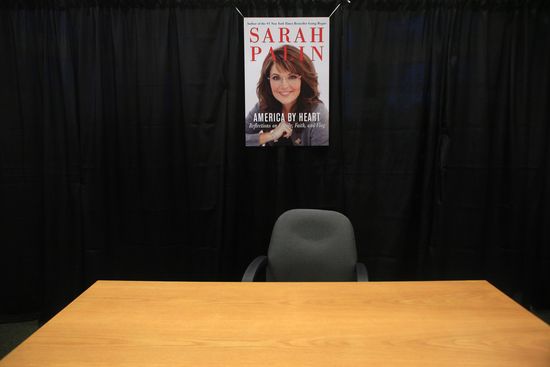
Weigel notes that sales of Palin's second book are much lower than those of the first and that her reality show ratings are respectable but not extraordinary: 

Ken Vogel's story on Palin and the mainstream media is required reading here. Normally, when a politician opens up access to the MSM, as has been happening since the election, there's more excitement about him/her. But one of the reasons why Palin was such a phenomenon in 2009 and 2010, and so able to lock down good deals for books and TV, was that she was elusive. At what point does Palin become overexposed, and we learn the limits and real size of her fan base? Maybe we're at that point.

(Image: Eric Thayer/Getty Images)