Pay The Best Teachers More And Fire The Worst

by Conor Friedersdorf

If true, what a tremendously consequential abstract:

A teacher one standard deviation above the mean effectiveness annually generates marginal gains of over $400,000 in present value of student future earnings with a class size of 20 and proportionately higher with larger class sizes. Alternatively, replacing the bottom 5-8 percent of teachers with average teachers could move the U.S. near the top of international math and science rankings with a present value of $100 trillion.

Adam Ozimek reacts:

There are really two important claims here. I think progressives tend to be very pleased with claims like the first one, which is that teachers have a very high value. You can find similar results in the work of Raj Chetty, which suggests that good kindergarten teachers are worth $320,000. If this is true then the marginal benefit of teaching skill -or quality, if you want to think of it that way- is far below the marginal cost, and therefore we should increase wages to draw more talented teachers.

However, the second claim is just as important and is suggested by, although not a necessary condition of, the first: if good teachers are very valuable, then bad teachers are very costly. This means we should be willing to pay more for good teachers, but it also increases the benefit of getting rid of bad teachers and ensuring we have a system that can do that.  After all, every dollar spent on a bad teacher has the high opportunity cost of good teachers. Findings like this tell us that we should place even less relative value on teacher well-being for it’s own sake (which is separate from teacher well-being to the extent that it improves outcomes) when considering reforms.

Obama’s Right Flank, Ctd

by Patrick Appel

A reader writes:

You posted this from Tom Jensen, so it appears that you believe it to be true (or at least likely to be true):

"Conservative Democrats are ultimately a bigger threat to Obama's reelection prospects than liberal ones. They don't necessarily make a lot of noise about it when they're unhappy- they just go out and vote for Republicans. Liberals on the other hand really have nowhere to go … "

For me as a Progressive, it does indeed seem to be the way things work, but if this were just because of the internal dynamics of a two-party system, then it should be true of the GOP as well. However, no one would ever say that Moderate Republicans have more leverage than the very conservatives within the Republican Party despite their smaller numbers. Why do you think this is?

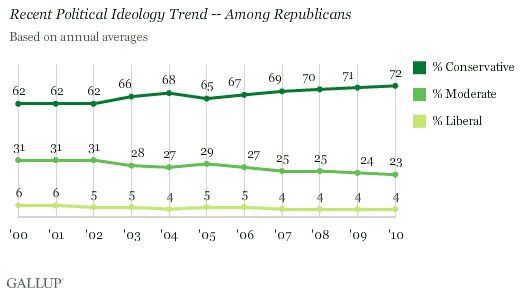
There are many more conservative Democrats than Republican liberals. Two charts from a recent Gallup survey on ideology illustrate this:

Democrat_Ideology

Republican_Ideology

How Afghanistan Is Not Like Iraq

Marine_Massoud_Hossaini_Getty
by Patrick Appel

Nir Rosen, along the most compelling critics of the wars,  has a new dispatch worthy of contemplation:

My time in Afghanistan has convinced me that the U.S. is drawing the wrong conclusions from the Iraq experience. The most obvious lesson of course is not to invade and occupy another country. But in addition, none of the factors that helped reduce the violence in Iraq exist in Afghanistan. At 20 percent of the Iraqi population, Sunni Arabs could be brutally crushed by Shiites and Americans until they were forced to accept a new order. The Taliban are dominated by Pashtuns who are 40 percent of the Afghan population, the largest group. And the Taliban have every reason to feel like they are winning. Every year they control more and more of the country and reduce the ability of the Afghan government to operate anywhere. In fact now there are Taliban groups in non Pashtun areas, among Tajiks, Uzbeks and Turkmen. Moreover, the Taliban are not only Taliban these days, meaning they are not just religious students led by Mullahs, the way they were when they fought the British in the 19th Century, the Russians in the 1980s or warlords in the 1990s. Many of them are just common Afghans, farmers, villagers, who view themselves as Mujahedin.  

(Image: US Marines from 1st Battalion 8th, Bravo company open fire on Taliban fighters in the Musa Qala district of Helmand province on December 20, 2010. By Massoud Hossaini/AFP/Getty Images) 

The Downside To RINO Hunting

by Patrick Appel

Chait argues, convincingly, that Republicans could have stopped health care reform:

If the Republican Party had more tactical flexibility in its candidate selection and legislative strategy, nothing like health care reform would have succeeded. Luckily, as Yglesias notes, the structure of the conservative movement is such that it is only able to criticize left deviation and never right deviation, even when right deviation created a worse outcome by conservatives' own terms. The primary challenge against Specter, in particular, was an utter disaster, yet you simply never hear Republicans admit this.

The Right’s Sledgehammers

Conor Friedersdorf

When Internet radio host D.R. Tucker alerted me to an interview he recorded with Jonah Goldberg a couple weeks back, I had no idea it would contain one of the more revealing accounts of what the National Review Editor-At-Large really thinks about the conservative movement's bomb thrower talk radio types. (Transcript of relevant segment here.) I'd always imagined that he and I would be utterly at odds on that subject. As it turns out our assessments overlap.

The initial example discussed in the segment is Mark Levin. To my surprise, Goldberg noted that the nationally syndicated talk radio host has said "awful things" at his expense, pointed out that he's "constantly ripping into" Stephen Hayes at The Weekly Standard, and expressed bafflement at his "minor war on National Review." It's rare and gratifying for a prominent voice in movement conservatism to acknowledge that Levin's rhetoric is baffling and that he serially launches unfair attacks.

Does he therefore hurt conservatism? Goldberg doesn't think so:

The problem is that Mark Levin – his myriad talents and successes notwithstanding – is not the pope of conservatism. And the reality is that very very few people listen to Mark Levin who don’t already agree with Mark Levin. The idea that Mark Levin is doing some profound damage to the country or the conservative movement rests on the idea that there are all these liberals tuning in who would otherwise be persuaded by Bill Buckley, but instead are being turned off by Mark. I don’t buy the logic of it.

Isn't Goldberg's answer interesting? His mind immediately goes to the David Frum critique of talk radio: that the overheated rhetoric of its blowhard hosts turn off independents. Its arguably true about Rush Limbaugh, whose high profile makes him unique. But whatever you think of the Frum thesis, there are two distinct arguments about how talk radio hurts conservatism that Goldberg never seems to consider.

1) It's damaging when someone within an ideological movement regularly launches baffling, intemperate attacks on ideological allies. It's strange to me that Goldberg isn't more sympathetic to this argument: he's a movement guy who thinks that Levin is unfairly attacking other guys in the movement; he just doesn't seem willing to say that this is damaging.

2) Then there's the case I'd make against talk radio – not just Mark Levin, but Rush Limbaugh, Sean Hannity, and Glenn Beck too, among others. That they hurt the conservative movement isn't something that bothers me. It's now a corrupt moneymaking enterprise more than a vehicle for principled political gains. What bothers me is that talk radio hosts hurt conservatism the political philosophy. They do so by willfully misinforming its natural constituency. Every single day, the people I've mentioned broadcast shows that are rife with factual inaccuracies and poorly reasoned if emotionally resonant arguments.

The effect is what you'd expect when people of any kind are constantly fed bad information: they become less adept at advancing the valuable insights that they retain, and even worse at identifying and improving the flaws in their belief system.

With this in mind, consider the argument that Goldberg makes when he turns to talk radio hosts in general:

My position on the conservative movement is that different people need to do different things. As I put it in that C-Span interview, it’s not the best analogy, but if you’ve got to tear down a house and replace it with another one, you need some guys with sledgehammers and earth movers, those are the people like Levin and Glenn Beck, some of those guys. But you also need people who do the fine carpentry and detail work. The way Bill Buckley or George Will or Charles Krauthammer might, or the guys at the Claremont Review of Books. It’s like a symphony. You need the string instruments and you need the percussion.

And there are all these people who think it’s up to conservatives to get rid of the percussion section because it’s too loud. And I don’t buy that. I think you need some people whose job it is to buck up and be cheerleaders for our own side. And you need some people who are going to be kind of Jesuitical proselytizers for conservatism, and go out among the masses and try to convert them.

In one way, it's admirably forthright to acknowledge that listening to Levin and Beck is akin to turning a wrecking crew loose in one's mind – that their supposed utility is their ability to be maximally destructive, and that their work doesn't desserve to be taken as seriously as the stuff produced by the Buckelys and Wills and Krauthammers of the world. It isn't often that you'll hear someone like Goldberg publicly acknowledge as much, though opinions like his are expressed in private all the time.

What I'd ask is that the folks on the right who take his position reassess the costs and benefits of the strategy they're endorsing. The staunch conservatives who make up the majority of the Levin, Beck, Hannity and Limbaugh audiences do not require a demolition crew to tear down liberalism's excesses on their behalf. They find it cathartic and entertaining, but they'd be antagonistic to the left even absent their daily dose of sledgehammers, and plenty of intellectually honest, tonally temperate conservatives are capable of airing informantion and arguments. (I've yet to hear a conservative who insists on the importance of Limbaugh and Fox News answer the observation that the Reagan Revolution happened without either. And that the rise of a parallel conservative media has coincided with a series of policy disasters for the right.)

Note too that talk radio hosts aren't merely doing demolition work against the left, as Goldberg's analogy implies: using few tools save their sledgehammers, they're also engaged in influencing the outcome of primary elections, informing their audiences about the news of the day, pressuring GOP Congressmen on various matters, weighing in on the details of policy, and drawing the bounds of ideologically acceptable discourse. Daily factual errors, pathologically outsized egos, and poorly reasoned arguments are not compatible with doing these things well.

Even if you believe that politics requires angry shouting against ideological adversaires, consider that it is possible to shout without lying – to forcefully rail against the excesses and errors of your opponents without resorting to bad facts or fallacy-filled arguments.

Those who insist on keeping right-wing talk radio hosts around should at least demand better from them. Criticize them for getting facts wrong. Mock them when they make bad arguments – they'll start making better ones. ("You could have a steam train/if you'd just lay down your tracks!") Their intellectual dishonesty and lazyness will manifest itself even less frequently if it's bad for ratings. In a single generation, the conservative movement has gone from counting William F. Buckley and Milton Friedman as its most effective, popular advocates, to throwing in with Rush Limbaugh, Glenn Beck, and Sean Hannity. It's time to stand athwart history yelling stop.
Face Of The Day

Dinka_Trevor_Snapp_Getty
A member of the Dinka tribe from Bor attends the final of Sudan's first commercial wrestling league between his tribe and the Mundari from Central Equatoria at a stadium in the southern Sudanese city of Juba on December 18, 2010. The traditional sport has been embraced as a way to increase unity among southern tribes torn apart by cattle raiding conflicts. By Trevor Snapp/AFP/Getty Images.

“I’m Getting Kind Of Sick Of Talking About Facials”

Elizabeth Weingarten reports on the Groupon editorial team:

Forty percent of Groupon's writers have prior journalism experience, 70 percent were creative writers and 20 percent wrote marketing or business copy. As of this writing, there are 59 writers, 16 editors, 15 image designers, 24 fact-checkers, 11 copy editors and four editorial recruiters. They've hired 40 writers in the last six months.

"We have this insatiable need for writers," Managing Editor Brandon Copple said. And if you're hired as a writer at Groupon, you will be writing. All day long. Writers churn out anywhere from six to ten blurbs each day.


Why Young Christians Should Temper Their Rebellion

by Conor Friedersdorf

David Sessions makes the case:

Even as many “next Christians” remain rightfully critical of the ways they were raised to think and believe, there’s the indisputable fact that many of us have gone on to live happy lives with relative intellectual stability and modest to wild success in whatever endeavors we choose. We may have been inculcated with science denialism or bigotry or more difficult emotional things like self-hatred and repression.

But on the whole, the “next Christians” are not badly damaged, wounded souls whose parents and churches have left them for dead. In fact, quite the opposite: many are well-adjusted, upwardly mobile young professionals who owe what success and sanity they have to the values they were raised on. It’s important that every Christian who faces the inevitable bitterness that results from breaking out of a small-minded worldview remember that when they turn to critique the ones who came before. And though I clearly believe in opposing those who continue to articulate a reactionary political version of Christianity, I think a lot of the Next Christians can probably do more good persuading their parents than condescending to them.

For a lot of people, it is far easier to identify what their parents did wrong than to perceive, let alone appreciate or understand, what they did right. Doing both is the best way to make progress from one generation to the next.

What I like about the attitude that Sessions suggests – persuading parents rather than condescending to them – is that respectful efforts at persuasion leave the person engaged in them open to being transformed , whether by being shown that they are in error, or else that they are correct but needful of nuance. Its an insight that would seem to apply to people of all faiths, or none.

Obamacare, Romneycare, Clintoncare

by Patrick Appel

Joyner defends calling health care reform "Obamacare":

 ObamaCare … is short, memorable, and nonjudgmental. It has a nice parallelism with Medicare, a very popular program with similar goals, and correctly identifies the president who pushed it through Congress. And, even as one who opposed Obama’s election and the passage of this act, the term “ObamaCare” doesn’t conjure up negative imagery.

Megan agrees. Me too, and I support the law. Writing "Obama's health care reform law" gets tiresome. Calling Bill Clinton's 1993 health care reform plan "Hillarycare" wasn't neutral – it was an attempt to discredit the bill as illegitimate due to Hillary Clinton's shepherding it through Congress. But Clintoncare would have been acceptable. And I've no qualms about calling the Massachusetts reform Romneycare.

Why is Obamacare so offensive to some liberals?