For centuries, one reason people have chosen to live in cities is the comparative privacy that they offer: unlike the small town, where everybody knows your business and community ties are pervasive, the city dweller can cultivate strong community ties if he likes, even as he is an anonymous man in the crowd everywhere except his apartment elevator, his weeknight soccer league, and trivia night at the corner pub.
Early on, the Internet Age seemed as though it would enhance the ability of city dwellers to calibrate their community ties as they saw fit. A mere Internet search could yield like-minded people, whether for sex or volunteerism or shared activities. And it remains easier than ever before to find whatever it is you’re seeking. But the anonymity that seemed such a pervasive and intrinsic feature of the Internet Age turns out to have been illusory. These days 24-year-olds pack up their belongings, drive to a metropolis a thousand miles from their previous home, and arrive with a Google trail, a Facebook identity displaying status updates and friend networks dating back to high school, and perhaps even blog archives or Twitter updates that detail years worth of thoughts on sundry subjects.
And ponder what’s next. We’ve all got cameras on our phones. Photo sharing Web sites already have tagging and facial recognition technology. Patronize a sex shop or a gay bar or Sunday morning services at a Catholic Church, and who knows when a passerby might snap a cell phone photo, post it to the Web, and expose activities you’d rather keep private to your Facebook friends/landlord/Jewish mother. In this world, the dystopian future looks less like 1984 than Gossip Girl.
Here is the question I want to pose: Does the Internet age portend the end of cities as a place where anonymity is an option? I’d love to publish all sorts of responses. Examples drawn from the news. Musing on the same theme. Co-signs that suggest I’m right. Arguments that prove me wrong. Thoughts about whether we exert any control over the privacy norms of tomorrow. And especially notes from city dwellers sharing relevant anecdotes, concerns, or even making the case that less anonymity would be a good thing.
E-mail conor.friedersdorf@gmail.com with "city" in the subject line, or send relevant links via the Twitter handle @conor64 – as always, comments published anonymously unless otherwise requested.
Tim Lee continues to reluctantly defend the health care mandate:
I think [those arguing Obamacare is unconstitutional] have something much broader in mind: that Congress shouldn’t be using the tax code to force people to do stuff they wouldn’t otherwise do and buy products they wouldn’t otherwise buy. But if so, then the courts have two options: One is to bite the bullet and invalidate the child tax credit, energy efficiency tax credits, college tuition tax credits, and so forth. Or two, they need a story about why coercing people to buy health insurance is more objectionable than coercing them to have children, pay tuition, take out a mortgage, or install solar panels on their house. Personally, I’d be happy to see the US tax code ruled unconstitutional. But I think it’s safe to say that the courts aren’t going to do that. And I have trouble imagining a principled argument for invalidating tax incentives to buy health insurance without invalidating a bunch of other tax credits that have long been regarded as constitutionally sound.
Adam Serwer argues along the same lines with more vigor.
As a person who has suffered for more than 20 years from recurring, difficult-to-treat, severe depression, I find articles like this frustrating. I have done multiple rounds of talk therapy and mindfulness training, both of which help sometimes, but they are often not enough for people with depression like mine.
Unfortunately, Lehrer and the hundreds of other science journalists out there who do better by being contrarian typically fail to report that the very studies they reference do show a statistically significant benefit over placebos for people with very severe depression – i.e., the people for whom depression can be a life-threatening emergency.
Frankly it strikes me as irresponsible to leave out or gloss over this little detail. In her article for Newsweek, Sharon Begley cites the information that antidepressants have significantly better-than-placebo effect for severely depressed people, then points out that 13% of people with depression fall into this category, and then still goes on to call antidepressants "the emperor's new clothes," no better than "expensive Tic-Tacs."
If patients deserve to know the truth about antidepressants, then surely those with the most immediate need for help have the most immediate need for the full truth, not just the truth that suits the popular "patient vs. Big Medicine" narrative. Expensive Tic-Tacs have meant that my girls won't grow up with a dead mother, and the available science cites supports that causal link. Severely depressed people need to hear that.
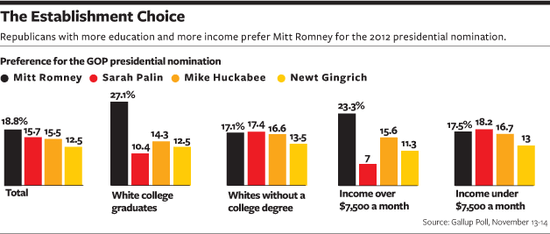
Ronald Brownstein splits the 2012 GOP presidential candidates into managers and populists. He notes that Palin, the archetypal populist, takes the lion's share of the low-income non-college vote while Romney, the stereotypical managerial candidate, overwhelming wins high-earning college grads. How the political environment might help determine the winner:
If the race focuses on hostility toward Washington, anger at elites in both parties, and tests of ideological purity, those dynamics will favor the populists, as they did the tea party insurgents who won several GOP Senate primaries this year. One senior strategist for a 2012 contender, who asked not to be identified, says that anyone who thinks a populist can’t win the Republican nomination should “just frankly … look at this year’s Senate primary elections” for proof to the contrary.
But doesn't Christine O'Donnell's epic failure demonstrate the limits of Tea Party infused populism? Brownstein continues:
[M]anagers will benefit if the election revolves around reviving the economy. Whit Ayres, a veteran GOP pollster, predicts that the Republican contest will overwhelmingly focus on that issue, boosting candidates such as Romney and dooming Palin if she runs. “Until the economy turns around … jobs and spending are going to dominate everything, and that means cultural affinity is less important,” Ayres contends. “Palin has no record of significant job creation or significant public-sector accomplishment. She is going to run up against a wall at some point because of that lack of a demonstrated record of accomplishment.”
Yes, but Romney is too busy running away from his accomplishments to run on them.
One of the most damning character indictments of recent presidents is the cowardly, borderline corrupt way they've misused the pardon power. Many people desserving an executive reprieve are left to rot in prison. And the odds of being shown mercy is incalculably higher if you happen to be a personal, political or ideological ally of the president, as evidenced by the records of George H.W. Bush, Bill Clinton, and George W. Bush.
President Obama has so far been a failure too. Though he has avoided cronyism, his first nine pardons were granted to people who either finished serving their time long ago or never went to jail at all. But I don't know that I've ever seen a more perfect illustration of misplaced priorities than what appears in this story from The Land Of Enchantment:
Nearly 130 years after the death of Henry McCarty, alias William Bonney, but better known as Billy the Kid, New Mexico Gov. Bill Richardson will take some of the final hours of his administration to decide whether to pardon the baby-faced gunslinger.
Richardson will review evidence that in 1881, one of his predecessors promised to pardon Bonney for killing a sheriff in return for his testimony in a murder case. The record suggests that New Mexico territorial Gov. Lew Wallace later reneged on that promise.
Richardson has promised a decision by Dec. 31, his final day in office.
If I knew nothing about how governors actually behaved at the ends of their terms, I'd imagine them frantically trying to determine the identities of the inevitable innocents incarcerated in their states. Or perhaps showing mercy to people imprisoned for years on end despite only having violated drug possession laws.
In fairness, it is conceivable to me that a governor might have a principled objection to interfering in the criminal justice system. I'd find that misguided – pardons are a check built into the system itself – but I'd at least comprehend the mindset. What I cannot fathom is how a governor who apparently accepts that pardons are sometimes appropriate could be so frivolous and lacking in judgment to spend the last hours of his administration wringing his hands over a long dead man whose guilt isn't in question.
As far as I can tell, this is the very first piece of pro-gay legislation that is not attached to any other piece of legislation making its way through both chambers of the U.S. Congress on its way to the President’s desk. Please correct me if I’m overlooking something, but I cannot think of any other federal pro-LGBT legislative accomplishment that has been achieved through a straight up-or-down vote as a stand-along bill.
Dahlia Lithwick smacks Minority Whip Jon Kyl (R-AZ) for claiming, without a scrap of evidence, that DADT repeal "could cost lives":
What Kyl seems prepared to ignore is that also as a result of this long overdue piece of legislation, people may live. If we’ve learned anything else from Dan Savage’s astonishingIt Gets Better project, it’s that there are indeed life-and-death consequences to telling gay teenagers that they are second class, or shameful, or disgusting. And a military policy that legally enshrined such humiliation — a policy that allowed soldiers to die for their country so long as they lived in shame or silence – was nothing if not government-sanctioned intolerance. As Jason Linkins explains, one of the reasons President Clinton first sought to end discrimination against gays serving openly in the military was because of the violent abuse (and even murder) they suffered at the hands of other servicemen. The lives of young gay Americans who may now feel pride in living openly may not count in Kyl’s vague calculus of lives lost, but they should.
There are, in the lame duck session, 11 Republican senators from states that President Obama carried in 2008. Of these, 7 voted with the Democrats to repeal the policy, while 3 voted against it. (One other — the retiring Republican Judd Gregg of New Hampshire — did not vote at all.)
By contrast, right there are now 31 Republican senators from states that Senator John McCain won in 2008. Just one of these — Lisa Murkowski of Alaska — voted to repeal the ban on gay servicemembers. Another 28 voted against it, and two did not vote.
One thing that history won’t remember, but that will certainly be true, is that the Democrats chose the single moment in all the possible permutations of the election cycle when it would cost them the very least — when an election has just been held, when it costs the least in their own members’ cushy seats, when many of them are leaving anyway, and when they can spend the next two years complaining about an agenda not of their own making. Still, well done.
David Link, on the other hand, applauds Obama for taking the path of least resistance:
When Clinton promised he would resolve the problem of gays in the military with the stroke of a pen, he gave Sam Nunn an engraved invitation to visit those infamous submarine bunks, and paved the way for Republicans to invoke the most fearsome set of showers since World War II.
This is the kind of political problem that can best be solved more indirectly. There was no doubt about the public support for repeal, and while there was concern about how the troops would view it, that turned out to be based on the same wishful thinking by the right as everything else in the area of gay equality. But even in the face of genuine popular support, the equally genuine, gut-level ugliness of the minority also has to be negotiated.
That is Obama’s real triumph, and he proved to be quite right about how you approach the problem.
I'm thrilled about the repeal of DADT and didn't think it would happen. It was skillfully done. And on a grander scale, I'm surprised at how well he's managed the press, which I didn't believe was possible. For the most part I think he's really figured out how to keep them happy and that's no mean feat. Remember, Clinton offended them even when he was passing GOP policies, so it's as much a matter of style as substance. I think they've skillfully managed to keep them where they want them and that's very helpful in navigating public opinion in hard times.
Reading around mainstream traditional media coverage this morning, I notice a lot of emphasis on the discrimination/second-class citizens/Obama fulfilling a promise to a core constituency, the gays. Let’s not forget that ending this policy will start to strengthen our military the way it has strengthened armed services in other countries. 14,000 discharged. We have to recruit former convicted felons, people who perhaps aren’t as sharp educationally speaking as those who were discharged. We’ve wasted billions on discharge investigations and court-martials. While people like McCain were grandstanding on and on about unit cohesion, disrupting a unit by kicking out a member over an e-mail from his boyfriend back home sure sounds like disrupting cohesion to me. Sure, discrimination must be ended, but there are two aspects of why this is good for America.
Among the consequences: this removes the last stated objection to the return of ROTC programs to on-campus operations at Harvard and some other elite universities. I've discussed the background extensively, starting here and here. ROTC left these campuses four decades ago because of bitter disagreements over the Vietnam war. That's long in the past; since the early 1990s, the main argument against ROTC's return has been the military's exclusion of openly gay members.
This isn't another "Whatever happened to the old McCain?" piece, which we've all seen too many times in recent years. Rather, this is to suggest McCain has done more than make the transition from "maverick" to petulant right-winger. Yesterday, the man waving his arms on the Senate floor was a misanthropic hack who's abandoned basic decency, and trashed any hopes he might have had about a respectable legacy.
We have, of late, taken to avoiding comparisons between the struggles of gays and the struggles of blacks. And yet, in this instance, the notion that DADT is actually a Georgetown cocktail party plot, surely recalls the notion that "Lincolnism" is actually the work of miscegenaters. The case is different, but the disinclination to argue on the grounds of facts, the proclivity for changing the subject, the penchant for deceitful ad-hominem, and the bigoted appeal to fear, is the same as it ever was.
Lieberman … played an important role as a public counterbalance to John McCain, whose quixotic, erratic and desperate efforts to stall and defeat repeal might have commanded more public respect, were it not for Lieberman's high-profile campaign. Lieberman's independent status and Beltway reputation as a hawk made him perfect for the lead role in undercutting McCain's arguments. He succeeded in doing this in scores of TV interviews and at the Senate hearings, where he cross-examined military leaders inclined against repeal and got them to acknowledge that they could live with repeal if it were implemented by Defense Secretary Robert Gates. In a sense, this has been an old-school epic battle between two senators. Lieberman won.
More Republicans voted for repeal than expected, but this vote can and should be remembered as a moment when the Democratic Party lived up to its finest traditions as the party of tolerance and the Republican Party was willing to invoke its procedural rights in the name of denying fundamental rights to others. The DREAM Act and DADT repeal votes were about more than just policy–they were mission statements for what each party stands for.
All of this was inconceivable seventeen years ago, and it raises the question of what this means for the future of social conservatism, or at least for the importance of so-called “social issues” in American politics. Social issues played almost no role in the 2010 midterms, for example, and their role in the 2008 elections was minimal at best. This is a dramatic shift from the early 80s when abortion played a huge role in election campaigns around the country, especially when the Supreme Court issued one of its many rulings from that era testing the limits of the holding in Roe v. Wade.
[T]his issue will now promptly go away, entirely. Oh, we'll have a bit of reporting on implementation, but seriously: does anyone think that Republicans are going to run in 2012 on re-instating DADT? Or, even less plausibly, on re-instating the ban that DADT replaced? Forget it. It's possible to believe that a DADT vote could be used in a GOP primary down the road, but it's utterly implausible to believe that the policy would ever be revived, no matter what happens in the 2012 (or any future cycle) elections.
Tom Jensen reports that "there are actually more Democratic primary voters in Ohio and Wisconsin who would like a more conservative nominee than Obama in 2012 than there are ones who would like someone more liberal":
Conservative Democrats are ultimately a bigger threat to Obama's reelection prospects than liberal ones. They don't necessarily make a lot of noise about it when they're unhappy- they just go out and vote for Republicans. Liberals on the other hand really have nowhere to go- they can stay at home or vote for Ralph Nader but ultimately that's just going to get them someone who makes them a lot more unhappy than Obama. It's not a pleasant reality, but in our two party system that's just the way it goes- conservatives definitely have more leverage than liberals within the Democratic coalition and that's why they so often get their way despite their smaller numbers.
[H]ow can anyone know what Romney will actually do it elected? I think the answer is, basically, the same way you can know that about anyone. He'll follow party incentives, and institutional incentives, and other such things that have little or nothing to do with what he "really" thinks. And that's mostly a good thing! As I've said many times, our presidents are experts on practically none of the issues about which they must make decisions. If they fool themselves into thinking that they know more than anyone else about arms control, or the effects of economic stimulus, or farming, or 5th amendment jurisprudence, or what North Korea is up to, then there's a good chance they'll fail. Even worse, if they convince themselves (as Woodrow Wilson, and probably George W. Bush, did) that as a result of being elected they share some mystical bond with the American people that allows them, and only them, to understand what the American people "really" want…well, that's a recipe for disaster.
Responding to public opinion is one thing, but Romney constantly does 180s to follow miniscule political advantages. He's the reverse of Obama –Mitt takes the long-term political hit for the short-term gain; he campaigns as if political opportunity costs don't exist. Yglesias is correct that basic beliefs and temperament matter. And John Gardner is right to point out that public opinion has its limits:
[T]he next President will have many, many occasions to inform the “customers” that they cannot have what they want precisely how they want it – America simply cannot afford it. Does the next President have the courage to do so? What proof do we have? Customer service and management consulting is a good model to run a company, even a large government agency. (Business leaders work best in government at agencies that bear some similarity to business, such as Social Security or Medicare.) But President? No – the style of leadership we need in a President right now is very different than corporate leadership. It’s far more about negotiation and persuasion than command, control, and organization management, to say nothing of the need for principles beyond customer service during the 3:00 AM phone calls made famous in the last campaign.
Because our lifestyle has become so expensive to maintain, every new resource now becomes exhausted at a faster rate. This means that the cycle of innovations has to constantly accelerate, with each breakthrough providing a shorter reprieve. The end result is that cities aren’t just increasing the pace of life; they are also increasing the pace at which life changes. “It’s like being on a treadmill that keeps on getting faster,” [Geoffrey West] says. “We used to get a big revolution every few thousand years. And then it took us a century to go from the steam engine to the internal-combustion engine. Now we’re down to about 15 years between big innovations. What this means is that, for the first time ever, people are living through multiple revolutions. And this all comes from cities. Once we started to urbanize, we put ourselves on this treadmill. We traded away stability for growth. And growth requires change.”
While listening to West talk about cities, it’s easy to forget that his confident pronouncements are mere correlations, and that his statistics can only hint at possible explanations.
I'm on vacation visiting family in Portland, so it was quite serendipitous to come across the trailer for the upcoming series "Portlandia" while waiting in the airport:
I'll be spending a good chunk of time in the storied pubs.
 The Dish