Malkin Award Nominee

by Patrick Appel

"The armies of other nations have allowed gays to serve openly in the military. The reason they could afford to do this is simple: they could allow homosexuals to serve in their military because we didn’t allow them to serve in ours. … Those days are now gone. We will no longer be able to bail out these other emasculated armies because ours will now be feminized and neutered beyond repair, and there is no one left to bail us out. We have been permanently weakened as a military and as a nation by these misguided and treasonous Republican senators, and the world is now a more dangerous place for us all," – Bryan Fischer, American Family Association. 

Confederate Yankee helpfully dismantles Fischer's illogic. 

Merry Merry

I’m taking some time off-grid for the Christmas season.  I leave you in the very capable hands of the Dish team: Patrick, Chris, Conor and Zoe. The Awards season is imminent, and, as you know, your input is essential. It’s been an amazing decade for the Dish, with what looks to be a very exciting second one coming up. Stay tuned; know hope; and see you in the next decade.

The Tory President

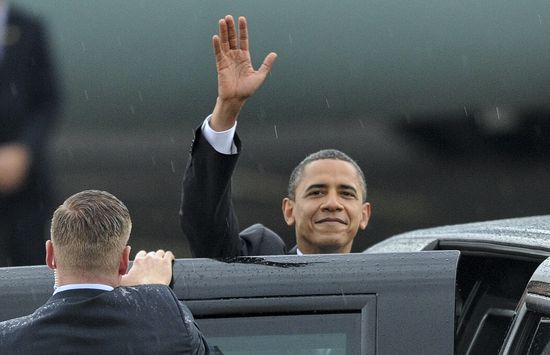
OBAMARAINRoslanRahman:Getty

I think of Frank Rich and Paul Krugman as brilliant men, but profoundly resistant to the core rationale of the Obama presidency (and the underlying dynamic of its accumulating success). That rationale is an attempt to move past the paradigms of the boomer years to a pragmatic, liberal reformism that takes America as it is, while trying to make it more of what it can be. Now, there’s little doubt that in contrast to recent decades, Obama has nudged the direction leftward – re-regulating Wall Street after the catastrophe, setting up universal health insurance through the private sector, recalibrating America’s role in the world from preachy bully to hegemonic facilitator. But throughout he has tried, as his partisan critics have complained, not to be a partisan president, to recall, as he put it in that recent press conference, that this is a diverse country, that is is time we had a president who does not repel or disparage or ignore those who voted against him or those who have grown to despise him.

This is particularly important since so many of his opponents are white and disproportionately affected by this long recession. Trying to get them to see him accurately through the haze of Fox propaganda and cultural panic is not easy. But he seems to understand that persistence and steadiness are better tools in this than grand statements, sudden moves or grandstanding attempts to please his own base. He really is trying to be what he promised: president of the red states as well as the blue states. And a president who gets shit done.

The results after two years: universal health insurance, the rescue of Detroit, the avoidance of a Second Great Depression, big gains in private sector growth and productivity, three stimulus packages (if you count QE2), big public investments in transport and green infrastructure, the near-complete isolation of Iran, the very public exposure of Israeli intransigence and extremism, a reset with Russia (plus a new START), big drops in illegal immigration and major gains in enforcement, a South Korea free trade pact, the end of torture, and a debt commission that has put fiscal reform squarely back on the national agenda. Oh, and of yesterday, the signature civil rights achievement of ending the military’s ban on openly gay servicemembers.

P M Carpenter:

Mr. Rich, no one I know of, especially myself, expects that civility “would accomplish” the necessary rebuilding of America. That indeed would be “childish magical thinking.” But in reality it is only, as noted, a straw man. The inescapable point, Mr. Rich, is that “civility and nominal bipartisanship” — attitudinally, the notion that America’s problems can be overcome only through a political consensus to work the problems and not merely the politics — is the inescapable starting point of rebuilding America.

What I find immensely ironic about this debate is that I — a ruthless pragmatist who so often scoffs at progressives’ boundless utopianism — retain confidence that American politics can indeed regain a two-party civility indispensible to socioeconomic progress, while the Frank Riches — ruthless utopians who so often scoff at others’ boundless pragmatism — have sunk into a bottomless despair.

I agree. If the next two years are as productive as the last two, and if Obama resists the Rich-Krugman-Maddow chorus to be Michael Moore in chief, then the promise of the Goodbye To All That presidency is very much alive.  From the perspective of this Christmas, after the many bewildering twists and turns of the last two years, Obama is looking good because he kept his nerve and retained his restraint. That’s a tough combo: nerve and restraint. It takes a cold-bloodedness to pull this off, and there are times when ice seems to run through the man’s veins.

I occasionally used to day-dream about a ‘one-nation’ Tory U.S. president, a second Eisenhower of a sort. Little did I know he would be a black man with a funny name.

(Photo: Roslan Rahamn/AFP/Getty.)

All At Once

An excerpt from David Eagleman's Sum: Forty Tales From The Afterlives:

In the afterlife you relive all your experiences, but this time with the events reshuffled into a new order: all the moments that share a quality are grouped together.

You spend two months driving the street in front of your house, seven months having sex. You sleep for thirty years without opening your eyes. For five months straight you flip through magazines while sitting on a toilet.

You take all your pain at once, all twenty-seven intense hours of it. Bones break, cars crash, skin is cut, babies are born. Once you make it through, it’s agony-free for the rest of your afterlife.

But that doesn’t mean it’s always pleasant. 

Continued here and well worth reading in full.

(Hat tip: Kottke)

Bitter, Party Of One

Joe Klein:

McCain distinguished himself doubly this weekend, opposing the Dream Act and leading the opposition to "Don't Ask," despite the very public positions of his wife and daughter on the other side of the issue.

I used to know a different John McCain, the guy who proposed comprehensive immigration reform with Ted Kennedy, the guy–a conservative, to be sure, but an honorable one–who refused to indulge in the hateful strictures of his party's extremists. His public fall has been spectacular, a consequence of politics–he "needed" to be reelected–and personal pique. He's a bitter man now, who can barely tolerate the fact that he lost to Barack Obama.

But he lost for an obvious reason: his campaign proved him to be puerile and feckless, a politician who panicked when the heat was on during the financial collapse, a trigger-happy gambler who chose an incompetent for his vice president. He has made quite a show ever since of demonstrating his petulance and lack of grace.

Petulance. That just about captures the sadness of someone who could have ended his career so differently.

The Outlines Of Superheroes

See how many you can identify: 

Minimalism_heroes1

You an buy a poster of the image here. Answers after the jump, in order:

Batman, Robin, Batgirl, Superman, Supergirl, Barbarella, Mighty Mouse Ironman, Captain America, Thor, The Hulk, Cyclops, The Incredibles, Kick Ass, Radioactive man, Fall out boy (milkhouse version), Wonder Woman, The Flash, Captain Atom, Aeon Flux, El santo, Wolverine, Invisible Woman, Human Torch, Professor X, Chapulin Colorado, The Darkness, The Tick, Ben (FF), Hellboy, He-Man, Freakazoid, Silver Surfer, Witchblade,Metamorpho, Spiderman, Mandrake, Mighty Man, Green Lantern, Falcon, Atom Ant, Hancock, The Phantom, Storm (Xmen), Birdman, Aquaman, Iceman, Captain Marvel, Spawn, Space Ghost, Blade, Blue Falcon, Dynomutt, Flash Gordon, Bartman, The Vision (Avengers),TMNT Raphael, TMNT Leonardo, TMNT Donatello, TMNT Michelangelo, Plastic Man, Duffman, Scarlet Witch, The punisher, Dare Devil, Hawkman, Black Vulcan, Zorro, Hawk and Dove, Sandman, Hulk Hogan, Gambit, Wonder Twins, Marshal Bravestarr, Electra and Spidergirl.

(Hat tip: Flowing Data)

The Age Of Depression

Jonah Lehrer says that we live in it. And he's worried about depression treatment trends:

[T]he percentage of depressed subjects seeking psychotherapy for treatment declined dramatically between 1998 and 2007, from 53.6 percent to 43.1 percent. (This drop has come despite the fact that a majority of subjects say talk therapy is their preferred method of treatment.) Needless to say, pills have taken the place of therapists, as more than 75 percent of depressed patients are now treated with anti-depressants, which has led to a dramatic increase in medical spending on the disorder. Between 1998 and 2007, Medicare expenditures for depression increased from $0.52 billion (1998) to $2.25 billion (2007).

When anti-depressants work, they are little blue miracles. But they often don’t work, at least not at rates higher significantly higher than placebo. (Plus, they often have unpleasant side-effects, which leads more than half of patients to stop taking the drugs shortly after the worst symptoms disappear. And then they relapse, which helps explain why patients treated with SSRI’s have relapse rates above 75 percent.) And that’s why I’m troubled by the drop in talk therapy, as most studies demonstrate that the most effective treatment for depression is pharmaceuticals coupled with a good therapist.


The Triumph Of Romneycare

Congrats, governor Romney, on forging what was to become the Obama administration's signature achievement: universal access to healthcare insurance:

This week, the state's health and human services agency released the results of a new, independent survey examining coverage in Massachusetts. More than 98 percent – 98 percent! – of the state's residents now have health insurance, as do more than 99 percent of the state's children.

Remarkably, those numbers have gotten better in recent years, with the number of uninsured residents in the state falling to 1.9 percent in 2010 from 2.6 percent in 2008. That's very unusual. Normally, the ranks of the uninsured swell during recessions as people lose their jobs and states cut back on public programs to balance their budgets. Nationally, the number of Americans who are uninsured rose to 16.76 percent in 2010 from 14.8 percent in 2008, according to Gallup.

That Massachusetts's reforms have survived, and even prospered, in this economic environment has left the law's architects feeling vindicated. "The goal of the law was covering people," says Jonathan Gruber, an MIT health economist who worked on the legislation, "and it couldn't have gone better."

By far the most interesting wrinkle: the healthcare exchanges set up for those shut out of the employer system have seen premiums decline 40 percent, even as all premiums have risen 14 percent nationwide. The power of the market. If the GOP were a serious governing party, they would focus on strengthening those exchanges in the federal bill, and working to break the employer-based healthcare system.

Music To Our Ears

Paul Boutin declares the age of music piracy on the internet officially over:

It’s time for everybody to go legit. The reason: We won. And all you audiophiles and copyfighters, you know who fixed our problems? The record labels and online stores we loved to hate. …

That leaves one last war cry: Music should be free! It’s art! Friends, a song costs a dollar. Walmart has pushed some of its MP3s down to 64 cents. At Grooveshark, you can sample any song you want before you buy. Rdio charges $5 a month for all the music you can eat, served up via the cloud.