He Who Makes Plastic Look Real, Ctd

Frum compared Romney to a restaurant manager who thinks what "matters is satisfying each and every customer who walks through the door to the very best of the manager’s ability." Ezra Klein semi-accepts this parallel:

Frum is right that customer service can be a principle in and of itself. And I'd be really interested to see a presidential candidate promise to better represent the people by explicitly using polls to steer his or her presidency. But that's not what Romney is promising. He's promising to do certain things, and uphold certain values, when in office. If he's lying about that, it's not customer service. It's betrayal yoked to a four-year contract.

Yglesias adds:

I think the real issue here has to do with character. The executives of Darden Restaurants are basically trying to make money. And so are the owners of the firm. And that’s fine. Most of us aren’t so distressed by the idea that the firm is, on some level, a soulless money-making machine. But on this view, Romney is . . . what? A soulless power-seeking machine? 

How Corker Views Civil Rights

A fascinating glimpse into the Republican psyche:

I’m just hoping that saner minds will prevail and that these issues that have been brought forth that are absolutely partisan, political, issues, brought forth to basically accommodate activist groups around this country. I’m hoping that those will be taken down or else I don’t think the future of the START treaty over the next several days is going to be successful, based on what I’m watching.

Civil rights are reduced to … "absolutely partisan, political, issues, brought forth to basically accommodate activist groups."

English 101, Ctd

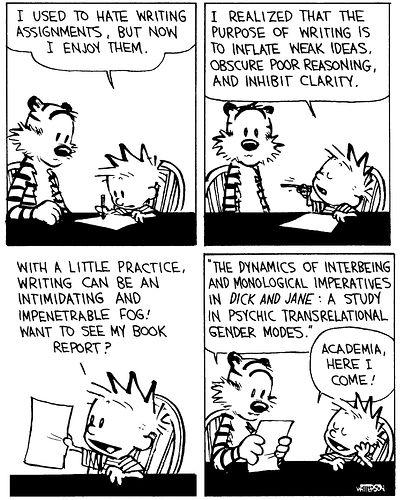
Calvin on Writing

Former students strike back against the professors. One writes:

While I realize that English professors, like anyone else, ultimately find some parts of their job tedious and repetitive, I have to say that those reader comments are prime examples of why lots of people dislike academics.  While many of the books mentioned may be old or even cliched to the professors, they are new intellectual discoveries for their students, and as such, the complaints about reading their papers come off as whining at best.  I certainly hope they aren't grading some students more harshly than others based on who writes about books they are sick of hearing about, because in that case those professors are guilty of something far worse than whining.

I'm a lawyer with a political science background and I suspect most papers about law or politics written by English professors would strike me as boring, simplistic cant.  But if I were charged with teaching a law or political theory class to such individuals, I'd simply grade the papers without complaint, because that's my job.  If reading another paper about The Great Gatsby, Huckleberry Finn or A Clockwork Orange (which are all books that will stand the test of time – unlike most humanities scholarship) is too much for the professors emailing you, perhaps they can quit their jobs and open some positions for people who are actually interested in working with young minds.  Heaven knows the PhD market is pretty tight these days.

Another writes:

When I was in college I felt that many of the English professors who were so harsh when grading and critiquing the papers of the less experienced students were lashing out to mask some kind of insecurity about not having lived up to their own expectations.  They never wrote the great American novel, and they couldn't figure out how to hack it outside of academia.  So they took jobs as professors, resenting every minute of it, and took solace in the fact they were superior to the 18 year olds who cluttered up their classrooms.

Granted, it must get tedious having to review papers of kids who simply don't get it, but if you can't GET THEM to get it, whose fault is that?

Another:

I was a senior in college in the fall of 2001. As an English major, I was seriously considering PhD programs in literature.  In the days and months following September 11th, only one of my English professors mentioned what had happened, and only briefly, and after acknowledging she was taking her “English Professor” hat off to do so. 

I had always loved studying literature precisely because I thought it provided insight into the human condition.  It was a catch-all major for studying philosophy, religion, human behavior, history, and culture, and it was extremely relevant to our modern lives.  Literature was exactly what I wanted to turn to in trying to cope with the devastation that 9/11 caused to the national psyche and to my own personal understanding of how the world worked.  I was disgusted by my professors’ lack of ability or willingness to bridge what we were reading in Tolstoy, Yeats, and Swift to what was happening in New York and in the White House. I then made a decision to leave the field for one where people weren’t so actively and consciously distancing themselves from the world around them.  

Number 5 on the Midwestern professor's list of paper topics he never wants to see again, ("Book _________ and How It Influences Society Today") and his accompanying explanation ("If I cared about society today, I wouldn't be an English professor"), reminds me of why I ended my study of literature that year, and gives me confidence, once again, that I made the right choice.

DeMint And Christmas

A reader writes:

The junior senator from the Palmetto State forgets his own state history. One hundred and fifty years ago, on Dec. 20, 1860, a gaggle of South Carolinians in convention assembled declared the state's secession from the Union. And four days later, on Christmas Eve, they published their legal defense of the move. That defense placed the entire blame on the North's hostility to slavery, which, it said, had been reinforced by "erroneous religious belief."

They have always been very, very sure of themselves down there in South Carolina.

If The Government Can Force You To Buy Healthcare … Ctd

A reader writes:

In my my job, I help low- and no-income patients enroll in government subsidized health care programs. The program in Minnesota that is designed for people in the "higher" low-income bracket, and also for people whose employers don't offer coverage, requires people to pay an income-based premium each month. It is amazing how many of my patients enroll in the program, get treatment, and then let their coverage lapse to avoid paying this premium. This drives up costs for all the other people on the program. Also, because the program takes three or four months to get on (a weak attempt by the state to convince people to stay on the program, rather than jumping on and off), many people fall through the cracks.

Perhaps because of this, I'm not particularly troubled by the mandate. I'm willing to make many small-but-significant concessions to control costs, as long as they result in a program that drastically increase our coverage rate, as PPACA does. And I see the mandate as a financial concern more than a "fundamental freedoms" issue. Sure, people have to either pay for coverage, or pay a penalty. But it's based on income. Low-income folks won't be paying high premiums (if they are asked to pay a premium at all).

That being said, I think there are some reasonable arguments against the mandate. And comparing such a rule with Ohio's (or Minnesota's) law that all drivers be insured is simply a false equivalency. As somebody probably has already pointed out, no state requires all residents to carry auto insurance, only that drivers and/or car owners carry it. If you don't want to pay for coverage, you have the option to not own/drive a car. There is a huge difference, when one is looking solely at personal freedom, between saying "You must pay for X, if you choose to do Y or Z" and requiring everybody to either have insurance or pay a penalty. The one is inclusive, the other exclusive. The draft analogy doesn't stand either. Only a limited percentage of the population is draft-eligible, and the draft is only adopted during specific periods of time, under specific conditions, and necessitates approval by legislators who will lose their jobs if the public thinks they've overstepped. It is not an ongoing, never-ending financial obligation for all (or a huge percentage) of the population. I'm with Reihan in thinking that this should just be called–and treated as–a tax.

I don't point this out because I don't support the mandate. I do. But sloppy comparisons and false equivalencies just weaken the case for an important piece of cost-control.

Another reader goes in a different direction:

Everyone seems to be missing the point here.  As Orin Kerr pointed out, Judge Hudson made a signficant error in his reading of the Commerce Clause when he wrote "if a person’s decision not to purchase health insurance at a particular point in time does not constitute the type of economic activity subject to regulation under the Commerce Clause, then logically an attempt to enforce such provision under the Necessary and Proper Clause is equally offensive to the Constitution."   As Kerr notes, "the point of the Necessary and Proper clause is that it grants Congress the power to use means outside the enumerated list of of Article I powers to achieve the ends listed in Article I" (or as Justice Marshall famously put it "Let the end be legitimate, let it be within the scope of the constitution, and all means which are appropriate, which are plainly adapted to that end, which are not prohibited, but consist with the letter and spirit of the constitution, are constitutional.")   

The Commerce clause is not what the government is claiming as authority for a mandate.  The Necessary and Proper Clause is.  And there is a long history and fairly well developed tests for determining what is necessary and proper.  If critics want to bemoan this perceived expansion of federal power, they need to consider the necessary and proper clause and its associated tests (rational relationship basis) used to assess the constitutionality of any federal action claiming it as a source of authority.  A good place to start would be Justice Kennedy's concurrence in the US v Comstock.  I'm not pre-judging an outcome here.  I'm just saying that there is a very clear and established frame for assessing these questions - and no one is using it.

Legalizing Incest

Switzerland is considering it. Tracy Clark-Flory takes up the issue:

Marriage between second-degree relatives (aunt/uncle, niece/nephew) is already legal in Switzerland, but the new measure would overturn the ban on consensual sexual relationships between siblings, and between parents and their adult children. (Sexual relationships with underage children would, of course, remain illegal.)

As I reported Friday in response to news about a Columbia professor's arrest on incest charges, some U.S. courts prosecute incestuous adult relationships on the grounds that the government has a legitimate interest in preventing inbreeding. Other courts view children as forever-and-always minors when it comes to sexual relationships with their parents: Law professor J. Dean Carro, told me, "Regardless of the age of the child, there's still a theory that a parent is always a parent, a child is always a child and, as a result, there truly can't be a consensual sexual act."

The Switzerland measure rejects that thinking and allows for the possibility that an adult can meaningfully consent to sex with their parent or sibling. The Swiss would hardly be the first to allow for this: According to a 2007 report by the Max Planck Institute (via WRS), China, France, Israel, the Ivory Coast, the Netherlands, Russia, Spain and Turkey do not have any prohibitions on consensual incest between adults.

That Palin Can’t Hunt, Ctd

Check out the comments section here at Field and Stream. Dish faves:

Watching that sequence made me cringe. The fact she was shooting a bunch of guns that apparently hadn't been sighted in and that she didn't seem to know how to load herself was irresponsible. We all had to start somewhere …

I think she's kind of a phony as far as being a big angler or hunter- while AK teenage boys were out honing their outdoor skills in the fall, I get the feeling Sarah was more interested in the beauty pageants and basketball.

This should have been a golden moment for hunting, but she totally blew it. Honestly, it was amateurish hunting and politics. She has to know everyone and there brother will scrutinize this scene and didn't site in the guns! Oh, and then you broadcast the fact that you didn't site in the guns. Why to protect her reputation for marksmanship? Cheney is a better hunter.

Now remember the core lie: that Palin regularly hunts with her dad, and has done so for years. This was always an obvious lie. Now Palin's delusions have allowed her to demonstrate the lie on national television.