What If The Mandate Is Ruled Unconstitutional?

Austin Frakt's guess:

Short of a unified government, I doubt Congress will be able to patch the law. That means it will become a state problem. I expect many, even most, states will do something to fill the hole left by a declared-unconstitutional mandate because the pressure from the insurance and provider industries will be enormous.

War As An Endless Entitlement Program

Think about it:

Tom Englehardt probes deeply into the war culture of Washington, D.C. He notes that only two positions have any real voice in contemporary public-policy debate: those who want more of this and those who want more of that. The key word is “more.” As Englehardt writes, when it comes to conflict overseas “however contentious the disputes in Washington, however dismally the public viewed the war, however much the president’s war coalition might threaten to crack open, the only choices were between more and more.” More drones, more troops, more nation-building… “Because the United States does not look like a militarized country, it’s hard for Americans to grasp that Washington is a war capital, that the United States is a war state, that it garrisons much of the planet, and that the norm for us is to be at war somewhere (usually, in fact, many places) at any moment.”

And neither party offers even the prospect of shrinking this footprint. In a way, that's surprising. As ABC News reports:

A record 60 percent of Americans say the war in Afghanistan has not been worth fighting, a grim assessment — and a politically hazardous one — in advance of the Obama administration's one-year review of its revised strategy.

Fa-Ra-Ra-Ra-Ra-Ra-Ra-Ra-Ra, Ctd

A reader writes:

I'm a Caucasian male, married to a Chinese woman, who has four biracial children, and the whole family finds A Christmas Story hilarious – the "fa-ra-ra-ra" scene in particular.  My wife grew up in China, and thus was not teased as a child for a foreign accent – it sounds like your correspondent (who is offended by the scene) grew up in a mostly-white US town where anti-Asian prejudice was frequently and openly exhibited.  Different experiences cause different people to react differently to things – something to keep in mind.

That said, the speech impediment portrayed in the movie – substitution of "l" with "r" – is not typical of Cantonese native speakers (such as most Chinese immigrants to the US prior to World War II; the time period portrayed in the film). 

The Cantonese language has an "l" sound but no "r" sound; it's more common for native Cantonese speakers who learn English to speak like Elmer Fudd – replacing "r" with "w", rather than inserting "r".   Fa-ra-ra-ra-ra is probably more likely to be heard from a native Japanese speaker than a native Chinese one; as Japanese has a sound approximating "r" but none approximating "l".

And finally, no discussion of Asian stereotypes in American films would be complete without inclusion of Geddy Watanabe's hilarious portrayal of the Chinese exchange student Long Duk Dong in Sixteen Candles.  Roger Ebert wrote of Watanabe's performance: "he elevates his role from a potentially offensive stereotype to high comedy".  Compared to that, the "fa-ra-ra-ra" scene is tame stuff, indeed.

The Afghanistan Review, Ctd

Kevin Drum is ready to throw in the towel:

The argument for optimism is that NATO forces have made substantial tactical gains in the past year: intelligence gathering is better, local support is stronger, security is improving, and the Taliban is in retreat. You can read a pretty good version of this case here, from Peter Mansoor and Max Boot. But tactical improvements only get you just so far. Our big long-term problems—lack of central government support, lack of Pakistani support, and lack of American public support—suggest pretty strongly that the war in Afghanistan isn't winnable in any ordinary sense of the word. It's hard to say if this has sunk in at the White House, which released its latest review of Afghanistan on Thursday and apparently plans to stay the course. Sort of.

Fred Kaplan sounds just as exhausted by the conflict:

On the one hand, our chances of success are improved if all the players in the region—Karzai, the Pakistanis, the Taliban, and the Afghan people—are convinced that the United States is going to stay for a long time to come. On the other hand, if our chances are nonetheless dim because of forces largely beyond our control (such as Pakistan's refusal to crack down on the safe havens inside its territory), then maybe it's time to draw down—but if we do that, how do we keep the Taliban from coming to power and al-Qaida from once again expanding its reach?

Nothing about this war gets any easier.

Quote For The Day II

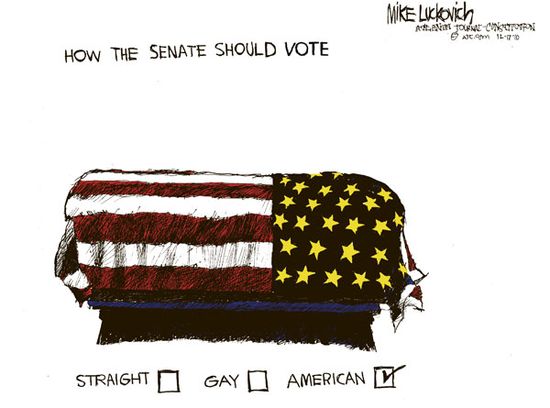
“I’m reminded of the moral courage of my partner, who encourages me everyday to continue to put on that uniform; who believes that some things are worthy of our energies; who quietly plods along and prepares for my deployment as I do the same. I know as a soldier, it is the people we leave behind who bear the real brunt of deployment, who hold it all together, who send the care packages and pray for our returns. He’ll have to do it on his own though. There are no support groups for the gay partners left back home.

In the meantime, gay soldiers who are still serving in silence will continue to put on our rucksacks and do what our country asks of us –- and wait,” – an American soldier, with a knife in his back.

Remove it.

Tax Rates Are Always Changing

Mickey Kaus points out that the oft-heard GOP talking point about "permanent" versus "temporary" tax cuts makes no sense:

Congress will still be in session in two years. And in three years. There's also an election in 2012. At any point, the people's current or future elected representatives could decide to jack up taxes to the "levels favored by President Obama." Or beyond. Businessmen can never have certainty in this regard. Pols are always fiddling with their tax rates. Maybe with a "permanent" tax cut there's only a 30 percent chance their taxes will be raised, while with a "temporary" tax cut it's a 50 percent chance. But it's a matter of degree.

I don't quite see how this translates into a night-vs.-day difference between deficit-busting growth and deficit-ballooning stagnation. … P.S.: The same goes for Milton Friedman's "permanent income hypothesis" when applied to argue that people will save "temporary" tax cuts but spend "permanent" tax cuts. Any rational person will conclude that "permanent" tax cuts might well be temporary (and "temporary" cuts are often likely to be permanent). Don't economists usually assume people are rational? Or do they assume they're dumb enough to be conned by semantics?

You really want me to answer that question?

The Long Game And Israel

Some readers understandably mock me for my occasional "meep meep" posts about Obama's shrewd sense of strategy. But I think the mockery is sometimes based on a misunderstanding. I do not now and never have believed that Obama is some kind of guru, capable of seeing far into the future, a Jedi president capable of foiling all enemies with cunning and foresight.

The, er, evidence does not exactly back this up. The errors of judgment and foresight are pretty clear – from letting Clinton win New Hampshire to Ben Nelson's months-long fiddling over health insurance to the collapse of cap-and-trade. My point is rather that he has a clear pattern of behavior that is acutely tuned to the longterm. He lets things take their course. Rather than tipping his hand early and decisively, he tends to hang back, aloof, distant, watching. Only when events have occurred that have proven the pointlessness of options he doesn't favor does he forthrightly present his own. And quite often, he almost seems intent on orchestrating such public failures of others' (and his own apparent) options – even at his own short-term cost.

And so on Israel, we have seen a laborious, frustrating, endless attempt to get the Israeli government to get serious about stopping settlements and work on a peace deal. The constant humiliations at the hand of Netanyahu, the contempt shown the US by Netanyahu's coalition partners, the massive bribes just to get Israel contemplating a minimal settlement freeze, the Pavlovian way in which Israel's reflexive supporters have done all they can to stymie any movement … well, it's been an exhaustive experience, hasn't it?

But here's the point: it has proven to almost everyone that nothing serious can get done between the current Israeli polity and the promising, if still inchoate, nation-builders in the West Bank. Obama has not asserted this; he has demonstrated it. And this is the key difference between Bush and Obama. Bush constantly declared things to be so. Obama waits until everyone sees it for sure.

This patience, moreover, does not go nowhere. Failure leads to new terms for success. And what Obama has done is get Netanyahu unwittingly to make the global argument that a peace settlement cannot be won with Israel's support and cooperation -  but can only be imposed somehow from outside. The two years of trying so clearly to make the old model work has … proven the old model is finished. Now watch the U.N.

I might add that exactly the same endless and agonizing process has consumed the US engagement with Iran. What Obama is trying to prove is that Iran will eventually bow to economic and political pressure on nukes. But if the long process fails to achieve that … then the case for war will be stronger.

The long game works both ways in the Middle East.