If The Government Can Force You To Buy Health Care … Ctd

Noah Millman pushes back on Conor's worries:

As for whether the Constitution has any meaning if there are no restrictions on Federal power: well, the reason we have a Bill of Rights is precisely that the anti-Federalists worried that there was no restriction on Federal power built into the original Constitution. But that doesn’t make the Constitution meaningless, because the Constitution also outlines the separation of powers – what the respective roles of the President, the Congress and the Judiciary are, and how they interact. It is not meaningless that Congress has the power to tax and to regulate interstate commerce; that means the President cannot simply issue edicts.

It is not meaningless that Congress has the power to declare war – though we’ve striven mightily to make that provision meaningless. It is not meaningless that it requires Constitutional amendment to change the composition of the Senate from two-senators-per-state to something more proportional, or that it required a Constitutional amendment for Senators to be elected directly by the people rather than appointed by state legislatures. It is not meaningless that the Constitution specifies life tenure for the federal judiciary. I could go on. The implicit assumption that the Constitution’s only possible role is to limit the scope of government is not only wrong, it’s silly – because Constitutions are only pieces of paper. What actually limits government is the existence of opposing forces, and a major function of the separation of powers is to establish such opposing forces within the government itself. The health-care mandate, for example, if it is struck down will be struck down by the courts – courts which are a creation of the Constitution.
He Who Makes Plastic Look Real, Ctd

Building off Ross's thoughts on Romney, Larison lists Mitt's many reversals:

My guess is that Romney doesn’t “really” have a stand on any of these issues, but what is annoying is not simply Romney’s lack of principle. Many and possibly most politicians are not that deeply committed to principles, and that’s to be expected, but Romney attaches a degree of smugness and sanctimony to the exercise that is genuinely obnoxious. What should be bothersome to his supporters is that his pandering is so impermanent and fleeting that he inspires no confidence that he will be in the same place a year or two from now. Very simply, he can’t be counted on and can’t be trusted. 

Will The Clock Run Out On DADT?

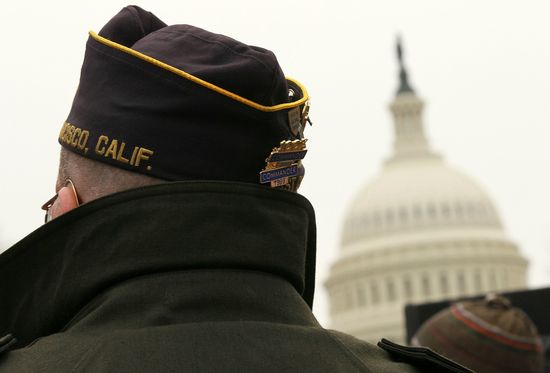
DADT_Getty_Alex_Wong

Sargent asks:

[T]here's no longer any doubt as to whether there are the necessary 60 votes in the Senate to get this done. The only issue, Harry Reid tells us, is this: Will there be enough time to vote on repeal before the end of the lame duck session?

As a matter of fact, there is a simple way that Reid can make the time necessary to ensure this gets done, aides involved in the discussions tell me. Reid needs to schedule a debate and vote on DADT repeal beginning as soon as this weekend, once the issue over government funding is resolved. Reid can do this before New START is resolved, or at least while it's getting resolved.

Sargent returned to the subject after reporters talked with Reid:

The good news: Reid appeared to commit to holding the vote on the stand-alone repeal bill. And he vowed to prolong the session if necessary to get it and other things done.

The bad news: He said he might not schedule the DADT repeal vote before Christmas. This has aides on the Hill worried. 

Josh Marshall says the "key background issue to think about here … is DADT repeal versus getting the START treaty passed. Which goes first and which there's time to get passed." On the same topic, Goddard provides this Reid quote:

We are in session, if necessary, up to January 5th. That is the clock our Republican colleagues need to run out. It's a long clock.

Which makes Bernstein hopeful:

Now, we still don't know what exactly can get through the Senate at the end of the day.  But Democrats should breath a sign of relief that Harry Reid isn't going to give up in the early afternoon; he's saying, as he should be, that he and the Democrats are going to sprint to the wire.  The truth is that Senate Majority Leaders are a lot less influential than most people seem to think; Senate rules and practices emphasize the rights of individual Senators, and so the leaders often can do little more than co-ordinate, as opposed to the way that the Speaker of the House really leads.  Even here, it's hard to say how much this is Reid's accomplishment, and how much it's just what his caucus wants.  Either way, however, he's making the correct play, this time. 

(Photo: A veteran takes part during a rally on 'Don't Ask, Don't Tell' on Capitol Hill in Washington, DC on December 10, 2010. By Alex Wong/Getty Images)

The Base Of The Republican Wave

Bill Connelly looks at the composition of state legislatures:

[R]ecruiting is as important as redistricting in House races because candidate quality is critical. Since the New Deal, Democrats’ dominance in state legislatures provided them with impressive farm teams. In the 2010 midterm elections, however, Republicans gained over 680 new state legislative seats, significantly expanding their farm teams and shrinking Democrats’.

In related commentary, Weigel points out that reapportionment likely means Obama will earn six fewer electoral votes should he win the exact same states in 2012 as 2008.

For Teens, Why Are Cigarettes Harder To Get Than Marijuana? Ctd

A reader writes:

Being a teen myself, I don't think it would be entirely accurate to associate the prevalence of marijuana use over cigarette use with merely the relative difficulties of obtaining them. I know a lot of people who smoke pot regularly, up to several times a day, but who don't smoke cigarettes simply because they don't like them. There's the health issues, the addiction, the odor and staining of teeth, gums, fingers etc., the general increasing social stigma towards cigarettes (and opposite trend in regards to marijuana) and, probably a big component, the relative lack of high. Why spend money on a pack of cigarettes that will kill you faster while getting you less high?