Question Of The Week: “The Man Who Wasn’t There”

by Conor Friedersdorf

A reader writes:

The last half century has been filled with antiheroes of all stripes in film, music and literature, but the character that resonated with me most closely is Ed Crane from the Coen Brothers’ relatively unheralded “The Man Who Wasn’t There.”  The movie is a wry neo-noir, replete with all the Coens’ emblematic genre homage and character subtleties, but I find the near-mute protagonist the most effecting element of the film.

Though the plot twists and turns around him, eventually delivering him to a tragic fate, Ed himself is unfazed and unsurprised by its development, endlessly smoking cigarettes, turning down offers of social drinks and literally incapable of finding anything to say in a number of diverse situations.  It is only until he is facing execution where he wishes for a place for all those things they don’t have words for in this life.

This perfectly encapsulates what I suspect is a similar feeling among many in a suddenly hyper-charged tech-driven world, a condition in which the courtroom testimony renders Ed “guilty of living in a world that has no place for him.”  Smoking on the street corner during my work breaks, this scene enters my mind consistently.

A Poem For Thursday

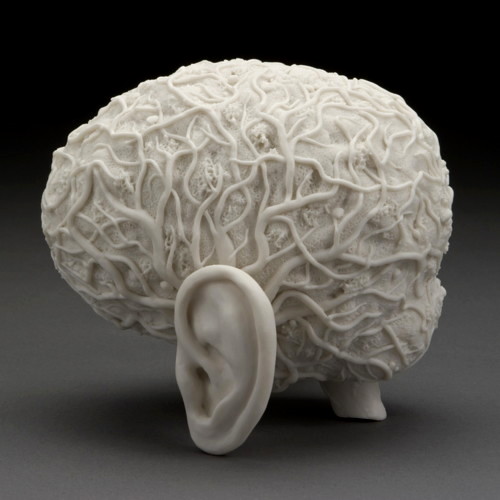
  Rootbound

by Zoë Pollock

"We Will Keep Our Dreams" by James B. Kenyon first appeared in The Atlantic Monthly in 1909:

Our dreams — nay, soul, we will not let them go;
    What though the braggart world scoff and deny,
    And pygmies in the market strive and cry,
As emmet-like they hurry to and fro?
The bright hours lessen, and the shadows grow,
    But we will seek the silence, thou and I,
    Content, while fame and treasure pass us by,
To rove through quiet coverts that we know.

Yea, we will hearken to the wordless speech
    Of opening buds beneath the vernal showers;
To us the morn its dewy lore shall teach,
    The evening whisper o’er its sleeping flowers;
 And secrets the stars utter, each to each,
    Shall breathe of Peace ‘mid her immortal bowers.

(Image of Root bound by Kate Macdowell)

The Argument For And Against Palin

by Patrick Appel

A reader makes a relatively obvious – but important – point:

It seems to me there is a bit of a paradox on these efforts to call out the dangers of a Palin nomination. The message "nominating her is bad because anyone nominated might end up winning due to fundamentals" is really targeted just at Democrats and independents. But that very same argument heard by actual Republican primary voters is a reason that it would be ok to nominate her rather than the opposite.

If any Republican nominee has a chance to beat Obama, then just back the one you feel strongest about. What will most probably prevent her from getting the nomination is the opposite argument: that she is the weakest candidate by far (excluding mostly unknowns like Barbour who could turn out to be even more polarizing) in the general election match-up. That some other GOP candidates could give Obama a tough run no matter what the fundamentals are in 2012, whereas Palin is the candidate who could most screw up even a sure-GOP-victory year. The more primary voters hear that, the harder they will find it to nominate her.

Sully’s Keepers: July-August 2010

In Breitbart's World
There is no hypocrisy in my record on Trig.

Michael Steele Was Right
This is now Obama's war – and one of his choosing.

Happy 4th
Blogs first gained traction in America for a good reason.

The Conservatism Of Same Sex Marriage
Once more with feeling.

The Iraq Tragedy
You couldn't make this up.

Mel Gibson And The Christianist Right
Will the cognitive dissonance ever break?

Back From A Breather
Weigel's Trig posts added nothing to the debate.

The Long Game And The Breitbart Implosion
It was an over-reach from hubris.

How To Rebuild Neoconservatism: Palestine
Or is it just about Israel?

The Partisan Tools At Journo-List And Trig
This is your liberal media, ladies and gentlemen.

The Unwinnable War
The Wikileaks monster-doc-dump told us little new.

Poz Face
HIV literally meant death for so long.

The Unique Quality Of "Lifelong Heterosexual Monogamy"
Douthat simply ignores the lives and dignity of gay people.

The Unique Quality Of "Lifelong Heterosexual Monogamy" Ctd
Ross responds to Serwer's objections by citing Tushnet.

Does It Matter That Walker Is Gay?
Did it matter that Thurgood Marshall was black?

Stockman's Diagnosis: Still True
The roots of the GOP's fiscal abandon.

The Pope Is Not Gay
Colm Toibin's essay is quite astounding.

Question Of The Week: “The Divine Comedy”

by Conor Friedersdorf

A reader writes:

I had no idea that any large work of literature could be so well orchestrated, or so complex, or so neat.

Every story and every character fits into a great self-referential web: from one point of view God is angry justice (Inferno), in another a tempting beloved who make you long for your own redemption (Purgatorio), and finally God is the Love so great that the history of the world is only his footnote (Paradiso). Dante is so completely aware that the nature of truth shifts and contorts a million different ways depending where you stand and where you look and that finally, somehow in the deepest mystery all the opposing truths and points-of-view fit together into God's ineffable plan. It isn't that I agree with all of Dante's politics and theology, much of it I strongly reject, but his vision of a whole universe build out of only love (distorted, sorrowful, and finally, human) is so grand that it begs me to try and find myself in it.

I think that is the poem's great victory: you can find yourself in it no matter where in life you are and the poem always seems to know where you should go next. As the years have gone by, I have been slowly walking along it's plot. I remember being frozen in the pits of hell because I was young and too proud to learn from my mistakes. I could only see bodies (that is, the torture porn of it all). But like Dante's Virgil, I had older, smarter, wiser people who lured me out. I remember in my late twenties when I was definitely in ante-Purgatory: I made love wait, so love made me wait. Now I am slowly winding my way up the mountain of adulthood (that only ends after my own death, I guess). When I find myself in the world of the proud, I study the geniuses of art and morality and try to become humble. When I am in the world of the envious, I try to serve others. Lately I have been hanging out with the slothful as I have been trying to learn the value of hard work – we'll see how that goes. Hopefully, as Dante predicts – and I am becoming more sure that he is correct – it gets easier as you go, "like a boat floating upstream."

Question Of The Week: “Koyaanisqatsi”

by Conor Friedersdorf

A reader writes:

I saw the film "Koyaanisqatsi" in 1987, as a college freshman.  I had no idea what I was sitting down to watch, but some upperclassmen in the film club I belonged to were really excited to be exhibiting this one, so I went along for the ride.  At the risk of sounding ridiculously clichéd, it blew my poor naïve little white suburban mind.  This strange, unique, beautiful movie opened my eyes to the world around me, forced me to consider my place in that world, and has had the most profound effect on the way I’ve lived my life since.

Decades later, I still turn off the lights every time I leave a room, manage my thermostat carefully, approach shopping and consuming with forethought.  I was recycling long before big blue bins became ubiquitous.  I map out the shortest and most efficient routes for driving and take public transportation whenever I can.  I could list a dozen other examples, but you would just start to hate me.  I suppose I am “reducing my carbon footprint” according to the modern parlance that has arisen in the interim about this kind of lifestyle.  But that’s not how I think about it.  Because, in fact, I don't think about it; these aren’t conscious activities for me.  The film influenced me so completely that they are now instinctive behaviors.  I’m just trying to keep my life in balance.

Do I sound terribly obnoxious?  I’m really not; I don’t proselytize about this stuff, and I honestly don’t care or expect anyone else to understand or live the same way.  The farthest I will ever go is to recommend the film, though it is definitely one that can best be appreciated in a theatre setting with great sound and no interruptions.  But sadly, as the repertory/retrospective art-house cinema is nearly extinct, you might have to just rent it, or watch it here.

Dissent Of The Day

by Chris Bodenner

A reader writes:

I used to take psychedelics often, and I understand the appeal of them. I’d probably still be using them if I knew anyone who sold them. But the pro-drug posts on the Dish, with the exception of the marijuana posts, feel like they were written people who don’t have that much experience with drugs. While it’s true that most people just have fun and move on, it’s also true that a lot of people get into pretty serious trouble. Most people who have spent time around drugs know people who have had their lives ruined, or who have been turned into really awful shells of their former selves.

What that means, as a practical matter, is that when I read pro-drug posts, I think of a cocaine addict I used to know who would fly into violent rages at the drop of a hat, or the heroin addict who got hepatitis, or even just the drunk who looked 70 when he died at 50. I’m not saying that those people’s stories ought to drive policy for everyone. Again, most people don’t end up in those places. But if you really know about drugs, you know those people. And since their stories never seem to inform your posts, I wonder where you guys are coming from.

Andrew always says the same thing – people who hate drugs are anti-pleasure. He never addresses any real arguments against drugs – the damage they often do to people.

I love acid. If I had some, I’d take some and hole up this weekend, watching old movies on TV. But the idea that it gives you some deep insight into the world is bogus. It *feels* like it gives you deep insights into the world, but it’s very hard to bring anything back to your day to day life. It’s sort of like after you’ve had a vivid dream, as you are waking up you can feel the events of the dream slip away. People who do real work — who pray or meditate over extended periods of time — have an aura about them. They seem calm, centered. You don’t really get that same feeling from acid heads.

And the idea that you can take drugs and grab ahold of some easy wisdom is really misleading. Maybe I sound like a Puritan, offended by someone finding a shortcut. That’s not where I’m coming from, though. I really wish it were true. But wisdom is hard to come by. it takes effort, and time. People wrestle with their faith their entire lives, in good times and bad. It’s hard, but it makes them deep. The idea that some molecule is going to give that to you over a weekend is similar to the idea that the right penny stock will make you rich, or that some pill will let you lose 50 lbs without exercising or dieting.

I agree with you guys that if you look at our prison population, or at what’s going on in Mexico, or in Afghanistan, our drug policy is really messed up. And it’s not just sub-optimal in some abstract sense. It’s ruining lives and communities, and in some cases, nations. It’s really wrong, and it has to be changed.

But if you’re going to have a real debate about it, you have to get all of the various perspectives to sit down together and hash it out. Simply ignoring all of the negative stuff, and talking about how much fun it is to take ecstasy, or how medical marijuana really helps people, and wow we’d really be living in the age of Aquarius if only those uptight people would take the sticks out of their asses, isn’t going to convince anyone. It’s such an unconvincing (and self-satisfied) argument that it makes people think you don’t have a good argument at your disposal. If you did, why would you deploy such a weak one instead?

If you talk about medical marijuana, and you don’t talk about the rampant fraud among people who lie about symptoms to get prescriptions, then you’re not having a realistic discussion. Some people are helped, there’s no doubt about that. Sometimes the help is life changing. But there’s a lot of fraud out there as well. It’s all part of the bigger story. And it all has to be balanced out.

For the record, the Dish has run a long series of posts on the horrors of crystal meth – here, here, here, here, here, here, and here, for instance. We’ve also aired many dissents over marijuana use – here, here, here, here, and here, for instance.

Does Politics Have A Conscience?

by Patrick Appel

Awhile back Jonathan Bernstein wrote, while talking about Romney's constant policy reversals, that "flexibility of beliefs in pursuit of office is generally a good thing in a presidential candidate." Andrew Sprung observes that Bernstein's "approach can alternately seem extremely cynical, in that it assumes that politicians are motivated almost entirely by the drive to amass and keep power, and the the opposite of cynical, since it embraces the process and its outcomes so cheerfully." Sprung's main criticism:

[W]hat if the electorate and elected official are in perfect concert about a policy that be judged by some credible outside standard (or all but unanimously after the passage of time) to be wrong?  Was the George Wallace of the 1960s a "good" governor?  Were secessionist leaders ideal democratic statesmen?  Was Mitch McConnell right to oppose New Start if a) he thought the treaty a good one and b) he thought Republicans had a reasonable chance of preventing ratification?  Does political calculation have no bottom?

The 2010 Daily Dish Awards

Hewitt-2010

Click the following links to vote for the 2010 Malkin AwardMoore AwardYglesias AwardHewitt Award, Von Hoffmann AwardMental Health Break Of The Year, and Face Of The Year. Also – for the first time -  Chart Of The Year and Hathos Alert are on the ballot. The Shut Up And Sing finalists have likewise been announced; it's now up to you to pick the worst pop song designed to reflect a profound moral conscience. I.e. the smuggest, most pretentious pop song in history.

Among the various contenders for the prizes, a roster of the big names in political and cultural discourse: Sarah Palin, Rush Limbaugh, Kos, Justin Bieber, Bill Donohue, Jim Manzi, Glenn Reynolds, Sean Penn, Bryan Fischer, Keith Olbermann, Bristol Palin And The Situation, Larry Kudlow and … Andrew Sullivan.

We're giving readers a week to pick the winners for these prestigious prizes. The polls will close on the first of the year. You picked many of the entries; we just marshalled the very best/worst for your selection.

Vote early. Vote often.

The Daily Dish Awards Glossary

Click here to vote for the 2010 Malkin Award!

Click here to vote for the 2010 Yglesias Award!

Click here to vote for the 2010 Moore Award!

Click here to vote for the 2010 Chart Of The Year!

Click here to vote for the 2010 Hewitt Award!

Click here to vote for the 2010 Face Of The Year!

Click here to vote for the 2010 Von Hoffmann Award!

Click here to vote for the 2010 Hathos Alert!

Click here to vote for the Pretentious Pop Song In History!

Click here to vote for the 2010 Mental Health Break Of The Year!