Karl Smith looks at the economics behind Peter Orszag's jump to Citibank.
Month: December 2010
Where Is Bipartisanship Hiding?
Chris Beam attacks No Labels, a new bipartisan political group:
No Labels sounds noble in theory. But the group misunderstands what bipartisanship is. It's not two parties deciding to be nice to each other. It's a moment when their self-interests happen to align—moments that are increasingly rare. Washington does not have a "civility problem." It has a polarization problem. Politicians aren't any meaner now than they were 30 years ago. It's just that over the last few decades, the two parties have become more ideologically coherent. Back in the 1950s, some Southern Democrats opposed racial integration, and some Republicans in the North favored a robust social safety net. Opposition to abortion was a bipartisan affair. There was a Christian right, but there was a Christian left as well. (The first Catholic president was a Democrat, after all.)
All of that changed in the '60s and '70s.
Weigel presents a two-point plan for making No Labels, or something like it, useful.
Every. Zombie. Death.
Or the least interesting moments of The Walking Dead in 1:09.
A Perk Of Partisanship
Seth Masket highlights a social good:
Senators really do switch positions on issues just to make the president or members of the other party look bad.
Yet even if such bickering is hypocritical and convenient, there is still considerable democratic value to it. If the president and the majority party in Congress are proposing a massive overhaul of a large chunk of the economy, the public has a right to hear critiques of it. The health reform bill may well have been the best possible legislation on the topic with any real chance of passage, but that doesn't mean it was perfect, and people should know both the pluses and minuses of its features. Only the minority party has any real incentive to bring those arguments up. Similarly, only the minority party has any real incentive to investigate the president's nominees and appointees. Sure, this creates a climate of distrust, but it also has a better chance of rooting out and preventing malfeasance than bipartisan harmony does.
Winning At The Local Level
Ben Smith and Byron Tau report on recent actions by gay equality activist Tim Gill. Josh Green, who profiled Gill a couple years back, weighs in:
What was interesting about Gill in 2007 was that he was the rare major donor content to remain anonymous; indeed, his political strategy of quietly jumping into races at the last moment with boatloads of money to defeat anti-gay politicians depended upon it. Gill's great success in the last few years was influencing the makeup of Iowa's state legislature, knocking off opponents and supporting gay rights' advocates (not all of them vocal), in anticipation of the Iowa Supreme Court ruling upholding gay marriage. By the time that happened, the legislature had become amenable enough to gay marriage–largely as a result of Gill's years-long effort–that no law overturning the decision could pass. The court's ruling stood.
The Uneven Unemployment Rate, Ctd
This unemployment insurance discussion piques Austin Frakt's interest:
I wonder to what extent UI benefits discourage migration. North Dakota could use some workers. Nevada has too few jobs. Yet we’re paying people in Nevada whether they have a job or not. I doubt many would move to North Dakota anyway. Paying them not to makes it less likely. But how much less likely?
The Daily Wrap
Today on the Dish, George Packer, Leon Wieseltier, and Rick Hertzberg remembered Richard Holbrooke, as the man's last words took on a life of their own. Critical DADT developments here, here, and here. Assange fought Sweden over bail, Berlusconi survived a no-confidence vote, and an HIV case was cured. As bitterness among Palestinians grew, Andrew took a long look at Israel's intransigence over a two-state solution. A reader sounded off.
A reax of the unconstitutional ruling for Obamacare here and here. Mitt came out against the tax deal, thus joining the awakened opposition on the Tea Party right, and Chait heard a dog whistle. Douthat predicted a Dem revolt stemming from tax deal, Seth Masket downplayed liberal handwringing, Sprung mulled Obama's strategy, and Ezra talked unemployment rates. Ron Paul tipped his hat toward 2012. Kevin Drum and Andrew reflected on the risk-averse decade of the '00s. Andrew also went another round with Pejman over presidential legitimacy.
Bush basked in his lack of self-awareness while Limbaugh displayed a shocking dose of cognitive dissonance – in sharp contrast to the sane conservatism of Jim Manzi and Adam Ozimek. A RedStater called for invading Mexico and ACLU critics engaged in epistemic closure. Get your Palin fix here, here, and here.
In assorted commentary, Julian Sanchez cautioned celebration over Holder's reform of the Patriot Act, Avent reassured us over a bubble bursting in China, Adam Ozimek gave investment advice, Bjørn Lomborg showed how household energy efficiency hasn't gone anywhere, Stephen Budiansky charted consumption, and Adam Serwer observed downward mobility among blacks. A reader questioned Beam's article on legalizing online gambling.
More on O'Reilly's conflict with Christianity here, here, and here. More on Chicago pubs here and a new installment from Boston here. Andrew reminded us to watch the powerful documentary Restrepo. Hathos here and here. VFYW here, FOTD here, and MHB here. The latest VFYW Contest here. Get your Dish merch here and "The Cannabis Closet" with shipping discounts here.
— C.B.
Intrigue And Idealism

Leon Wieseltier on Richard Holbrooke. Rick Hertzberg:
If the Supreme Court had allowed the votes to be counted in 2000, then the Envoy, almost certainly, would have become the Secretary of State, and the next decade would have unfolded very differently. As it is, Holbrooke has left a stronger, more positive, more creative mark on history than all but a few of those who have held that post. He certainly did not die of a broken heart—Kati Marton saw to that—but it was surely the ghastly, impossible demands of his last, impossible assignment that brought on the rending of his aorta. He died for his country as surely as any soldier, and his deathbed words may turn out to be the most important he ever spoke.
(Photo: Secretary of State Hillary Clinton talks about the sudden passing of Amb. Richard Holbrooke, at the State Department on December 14, 2010 in Washington, DC. Secretary Clinton spoke to reporters during a news conference with South African Foreign Minister Maite Nkoana-Mashabane. By Mark Wilson/Getty Images.)
DADT Repeal: Will There Be Time?
Sargent does some reporting:
Some aides … want Reid to indicate that the DADT vote will happen before New START. If the Senate takes up New START first, it could take days, and once it passes, Senators may start going home before DADT is repealed. By contrast, if the Senate does DADT first, it will take far less time, and it won't put New START at risk, because no Senator is going to leave before that's done. Aides, however, signal that this is not likely to happen, because the White House badly wants START done. All indications are that Reid genuinely wants repeal to happen. Indeed, aides say he is the one who asked House Dems to hold their own vote, to make it easier for the Senate to move. But repeal's odds would be greatly improved if Reid would indicate right now that a vote is definitely going to happen.
And this is something for which Obama is responsible and should be held to account for if repeal fails.
Where Are America’s Corner Pubs? Boston.
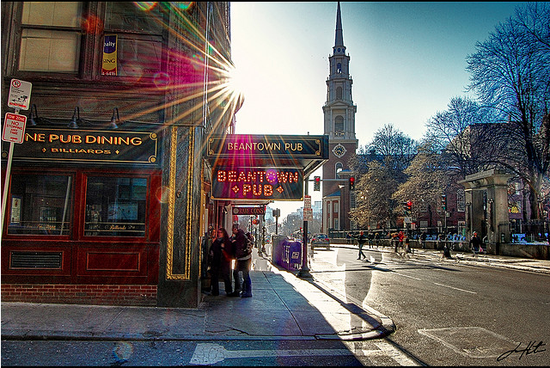
A reader writes:
I am stunned that with the sheer number of people that read you, and the percentage of those in Boston, no one has mentioned the pub culture here.
We don't usually call them pubs, of course, but exactly what the first post described is what we have: small, friendly places that are walking-distance from wherever you are, where you can grab a bite and a pint and make a new friend for an hour. Cambridge, Somerville, Allston, Brookline, even Quincy are all places with this type of culture. No loud music, just friendly people who don't want to have to deal with parking, but still want to go out for an evening.
Even in my hometown of Scituate, about an hour outside of Boston, we have our local harbor sports bar. Always a seat, always some cheap beer, always some decent food, everyone knows who you are, and if they don't, they will in twenty minutes … we call them bars, but isn't this what everyone is describing?
Why do you think Cheers was set in Boston?
Another writes:
One exception doesn't negate the rule, but if you're interested in English-style pubs as you describe, I'd point you to The Sevens Pub on Charles St in Boston. Filled to varying degrees on any given day/time with 20 something professionals, older locals reading books or cheering the celtics, or people who have popped in after a run (often still sweating). It's the definition of neighborhood pub.
Another:
I just got back from my first trip to London, and, like with other European cities I've been too, I was pleasantly surprised at how similar it is to my hometown of Boston.
You know Boston and Cambridge – and especially some of the neighbourhoods between Harvard Square and Davis Square, in Somerville – are full of pubs, just like London. New Yorkers come to Boston and woefully complain about the nightlife, but I can't think of anything better than a hot cider made with port next to a plate of fish and mashed potatoes, enjoying being able to actually hear the conversation at my table at Grendel's Den. Or trivia night, Thursdays, at Harvard's own pub, the Queenshead, which has terrible food but also rocking chairs. The Thirsty Scholar was great, until "The Social Network" came out and made it too popular and too crowded, but they also advertise their chef.
If someone is driving there, it's not a pub. There's something glorious about walking five minutes and nodding to the bartender when you take off your coat, and he remembers your favourite beer.
(Photo by Flickrite HuTDoG83)
 The Dish