Obama Hatred vs Bush Hatred: A Blog-Off, Ctd

Pejman Yousefzadeh goes another round.

I think he's wrong to say that the Republicans who backed an Af-Pak "surge" to save a Bush era war are the equivalent to Democrats supporting Bush tax cuts just after the most divisive and polarizing election in decades. I think his point that three Republican senators backed the stimulus package somehow disproves the GOP's near-total obstructionism in the middle of a terrifying economic and financial crisis is also silly. I find his evidence that Carville and Greenberg had told some reporters that they wanted Bush to fail but then switched dramatically as soon as 9/11 happened … counts for something, but not much. Obama took office in a terrible crisis and asked for support from the GOP. He got none. Bush took office in a period of peace and prosperity, asked for Democratic support after losing the popular vote to a Democrat, and plenty went along, respecting the president's legitimacy. After 9/11, almost the entire Democratic party backed him.  The Dems simply get the give-and-take necessary for civil governance. The Republicans simply cannot tolerate the idea that anyone else can represent and govern America and act like spoiled children if they do not get their way at all times.

I remain quite persuaded of the relative dickishness of the GOP with respect to Obama (elected in a landslide in what looked like a Second Great Depression) compared with Democratic hostility to Bush (elected by a Republican majority on the Supreme Court after inheriting a surplus and a boom). I also remain persuaded that the racial and cultural forms of delegitimization – from the birthers to the tea-partiers – are far more potent and incendiary than the spittle-flecked hate of the hard left. This news doesn't exacly hurt my case:

The Senate has overseen the slowest pace of judicial staffing in at least a generation, with a paltry 39.8 percent of Obama's judges having been confirmed, according to numbers compiled by Senate Democrats. Of the 103 district and circuit court nominees, only 41 have been confirmed. By this time in George W. Bush's presidency, the Senate had confirmed 76 percent of his nominees. President Clinton was working at a rate of 89 percent at this point in his tenure.

Yes, the hard left were furious at what they saw as a fraudulent election. Pej even hauls out Michael Moore to buttress his claims. And I agree. But even as I excoriated them, they had a sliver of a point, no?

Only the second ever presidential election that gave the prize to the popular vote runner-up was bound to unleash passions. But what crime did Obama commit before he took office to be portrayed the way he was almost instantly by the hard right? What policies has he pursued that he didn't fully explain and fight an election on? How is a bank bailout socialism when a Democrat continues it, but rescuing capitalism when a Republican initiates it? Why is a stimulus package anathema under Obama when it was fine under Bush?

I carry not water for the anti-Bush excesses of the far left. I didn't at the time and I don't now. But at no point did the Dems unite against Bush the way the GOP united against Obama in his first eighteen months; and at no point did they coopt the language of extremists into their core message, as Palin and Cantor have.

As Netanyahu Gloats

It's been a great week or so for AIPAC, Netanyahu, the neocons and all those who desperately want to find reasons to avoid a two-state solution in Israel-Palestine. Tom Friedman threw up his hands last weekend – but his analysis was, to my mind, far too even-handed. Money quote:

Israel, when America, a country that has lavished billions on you over the last 50 years and taken up your defense in countless international forums, asks you to halt settlements for three months to get peace talks going, there is only one right answer, and it is not “How much?” It is: “Yes, whatever you want, because you’re our only true friend in the world.”

Palestinian President Mahmoud Abbas, what are you thinking? Ehud Olmert, the former Israeli prime minister, offered you a great two-state deal, including East Jerusalem — and you let it fritter away. Now, instead of chasing after Obama and telling him you’ll show up for negotiations anywhere under any conditions that the president asks, you’re also setting your own terms.

Notice that there is no parallel here in time. The Abbas rejection of the Olmert offer preceded Obama's term in office; the Netanyahu government's refusal to make any sacrifices or concessions to its indispensable ally occurred entirely during Obama's term of office. Moreover, the reason Abbas turned it down, according to George W. Bush, was because Olmert was being ousted from office because of a corruption scandal and Abbas was not sure he was negotiating with a leader who could subsequently deliver. That's important context for Friedman's alleged moral equivalence between the two sides under Obama.

Since 2009, the new leadership of Abbas and Fayyad has done nothing wrong, so far as I can see, except insist on a freezing of settlement construction in the occupied West Bank and East Jerusalem before they negotiate. Obama's critics have argued that this precondition was the error – not Netanyahu's intransigence. I really don't see this. No one can defend the settlements in the context of a two-state solution; to negotiate while you are aggressively moving the facts on the ground to maximize your leverage is not a clean negotiation. It's a negotiation where one side has an interest in stalling while it achieves its real end of permanent occupation and NETANYAHUJimHollander:AFP:Getty colonization. Ending that construction is therefore essential to establishing a viable dialogue between the two sides.

Look: I'm not exonerating the Palestinians for their countless missed opportunities in the past. They bear real responsibility over the decades for their own plight. But when they change behavior – and Fayyad and Abbas surely have in constructing the backbone of a democratic state on the West Bank for years now – they deserve rewarding. And yet they are still treated almost as dismissively as Hamas, which, of course, has benefited greatly from its rival's inability to get any substantive concessions from Israel.

But there's no point in window-dressing this. After the mid-terms, Netanyahu was assured by his US operation (from Cantor and Cheney and Krauthammer on down via the Washington Post to McCain and Lieberman and Graham) that he could wait out Obama. He was so sure of it he even demanded written assurances of the massive bribes the US was offering to get even an extra three-month moratorium on construction. Obama's decision to give up this desperate tactic perhaps reveals he now understands just how cynical and self-serving Netanyahu is, even as he ponders what to do next. (Netanyahu recently asserted that all of Jerusalem would be Israel's for ever, meaning that he will never back a viable two-state solution.)

This is therefore a big win for the "pro-Israel" lobby, and it proves indisputably that in any serious contest between an American president and an Israeli prime minister, the US president doesn't have a prayer. He is emphatically the junior member of this "alliance." Netanyahu was right:

“I know what America is. America is a thing you can move very easily, move it in the right direction.”

And so the whole possibility of outreach to the Muslim middle – a key pillar of the rationale for the Obama presidency – is in danger of being derailed by seeming proof of what so many Muslims in the world believe: that Israel occupies a unique place in global politics in being capable of directing the foreign policy of the alleged hegemon.

See, the Arabs and Europeans and leftists and Jihadists are now saying: "We told you Obama could not break through the anti-Muslim paradigm of American foreign policy. Because he is helpless in the face of Israeli power. He is Bush in camouflage – and if Obama is Bush in camouflage, there will never be a US president capable of being an honest broker." If you want to give a boost to the ideology and paranoia that fuels Jihadism, you couldn't have come up with a more lethal scenario.

But the US president is only helpless when he needs the Israelis' cooperation with the Palestinians, when he operates within the paradigm that has framed US administrations on this question for two decades.

He is not helpless in explaining and advancing the sane two-state solution everyone knows we need in the wider context of the international community. Today, Bob Wright proposes an obvious way forward past the intransigence of an increasingly radicalized and fundamentalist Israeli right and center:

The United Nations created a Jewish state six decades ago, and it can create a Palestinian state now. It can define the borders, set the timetable and lay down the rules for Palestinian elections (specifying, for example, that the winners must swear allegiance to a constitution that acknowledges Israel’s right to exist).

Establishing such a state would involve more tricky issues than can be addressed in this space. (I take a stab at some of them at www.progressiverealist.org/UN2states.) But, however messy this solution may seem, it looks pretty good when you realize how hopeless the current process is.

Israel's international isolation is growing, which is why this approach may be more amenable to Israel's government than the nightmare of constant fruitless diplomacy. Bob:

This month Brazil and Argentina recognized a Palestinian state with 1967 borders. By comparison, a United Nations solution looks Israel-friendly. Borders could be drawn to accommodate some of the thickest Israeli settlements along the 1967 lines (while giving the new Palestinian state land in exchange). But perhaps the biggest advantage is the political cover this approach would give President Obama.

Sure, he’d have to endure some noise from America’s Israel lobby. But at least he’d have to put on his noise-canceling headphones only twice: (1) when he agreed to explore this path with other members of the “quartet” — the European Union, Russia, the United Nations; (2) when the quartet, having produced a plan, handed it to the Security Council, at which point America would vote for it, or at least not veto it.

Yes, we can have a Middle East foreign policy that reflects America's goals and interests. Maybe the silver lining of Netanyahu's triumph is that it might become a pyrrhic one.

(Photo: Jim Hollander/Getty.)

What If Gary Johnson And Ron Paul Run?

Paul tells the NYT there's a 50% chance he will run again in 2012. Larison is chuffed:

Instead of the usual 7 or 8-against-1 odds that prevailed during the Republican primary debates in 2007 and 2008, Johnson and Paul would be a ready-made pair of allies criticizing the other candidates and presenting their alternatives in turn. 

Yay!

Republicans Against The Tax Deal

I wondered when the Tea Party would wake up. Ezra Klein wonders if Republican legislators are about to bolt:

With Palin, Romney, Limbaugh and the largest tea party group on the same side of this, I'd bet there are plenty of elected Republicans looking to bail. What they need is an excuse. If the House Democrats manage to make any real changes to the deal, they'll have one — and so will John Boehner and Mitch McConnell. 

One more reason for the Dems to stick together. My own view is that the backroom deal with Obama will split open the GOP coalition as easily as Sarah Palin's stooges filet a freshly caught salmon.

The Aughties: A Risk-Averse Decade

Kevin Drum reflects on the irony of the housing bust:

The entire decade of the aughts was marked by an almost fanatical aversion to risk. All those synthetic CDOs and credit default swaps, all the super senior tranches that banks smugly kept on their books, the whole panoply of measurement tools like VaR and the Gaussian copula — all of them were designed to convince investors that risk had been engineered out of the system. That's why they were so popular. Not because Bush-era investors were bold capitalists with confidence in the future, but just the opposite: it was because Bush-era investors were desperately looking for high-yield investments that were essentially fully hedged and risk free. It was a fool's paradise, all right, but it was a fool's paradise based thoroughly and explicitly on avoiding risk.

Now, of course, it's worse. Investors are still risk averse, but they're also operating in a recessionary environment in which good investment opportunities are genuinely hard to find and financial engineering no longer seems like a panacea. What's changed isn't the fundamental timidity of America's modern millionaire class, only the fact that it's now a lot more obvious.

That insight actually applies to other aspects of the Bush years. Many of us supported the Iraq War because after 9/11, we became so risk-averse that the idea of Saddam's alleged WMDs was enough reason to invade and occupy a country for a decade. We were so frightened by post future attacks, we instituted illegal torture as a mainstream US interrogation technique. We remain so terrified of loser teenage religious nuts we allow our privates to be vigorously groped at airports. We remain so terrified of adults experiencing pleasure in the privacy of their own homes that we have a "war" on marijuana that upends hundreds of thousands of lives. We are so alarmed that America may not for ever be the unquestioned greatest power on earth that we spend ourselves into bankruptcy trying to occupy or dominate the entire planet.

The only things we do not seem to be scared of are fiscal default and climate change. On those we are perfectly happy to let the winds blow where they will. Because it might just mean a little sacrifice from … us – and not from somebody else.

The War We Don’t See

Only this week, six servicemembers were killed, buried under rubble after a Taliban bomb destroyed their recently acquired outpost in Kandahar. This year, the American human toll in Afghanistan has reached the highest levels in the decade of war and occupation – a war longer than Vietnam. But we can ignore this toll because it is borne by a professional military – and remains far from many of our daily lives. Yes, we all remain loyal to the troops, and we should. But it seems to me that being loyal requires more than lipservice; it requires doing our job as civilians to figure out the strategy and tactics that these young men and women are ordered to implement. It requires paying higher taxes to pay for their efforts – and to remind us of the costs of war.

Sebastian Junger’s and Tim Hetherington’s documentary, Restrepo, now replaces “The Hurt Locker” as the movie that has helped me most understand the sacrifice and honor and horror of the wars we are now engaged in. You can watch it on multiple platforms, but I do hope you can see it. One scene in it is of such raw emotional power it actually defines what “reality television” could be, rather than what it is. (Think of “Restrepo” as a truth-charged antidote to the propaganda of “Sarah Palin’s Alaska” in this respect, although the two do not merit mentioning in the same breath.)

The war these men are fighting is as visceral, primordial and terrifying as any moment in Vietnam. Their bonds, their flaws, their fear and their tenacity are exposed with a candor that shocks. See it.

The View From Your Window Contest: Winner #28

Vfyw-contest_12-11

A reader writes:

It’s snowing, so it’s a northern temperate climate.  It doesn’t look like the US.  Also, the “hotel” sign doesn’t help, since the word is the same in English, French, and German. I’m going to guess that the minivan is the clue.  I didn’t see too many people driving those in Prague or Vienna (two cities that this scene reminds me of).  I think this is the one city in North America that truly resembles a northern European city: Quebec City.

Another writes:

It’s obviously somewhere in Northern Europe.  The cleanliness of the streets makes me think that it’s somewhere in “Scandihoovia.”  I’ve spent a little time in Oslo, so I know that some of the inner-city neighborhoods were damaged during World War II, but there was nothing comparable to the flattening of urban areas that occurred in Germany. Hence the mix of old and new.  Norway remained a fairly poor country (by European standards) until the Oil Boom of the 1970s and ’80s, so the reconstruction of central city Oslo was marked by some particularly ugly buildings, such as the modern one in the photo.  Tåkk for alt!

Another:

The colorful European architecture next to the drab Soviet-style building is so very Czech. This picture was taken facing the Acc-nifos Lublanka hotel in the Nove Mesto (new town) neighborhood of Prague, I think the corner is Tylovo nam. As a proud Czexan (a Czech from Texas, of course), I especially treasured my visit to the homeland, in fact my family is from a small town, also called Nove Mesto, in Moravia. This picture brought me back, so thanks. Now excuse me while I go eat some kolaches and remember my trip.

Another:

That’s got to be Edinburgh.  They just had that big snowfall recently, and those kind of angled streets and buildings just scream “Edinburgh”.  Even with the snow, I wish I was there having a nice Tennent’s lager in one of the nearby pubs.

Another:

Southampton, England? First time trying for this contest. But I’m hungover and just wasting time in bed, so I thought, why not?

Another:

My first thought was that the stark concrete architecture of the building on the corner seemed Soviet or at least Eastern European.  But I doubt I’d see the word “Hotel” on many hotels in that part of the word, the snow means not-Mediterranean, and a quick Google search for “yellow zigzag street lines” told me that such a thing is common in the UK.  I’ve only been to Italy so I don’t know if they occur elsewhere in Europe.

At this point I’m still completely lost, so I take another stab in the dark.  The dude walking with the girl is wearing a red and white cap.  I have no idea if the practice of wearing baseball-style caps with team colors is at all common in the UK (I kind of doubt it), but another search tells me that red and white are the home colours of Liverpool FC (and, of course, the away colours of the England national team itself).  So I’ll say the city is Liverpool.

Another:

I have no idea where this is. But I can’t wait to find out where it’s okay to park on the sidewalk and the line dividing street lanes appears to have been painted by Dali.

Another:

So, that zig-zag line for the bus stop led me to Paris, France.  Being unable to sleep, I turned on the Google Earth hotel tag and scanned the city, looking for an intersection the shape of the one in the picture.  I found a few candidates, but couldn’t pin down the exact spot and gave up after a couple hours.  Still, what I did find was generally so similar to the location in the picture that I still think it must be Paris.

Another:

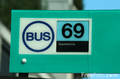
I’m guessing central Paris.  Along with the road markage being distinctly French (those zig-zag Screen shot 2010-12-14 at 12.05.12 PM yellow lines), the big tip off is the road sign with its distinct French royal blue rectangle with a flourish on the top.  In addition, the bus stop’s sign has the Parisien turquoise, though can’t quite make out the route number which would be kind of helpful. But I can’t narrow it down from there, can’t see the arrondissement or any other detailing figure.  Stumped beyond that.
Another:

The bus stop with the turquoise sign just said “Paris” to me, as I have lived there. Plus one can glimpse the blue street sign to the right, balconies, and the word “Hotel” displayed vertically – all typical of Paris. Less typical is the newer architecture and relative lack of storefronts. I’m going to say the 20th arrondissement because of the newer construction.

I love Paris and was just there last week being interviewed for an art history film. I met my husband there (but in the 13th arrondissement), and I love to pore over Atget and Marville photographs of Parisian streets. All this makes it painful for me that I cannot name the street in this picture.

Another:

I guessed Paris right away because of those waist high poles lining the sidewalk. They are just high enough to give me excruciating pain if I’m not looking carefully where I’m going. The modern architecture would suggest either 7th district or one of the outlining districts, maybe 16th or 18th.  There’s also an RER sign on the bus stop. Still, the poles are all I need. They still exist in my nightmares.

Another:

The “French touch” of the picture for me are the poles sticking out on the edge of the sidewalks: their function is to prevent cars from parking on sidewalk. The renowned Parisian sophistication goes through the window when they’re behind the wheel.

Another:

All your French readers will probably guess this one, or be close. Apart from the snowstorm that fell on northern France last Wednesday, there are many clues. The bus stop, the street lights, the street signage all look French. The hotel seems like a typical Paris and close suburbs building, as well as the street sign. I thought the shop’s sign was for the optical chain “Krys”, but couldn’t find a shop close to a crossroad with the required angle on Google Maps. So I have no clue as to the exact location.

Another:

I grew up in Paris, and the photo has the unmistakeable feel of somewhere in the 5th or 10th arrondissement. In any case, native or not, the tell is the green translucent plastic garbage bag hanging from the pole: after 9/11 they turn all public trash cans into see-through monstrosities.

Another:
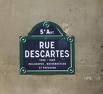
Rue-signIt’s definitely in France, because of the “French Windows” of the neighboring building, and it’s probably in Paris because of the shape of the street sign. The shape of the street sign is distinctive for Paris, at least to my knowledge: the rectangular field states the street name, a number under the bow above indicates the arrondissement.

Another:

I know this scene is in Paris, not just because I live here but because of the bus stop, the shape of the little blue street sign on the side of the building on the right and the bollards on the sidewalk. But the street sign is too blurred and so is the bus number for that stop. I just spent an hour on Google Earth looking at all the stops for the dark blue bus lines in Paris, but can’t find that spot. :-(

Another:

As soon as I saw the picture I knew it must be Paris, and it wasn’t hard to work out that it must be in one of Paris’s 19th century quarters, full of geometrically-designed streets meeting at acute angles. This is the intersection of Rues Commines and Froissart, Paris 75003. The building itself will carry several numbers, but the photo was taken from a window directly above Skyman Production company, listed at 1 Rue Commines. It’s the white building opposite the bank, and the photo was taken from the corner window on the top-but-one floor. I am rubbish with HTML etc, so after much fiddling with the code, the best I can do is insert a link to what I hope will be a google maps street-view of the building itself: Link.

I have probably cycled past this intersection on one of the city’s excellent rental bikes, on my many attempts to get from my cheap hotel near Porte de Clignancourt to the archives and libraries I’ve been using around Place Bastille as I work on a PhD in French history. The major roads near here are very busy and potentially dangerous (though I’ve never had trouble), so I would often cut through smaller streets like these. Brilliantly, this area is only a couple minutes walk from the delights of the Marais, and from the more trendy eastern districts. I envy your photographer his vantage-point.

Correct intersection! Another reader illustrates it further:

First, the architecture suggested continental Europe, and I recalled that there had been heavy snowfall in Paris recently. The details of the bus stop (zigzag pattern in the street, dark blue stop name sign, greenish route number sign) confirmed that it was Paris. From there, it was off to Google Maps to find narrow street blocks that looked similar to the layout of the photo. By chance, I was poking around Marais and found a likely candidate, so I switched to Street View and followed the bus I saw to the very street corner in the photo (the unusual shape of the ground floor window in the VFYW photo was the key to recognizing the place):
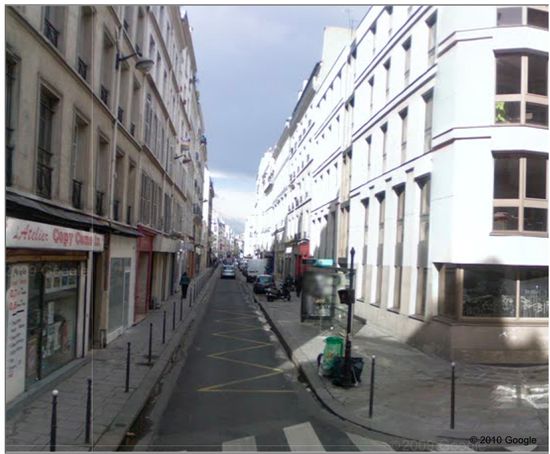
Rue Commines

The photo is taken from the building almost directly across the intersection from the unusual window:
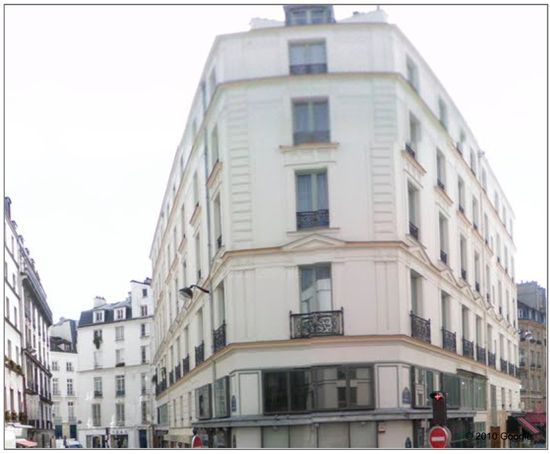
VFYW building

Remarkably, several readers guessed the correct intersection, building, and window. So to break the tie, this week’s prize goes to the only correct guesser of a difficult window in the past who hasn’t won yet:

Hotel_Commines2 The photo was taken from a 4th floor apartment on the corner of Rue Commines and Apartments1 Rue Froissart, Paris (Le Marais, 3rd Arrondissement). The hotel at left is the Hotel Commines (avoid at all costs, according to reviews!). The building across the intersection is an office block that appears to house several lawyers, whilst the apartments from which the photo was taken can be rented for about 1100 Euros per week.

From the reader who submitted the photo:

I took it from the fifth floor (sixth counting US-style) of the building at 92, rue deAnswer Turenne at 1:30p  on December 8, 2010.  View is of the Bretagne bus stop on line 96 at the corner of rue Commines and rue Froissart in the 3rd arrondissement.
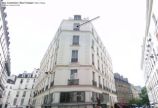
It’s really fun to see it posted, and we can’t wait to see the guesses on Tuesday.

One of our favorite guesses:

We figured out the city by googling different European bus stations and realized this is Paris. We then split the city between us and used Google street view to browse the streets of Paris, looking for this specific corner. Not necessarily a smart move but we had a lot of time on our hands. Paul McCartney was rehearsing on the monitors. As he was singing “Give Peace a Chance” we were all virtually walking the streets of Paris. Thanks for a great day! The Interns at SNL …

See you Saturday!

(Archive)

DADT Repeal: Yes We Can

How? By a simple, fresh House vote and a simple Senate vote, divorced from other issues:

“There has always been the possibility of bringing up the repeal as a free-standing bill in the House or Senate,” Pelosi spokesman Drew Hammill said in a statement Monday night. “As we come to the end of the session, all options to repeal ‘don't ask, don’t tell’ are now on the table.” House Majority Leader Steny Hoyer (D-Md.) has been working on a bill with Rep. Patrick Murphy (D-Pa.), with language reportedly tracking a bipartisan measure introduced last week in the Senate. The House approved a Murphy repeal amendment to the massive defense authorization bill, 234-194, in May.

And part of the pathway to this is resolving the tax cut deal as soon as possible. As I've noted before, the final days of this Congress are revealing it as a remarkable closer – after a remarkably substantive two years.