Holbrooke, RIP

George Packer remembers:

His [government] work was so core to his being and happiness that, once he started his new (and nearly impossible) job, it was as if a pilot light inside him had suddenly become a flame: his eyes had a new gleam. He harbored a dose of skepticism about the Afghanistan war, but he worked tirelessly for success, to the obvious detriment of his health. In a sense he gave his life for his country.

Is Obamacare Really Unconstitutional?

A somewhat surprising blogospheric chorus of: meh. Reihan:

The individual mandate is a rhetorical device. To pay for a new health entitlement, we need to impose a tax. But to mask the cost of the new health entitlement, the president and his allies chose a more complex structure. That’s really all there is to it. The federal government can very easily offer everyone health insurance, and it can offer a choice of private insurance providers through an exchange. This is roughly what happens in a number of advanced market democracies. Yet if the individual mandate is found unconstitutional, the federal government will have to do this through a more transparent and coherent vehicle.

Chait:

Hudson conceded that striking down the individual mandate would not invalidate the whole Patient Protection and Affordable Care Act. If you strike the individual mandate but leave the rest, you have a system that could easily be patched up with a better mechanism to avoid free-riding. The real loser here is the health insurance lobby. Health insurers would have preferred to avoid any health care reform at all. But the health insurance lobby’s second-highest priority would be a working system with an individual mandate. A world in which they cannot discriminate against sick people but in which healthy people can avoid buying insurance until they’re sick is a nightmare.

Megan:

… a year ago, proponents of the law were dismissing legal charges as crackpottery with no chance of succeeding.  Now, while it doesn’t look precisely likely that the law will be overturned in the courts, there does seem to be at least a small chance it will happen.  As it should be in my opinion, even though I’m aware that this could have a disastrous impact on the insurance markets.  If the law stands, what does that mean for American liberty?  Or to put it another way:  what do supporters of the law think the government can’t force you to buy, and how do you reconcile the answer to that question with the rights the government is now asserting?

Josh:

A year ago, no one took seriously the idea that a federal health care mandate was unconstitutional. And the idea that buying health care coverage does not amount to “economic activity” seems preposterous on its face. But the decision that just came down from the federal judgment in Virginia — that the federal health care mandate is unconstitutional — is an example that decades of Republicans packing the federal judiciary with activist judges has finally paid off.

Richard Epstein:

The decision of Judge Henry Hudson in Virginia v. Sebelius is no bird of passage that will easily be pushed aside as the case winds its way up to its inevitable disposition in the United States Supreme Court. The United States gave the case its best shot, and it is not likely that it will come up with a new set of arguments that will strengthen its hand in subsequent litigation.

Ilya Somin:

The weakest part of Judge Hudson’s opinion is his analysis of the government’s Necessary and Proper Clause argument, which merely claims that the Necessary and Proper Clause only authorizes legislation that is linked to an enumerated power, but does not really explain why the mandate is not. In my view, a far better answer to the government’s argument is that the mandate isn’t “proper” even if it is “necessary” and that it runs afoul of the five part test recently outlined by the Supreme Court in United States v. Comstock. I discussed both points in some detail in the amicus brief (pp. 25–30), and in a shorter form here

Robert Alt:

Although the severability question is far from clear, we think the best evidence of what Congress and the President would have done is found in the statements of its leading sponsors (including Sen. Baucus) and President Obama that the individual mandate was absolutely essential to the economic scheme in the rest of the act.  In short, they would not have enacted the law without the individual mandate, and thus, the entire law should be struck down.

Don Taylor:

The practical definition of what is constitutional these days is whatever Anthony Kennedy thinks. This is the clearest, simplest treatment of the constitutional issue I have read, and makes me think the individual mandate will be upheld eventually (as does private convos with a couple of constitutional lawyers). …

No country has gotten anywhere near a universal coverage system without some type of a mandate, or a mix of mandates, and neither will we. Medicare, for example, is a type of mandate because you must pay payroll taxes, and then you are eligible for insurance.

Assange Granted Bail

ASSANGEMASKLeonNeal:AFP:Getty

The latest on the extradition case in London. And the twists keep coming:

3.36pm: Hang on. Swedish prosecutors plan to launch an appeal against the decision to grant Assange bail. They have two hours to do lodge an appeal. Assange will not be freed until that process is over.

Alexis Madrigal’s constantly updated summary of Wikileaks and all it means is here and invaluable.

(Photo: A mask depicting Wikileaks founder Julian Assange hangs on a fence outside the City of Westminster Magistrates Court, ahead of a hearing for the Wikileaks founder, in London on December 14, 2010. Assange blasted Visa, MasterCard and PayPal Tuesday for blocking donations to his website, in a defiant statement from behind bars ahead of a fresh court appearance in London. By Leon Neal/AFP/Getty Images)

Epistemic Closure, ACLU Edition

Balko observes that conservative critics of the ACLU remain strikingly ignorant about what the organization actually does:

In May, Matt Welch noted a storm of criticism from the right toward the ACLU for not defending some kids who were sent home from school for wearing shirts depicting the American flag to a Cinco de Mayo celebration. The problem was that the ACLU had intervened on the kids' behalf. The conservative critics just didn't bother to check. I'm working on a column that'll look a bit more at the right's oft-mistaken "Where's the ACLU?" syndrome, but I thought I'd share a pretty glaring recent example I found while researching it.

He goes on to detail the organization's work pushing back against TSA's treatment of passengers, and juxtaposes that fact with the conservative fantasy that the ACLU is being hypocritical by failing to protest.

The Daily Bile Of Limbaugh

Sometimes the hackery is so blatant it's amusing. Here's a December 10 classic:

The unemployed are being treated as virtuous.  They are being treated to further payments while not working, now up to three years.  You're seeing more and more Democrats come out and actually wage war on the rich; wage war on working people; wage war on creative people; wage war on the people that provide jobs; wage war on the productive people of this country.  You see it now.  It's been a little bit more abstract, but now these guys lost the election, and the mask is off and you are seeing the genuine Marxists that they are, you're seeing it, and you're seeing the venom that's attached to 'em.  I mean they look at what happened to Charlie Rangel as fair.  You know, there's an all-out war against productive self-reliant people in this country by the Democrat Party.  That's what you notice.

Shortly therafter he goes to a commercial break. And when he returns?

Ladies and gentlemen, if we were on the ball and if the Republicans were on the ball, the question being asked would be: Why are the Democrats trying to take away unemployment extensions here at Christmas?  That's how this ought to be framed.  If we were on offense, that would be the question: Why are the Democrats trying to take away unemployment benefits here at Christmastime?  That would put them on defense.  That's the question we should be asking.

This isn't surprising to anyone who pays any attention at all to the man's cynical, dishonest, disgusting daily broadcast. But it's worth noting if only to show the blinkered judgment of all the people in the conservative movement who continue to stand by the man.

The Uneven Unemployment Rate

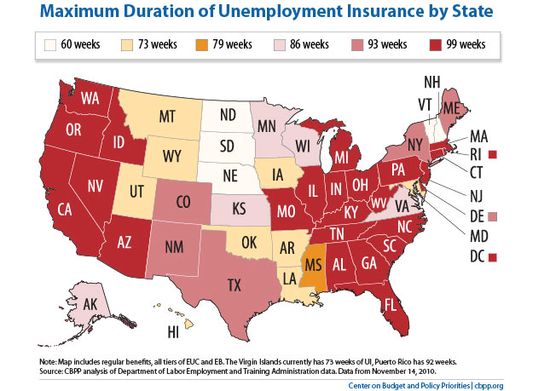
UnemploymentDuration

Ezra Klein explains how unemployment insurance durations depend on state unemployment rates:

North Dakota, for instance, has a very low unemployment rate. It doesn't make sense to have 99 weeks of unemployment benefits in a state where unemployment is 2.8 percent. That's when unemployment benefits really do discourage work.

But it does make sense to have 99 weeks in Nevada, where the unemployment rate is 13.7 percent. That's a state where the problem is too few jobs, not too few workers willing to take jobs. And that's basically how the three-tiered unemployment insurance system is working: States with high unemployment are getting very long extensions, while states with lower unemployment are getting less. Here's a map breaking it down:

Leaving Christianism Behind

A reader writes:

I really appreciated the "Radical" David Platt video you posted.  Some of us are already there.  I've been following your blog daily for two or three years now and have appreciated your ventures into theology and discussions of Christianity.  You are right on in your diagnosis of American Christianism and the Right's complete misreading of the Bible.

What you've probably missed is the extent that ideas like David Platt's Radical have already taken root in modern evangelicalism.  I live in Boston, so maybe I'm an outlier in the nation as a whole, but in evangelical circles here you are about as likely to find a liberal evangelical as a conservative one with the majority self-described moderates or totally apolitical. The emerging evangelism is more concerned with social issues like poverty and healthcare than abortion or homosexuality. Certainly, we've already rejected the American Dream as orthodox Christianity and instead are discovering new ways of living simply and generously in a post-Christian wilderness.

I'm part a community of young evangelicals that live in the majority minority neighborhoods of Boston and who actively volunteer our time to the city's needy.  

What's been amazing to me is how the community that is emerging in my neighborhood is being replicated all over the country in our major cities.  The idea of forsaking the suburban life for the sake of living in commune with the urban poor was one I once thought was too radical for today's evangelical Christians.  But every day I meet more and more Baptists, Presbyterians, and independent Christians forsaking a middle-class lifestyle in order to live more radically and more Christ-like.

It gives me hope that Christianity does not need to dissolve into Christianism but that a progressive, radical Christianity is possible in a world that no longer needs the Church as an institution.  Perhaps when the Church fails as an institution, the Church can once again be like Christ.

The Long Game: A Mirage? Ctd

Andrew Sprung peers into his own blind-spots:

Regarding my own speculation that Obama may have gamed out his tax cut deal way in advance, it does raise my bullshit radar about my own propensity to forever credit Obama with playing a "long game" — an article of faith among strong supporters.  As with another article of faith — that Obama has "the right temperament to be president" — this is a meme planted by Obama himself.   I am often torn between a perception of deep strategy and suspicion that it is a mirage.

I'm sure that the truth lies somewhere in between. 

Like anyone, and especially any president, and especially a new president taking office while the global economy is in mid-meltdown, Obama has had to navigate purblind through a maze of contingency, and not every decision and utterance is a result of deep planning. In the current case, Obama may have seen the deal he struck in faint outline last August or September and still have hoped until after November 2 that the Bush cut for the top 2% could be sunset. In refusing in September to promise a veto, he was probably just keeping his options open.

What I am sure of, though, is that a commitment to finding a way to take incremental steps that advance long-term goals is so embedded in Obama's rhetoric that it is unquestionably central to his theory and practice of politics, and to his own core concept of how he operates.

A Chinese Bubble?

Avent isn't too worried:

I am less fearful about a China implosion than some others, for a couple of reasons. One is that it's easy to overstate the extent to which Chinese property markets are experiencing a bubble. In some coastal regions, ratios of prices to incomes and rents are clearly in bubble territory, but elsewhere housing isn't much more expensive than it was in 2007 or has become more affordable relative to incomes. Another is that China's government has the financial and political ability to cushion its economy against negative shocks, whereas America has lately had one or the other, and Europe increasingly has neither. It's not impossible to imagine the Chinese economy producing destabilising shocks in the next year, but China is better positioned to handle them than most.