Could The Democrats Have Gotten A Better Deal?

Seth Masket dismisses liberal handwringing:

My impression of what actually happened is that Obama looked at the political scene and said, there are two real veto players here: me and Senate Republicans.  So let's cut a deal and not worry about everyone else.  He might well have looked back at the debate over health care reform and thought, wow, the entire nation debated this for over a year, and it didn't really move the issue at all.  The public option didn't get more or less popular — it always looked pretty popular but probably not commanding the support of 60 Senators.  And the bill that he signed into law looked remarkably like what he'd originally outlined a year earlier.  So it strikes me as legitimate to ask what the value of all that debate was.

Chart Of The Day

Emissions

From Stephen Budiansky:

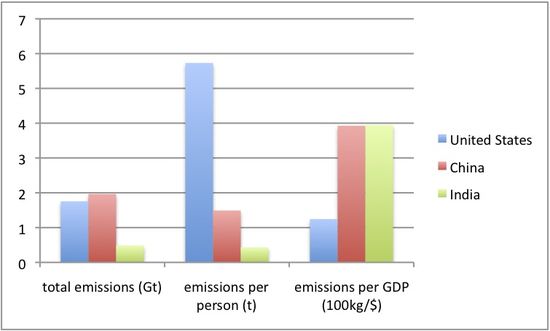
[W]hile population and affluence do increase consumption, technological gains counteract the impact of both. (And as affluence rises, it is also increasingly decoupled from material consumption altogether.)

Of course to concede that technology is often good for the environment runs against the Calvinistic, anti-materialistic strain of the environmental movement — a strain that goes back to John Muir and Henry Thoreau at least — and which tends to view the planet's ills as at heart a matter of personal guilt to be expiated through renunciation and penance. (A hilarious specimen of this was offered the other day by Prof. Kevin Anderson on Bishop Hill's blog, where he explained earnestly how little he washes himself or his clothing in order to save the planet.) You even used to hear a lot of derisive comments within the environmentalist movement about "technological fixes," as if that were somehow cheating (like buying indulgences).

Per capita comparisons are fine if you want to emphasize the idea that energy use is a personal sin and that industry and commerce either don't exist or are an evil in themselves, chargeable to our individual burden of sins by virtue of our citizenship in a country that is successful at these things. But a more sensible way of looking at it is that energy use is an unavoidable fact of existence — and so should be made in a way that produces the greatest buck for the bang.

Where Are America’s Corner Pubs? Chicago, Ctd

A reader writes:

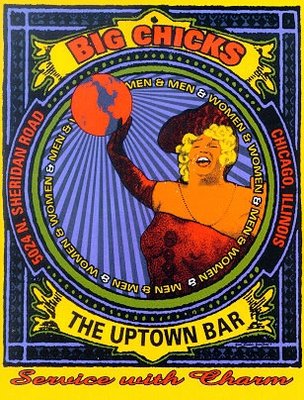
Please allow one more entry in the the Chicago pubs thread. A couple of decades ago, a pioneer by the name of Michelle Fire opened a small bar in Chicago's Uptown neighborhood.  She named it Big Chicks. 

The area, at that time, was considered by many to be a "no man's land" (and it's still dicey in places).  One of the bar's slogans was, "Men & Men & Women & Women."  In other words, it was a bar that welcomed everyone, and it was quickly embraced by the local gay population. It is also decorated with an extremely interesting collection of art.  This bar is exactly the type of unexpected treasure that brings together tipplers, partiers, and art aficionados.  (My favorite is a spin on Picasso's Les Mademoiselles Des Avignon.  Alas, none of the art is for sale.)

Big Chicks is perhaps best known for it's free Sunday barbecue (cheeseburgers, hot dogs, brats, salad, fruit and dessert) and $2 vodka lemonades, as well as its Monday $1 cheeseburger night.  It's a community meeting place that offers an open mic night, dancing on Fridays and Saturdays, a local card club, bear events, and it also sponsors local sports teams.  In other words, it is very, very popular.Bigchicks-chi

The Sunday barbecue is so popular, in fact, that the synagogue across the back alley allows bar patrons to use its parking lot.  It's not unusual to see Michelle in back  directing traffic on summer Sunday afternoons, helping to keep the free parking safe and organized.  But herein laid a problem.

Earlier in the decade, when the housing boom was on, a land developer became very aware of Big Chicks and started a campaign of mischief.  Illinois has long had a state law prohibiting any bar to be operated within 100 feet of a place of worship.  Forget the fact that the synagogue loves Michelle and the bar.  And, forget the fact that the bar had been operating since the 1940s.  Using the law, the developer attempted to close Big Chicks so that he could purchase the land, tear the structures down, and develop his own building.

The patrons banded together.  The local alternative media publicized what was happening.  The mainstream media got involved.  It took some doing, but within months, the Illinois State House of Representatives passed a law whose sole purpose was to exempt Big Chicks from the earlier described statute.  Then, the Illinois Senate passed the bill.  Then, the Governor signed the bill.  All to protect a tiny, dark bar in a forlorn Chicago neighborhood.

So much for disappearing pubs in Chicago.

Will Obama’s Base Revolt?

Douthat believes that the tax deal has made a grand deficit reduction plan before 2012 less likely:

The left-wing angst [over the tax deal] means that for the first time in his presidency, Barack Obama has to worry about liberal disaffection on a significant scale, which makes it hard to imagine him alienating his base still further by taking another plunge into bipartisanship and accepting entitlement cuts before the 2012 election. (A prediction: In the unlikely event that Obama makes a deal to means-test Social Security in the next 12 months, he will face a primary challenger in 2012.) 

Sargent doesn't see a lot of evidence of this in the poll numbers:

On the general question of whether to compromise with Republicans — and on [the tax cut] deal in particular — there does seem to be a real gap in opinion between Dem rank-and-filers and Obama's high-profile critics.

The Daily Wrap

Today on the Dish, Manchin lost his spine over DADT, Peter Orszag shamelessly cashed in on his government stint, RINO hunting season opened in Minnesota, a judge in Virginia declared the healthcare mandate unconstitutional, and Ezra explained a silver lining. Palin got her hair primped in Haiti, palled around with Kate Gosselin, elicited a hilarious quote, and continued to play the media. Andrew went toe-to-toe with Pejman Yousefzdeh over Bush and Obama Derangement Syndromes.

Drum analyzed new polling on the tax deal, Chait talked future tax reform, Continetti gave Obama credit for compromising over fiscal matters, Kristol cackled over the same, Larison chimed in, a reader defended lefty whiners, another criticized whiny Dem pols, Kaus discussed the estate tax, and P.M. Carpenter vented over Krugman's fundamentalism.

Bill O'Reilly's fundamental misunderstanding of Jesus was picked apart here, here, here, and here. Andrew disagreed with Sprung over the "doctrine of the fall". Jonathan Schanzer warned Palestinians against unilaterally declaring statehood, the Israeli far right was at it again over illegal settlements – which credit card companies were willing to support over the legal Wikileaks. Yglesias engaged Exum over local governance in Afghanistan and Joel Wing doubted a military coup in Iraq.

Stephen Walt added to the discussion over American exceptionalism, Ryan Avent had a foreboding feeling about Britain, Reihan joined the marriage debate, and Tyler Cowen commented on wedding expectations. Shirky cheered the death of news wires, Frederick Hess scrutinized school choice, and Chris Beam backed the legalization of online gambling. Frum practically begged Rich Lowry make NRO intellectually honest.

Andrew highly recommended a video on being and time. Idiotic hiking shoes here and more on Chicago pubs here. Chart of the day here. Creepy ads here and here. VFYW here, FOTD here, and MHB here. A Dishmas card from the whole crew here. And we're still selling T-shirts, totes, and the new Cannabis Closet book!

— C.B.
The Tax Deal’s Popularity, Ctd

A reader writes:

I’m a progressive Democrat and I am bewildered, appalled and exasperated by the reaction of most of my political cohort to the tax deal. My reasons are partly strategic, along the lines of your observations that it’s far better for Obama than what could have been expected and gooses the economy leading up to 2012. But my main concern is that all these Democrats (and Bernie Sanders), who profess to care about the middle class and unemployed (and, in my experience, truly do), are willing to throw those folks under the bus for what amounts to a chance to thumb their noses at the rich. Now, I’m no fan of the rich. A 90% tax bracket for billionaires sounds just fine to me. But I’m middle class. I do not want, and really can’t afford, to have my taxes go up, even marginally.

If I were still unemployed (thank God, I’m not anymore, but that’s another story) and facing a cutoff of aid, I would have been panic-stricken as the month began, elated at the news of the deal, and horrified at the actions of the Congressional Dems to sink it. Do they really think the Reeps will OK some new deal to keep the benefits flowing and the middle-class tax cut, if the House torpedoes the current deal? That’s just insane. What’s sure as death and taxes is that if this deal is upended, great hardships will be visited on millions of people this holiday season. And, BTW, you can kiss 2012 goodbye.

The Reps used the unemployed and middle class as pawns, to pry an upper-class tax cut from Obama. But the Dems are not even affording them that measly status, ignoring them altogether. I am almost completely baffled. I know these people and I know they’re intelligent and caring. I just don’t know what’s gotten into them on this issue.

Repeal, One Way Or The Other

Adam Serwer repeats himself:

[I]t may be more politically advantageous for conservatives if DADT is repealed through the courts, or they may simply like their chances better — after all, Justice Elena Kagan would likely have to recuse herself. But the administration's warning that repeal will come one way or another should be taken seriously, especially by Senate Republicans more concerned about the ability of the military to function than political gamesmanship.

DADT will reportedly get another vote in the Senate during the lame duck session.

The Upside Of Disunity

Joel Wing argues that a military coup in Iraq is highly unlikely:

A coup in Iraq is mentioned every now and then in articles and reports. Writers point to the political divisions that make the government unable to deal with the country’s long-term problems as a reason why some ambitious general may decide to take matters into his own hands. A commander would have to build up the loyalty of a large and powerful force of units to carry out his plans. That would appear to be a difficult task with so many splits within the army, and lack of a cohesive leadership structure. The Iraqi military is developing and hopefully the increasing nationalism will help overcome some of these divisions. Until then the military does not seem a good vehicle to power. As for those that talk about a coup, many appear to want some kind of answer to the country’s endless difficulties. Iraq, with its history of military rule, makes a coup seem like a possible solution to these issues. If they studied the make-up of the Iraqi army, perhaps they would be dissuaded from this line of argument.

WWJD? Something Other Than Papa Bear, Ctd

A reader writes:

Your excellent discussion of Jesus, Christianists and helping others regardless of their merit reminded me of this Zen story:

Two monks were washing their bowls in the river when they noticed a scorpion that was drowning. One monk immediately scooped it up and set it upon the bank. In the process he was stung. He went back to washing his bowl and again the scorpion fell in. The monk saved the scorpion and was again stung. The other monk asked him, "Friend, why do you continue to save the scorpion when you know its nature is to sting?"

"Because," the monk replied, "to save it is my nature."