Face Of The Day

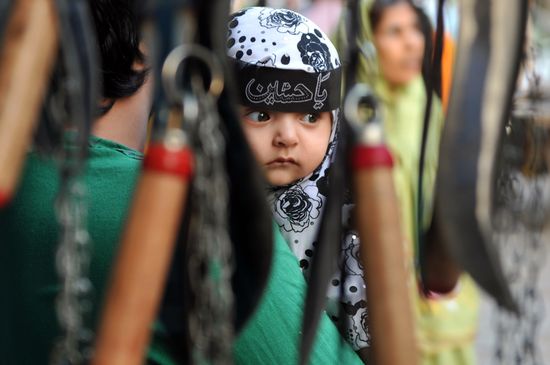
BabyAshuraSajjadHussainAFPGetty

An Indian Shiite Muslim holds his child as he stands near clusters of chains and knives used in self flagelation rituals as part of ceremonies marking the period of Ashura outside a Shiite mosque in Mumbai on December 13, 2010. Ashura is a period of mourning in remembrance of the seven-century martyrdom of Prophet Mohammad's grandson Imam Hussain who was killed in a battle in Karbala in Iraq, in 680 AD. By Sajjad Hussain/AFP/Getty Images.

Legalizing That Which You Can’t Prevent

Christopher Beam defends Reid's bill to legalize online poker. Given the gambling money behind Reid's re-election, the bill smells like a quid pro quo. But, as Beam points out, legalizing online gambling may make sense regardless:

Let's start with the most obvious reason to permit online poker: It happens anyway. An estimated 7 million Americans already log on to poker sites every month, according to one study. But the sites they visit operate outside the purview of U.S. law because they're located offshore. That means players aren't protected from fraud or cheating. If they get fleeced by another player, their only recourse is to complain to the site. Gambling sites like Poker Stars and Full Tilt Poker are self-policing. If someone's perpetrating a fraud scheme, it's up to the sites to punish them. They usually do—after all, they want to protect their reputations—but it's not a foolproof system. When an employee at a site called Absolute Poker allegedly cracked the system and looked at everyone's cards, he was caught, but the money he won by cheating wasn't recouped. If one of the poker companies disappeared tomorrow and took all its customers' money with it, they'd have no recourse.

Reid's bill would bring all this activity under the regulatory umbrella: Set up a licensing system, create standards for who can play, and enforce the rules.

Economists On Wedding Etiquette

Tyler Cowen is offering wedding advice:

Non-contractibility is a bigger problem than you think.  You can agree on the number of people, and the amount you will spend on flowers, but ex post many questions will pop up at the margin.  One of the two persons will care more about the right answer than the other.  One party will be more willing to work on the wedding than the other.  Contract in advance for a method of disagreement resolution, not just on the details of the wedding.  Get ready for the fact that one person cares less about the wedding than the other and realize this is not the same as caring less about the marriage.

More here. Ah, yes, I remember. The problem we had is that we were both in a game of chicken, as two grooms really didn't care that much about the wedding as such. When the game ground to a standoff about a month before the wedding, we desperately asked our friend, Bryan Rafanelli, to rescue us. He did. We really are bad gays sometimes.

Quote For The Day

"The overreach is beyond the ridiculous – Kate Gosselin is from a small town of 8,000 that is just as god-fearin' and gun-clutchin' as Palin's, just with smaller animals. Yet Sniff wants to paint her as a mix between Paris Hilton and Jackie O, some sort of socialite elitist. Please. I promise you Kate Gosselin has read even fewer books than Le Sniff and has way fewer high-class hob-nobbing friends. They're both worthless, but at least Kate Gosselin LITERALLY has enough sense to come in out of the rain, while Sniffy just blathers away about the nobility of being a fucking idiot.

I come from "real America," a tiny town of uber-rednecks and their women, and I promise you that exactly 0% of the women would say "stand in the rain for a few hours waiting to freeze to death while cooking some hot dogs? Ohh, YEAH!!!" – xmastime.

What Would You Pay?

Anthony Fowler and Ryan D. Enos asked Americans to pretend they could buy a congressional seat for their preferred party:

In a recent YouGov survey, we gave respondents a hypothetical scenario. “Suppose that you alone could determine whether a Democrat or a Republican represents your Congressional district by paying a specific dollar amount? How much would you be willing to pay to ensure that a Congressman from your preferred party will win the office?” We expected that most Americans would place a high value on the party of their Congressmen. Shockingly, 55% of respondents said “ZERO” — they would not pay even $1 to place their preferred party in power.

The lesson they draw:

[W]e have little evidence that Americans care about politics. They often say that they are interested in politics but they won’t put their money where the mouth is – even hypothetical money. 

The second paragraph doesn't follow first. One can care deeply about politics and still be unwilling to pay for an electoral outcome on the grounds that it would undermine democracy. 

The Majority And The Intensity

The latest poll on health insurance reform shows little real change, although the law remains unpopular by a 9 point margin, a record. But what's interesting is the intensity gap. Republicans hate the law more than Democrats love it. I think what we're seeing more generally in politics right now is the power of a highly passionate minority – in this case those Republicans strongly opposed to the law – against a less motivated minority, or less motivated majority in cases like DADT.

Where Are America’s Corner Pubs? Chicago, Ctd

A reader writes:

As a former newspaperman and lifelong Chicagoan, I just wanted to point out that The  Screen shot 2010-12-13 at 5.08.04 PM Mirage Bar wasn't run by the feds, as your reader stated. It was run by the Chicago Sun-Times, in one of the great undercover investigative journalism pieces of all time.
Can you imagine a newspaper today doing actual investigative work like that? I know, totally ridiculous. They'd be too busy telling us why we don't need wikileaks because they find out everything there is to know and tell us what's important.

Read more about the amazing story in The Mirage, by investigative journalists Zay N. Smith and Pamela Zekman. And there's more about the city's pubs in Sean Parnell's Historic Bars Of Chicago. Randy Kohl covered that book in an article called "The Gastropub Revolution":

According to Parnell, "Chicago bars are becoming more like the taverns of our grandparents' generation. Much like you'll still find in Ireland and the UK, our pubs are once again appealing to all with fine food, quality drink and a smoke-free atmosphere—though with one major improvement: in bygone days, the tavern's clientele reflected the ethnic profile of the neighborhood and were largely unwelcoming to outsiders. Today, gastropubs and gastrolounges are opening all over town, encouraging both residents and visitors to explore the city's rich tapestry of neighborhoods, particularly lesser known places like Andersonville, Logan Square, Noble Square, and River West."

Educational Choice: A Mixed Bag

Frederick Hess takes a hard look at the school choice movement:

The biggest mistake pro-market school reformers have made can thus be put simply: They have mistaken choice for competition. The conviction that school choice constitutes, by itself, a market solution has too often led reformers to skip past the hard work necessary to take advantage of the opportunities that choice-based reform can provide. Choice is merely part of the market equation; equally crucial are the requirements that market conditions permit high-quality or cost-effective suppliers to flourish, that regulation not smother new entrants, and that rules not require inefficient practices or subsidize also-rans.

Note that reformers rarely focus on "choice" when promoting market-based improvements to other sectors; in earlier decades, reformers didn't speak of "telecommunications choice" or "airline choice." Rather, they talked of "deregulation." Implicit was the understanding that deregulation involves more than the mere proliferation of options, that dynamic markets require much more than customers' choosing among government-operated programs and a handful of non-profits, and that vacuums in a particular sector will not naturally or necessarily be filled by competent or virtuous actors. Whether dealing with nascent markets in Eastern Europe in the 1990s or the vagaries of energy deregulation, reformers have struggled to nurture the institutions, incentives, and practices that characterize healthy markets. Markets are a product of laws, norms, talent, information, and capital, and the absence of these can readily yield market failures — not because markets do not work, but because markets are not a magical salve.

The Tax Deal’s Popularity, Ctd

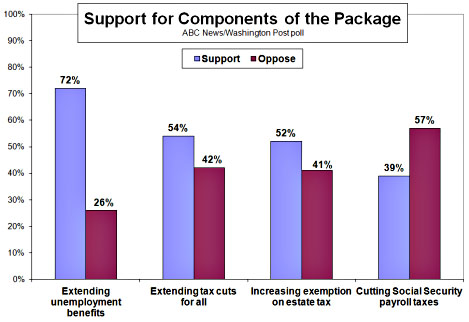
Abc_poll_tax_deal

Kevin Drum analyzes this poll

Why are so many more people in favor of an estate tax cut they'll never see but not in favor a payroll tax cut that will put immediate money in their own pockets?

Possible answers: (a) people don't really understand that cutting payroll taxes means they'll see an immediate increase in their take home pay, (b) people associate payroll taxes so strongly with Social Security solvency that they don't want to cut them, (c) people fantastically overestimate how likely they are to have a $5 million estate when they die, (d) lots of people have a strong instinctive view that people should be able to pass on their wealth to their kids no matter how much it is, (e) people are just generally confused about all this stuff and it's hopeless to try and figure out what's really going on.