Afghanistan As An Ex-Girlfriend

Michael Cohen responds to Andrew Exum’s report that “we have two “Achilles heels” in the current strategy: Afghan governance and insurgent sanctuaries in Pakistan.” Cohen emits disbelief:

Huh, you don’t say? Calling these two Achilles heels is a bit like asking Mrs. Lincoln,”other than that how was the play?” …

Sometimes when I read this stuff I feel like Afghanistan is like an ex-girlfriend that broke up with you. You’re still really in love with her, but she has clearly moved on and you keep coming up with ways to win her back, and maybe for a brief time you patch things up . . . but in the end she kicks you to the road because she just really doesn’t think you’re the one. …

Yup, that’s my analogy for Afghanistan! We keep thinking of new ways and new ideas to try and do something that simply can’t be done there. But instead of recognizing that our new ideas and ways aren’t going to work; that Afghanistan really isn’t interested in reforming its governance structure, that Pakistan really doesn’t want to crack down on Afghan Taliban safe havens we keep hoping against hope that maybe the next time will be different.

Immigration: The Fundamental Question, Ctd

Timothy Lee goes another round against Reihan:

I suspect that the process of debating and enacting the DREAM Act will actually increase the number of “slots” [for immigrants] by improving the public view of undocumented immigrants in general.

This is how politics works. If you want fewer abortions you focus on “partial birth” abortions. If you want legal pot, you start with medical marijuana. If you want universal vouchers, you start by focusing on vouchers for kids in failing schools. If you want to end the estate tax, you focus on the relatively small minority of families who are forced to sell off their business to pay the tax man. This kind of half-measure is not only much easier to enact, but it also tends to move public opinion to be more favorable to the 200 proof version. In an ideal world, voters would be perfectly rational and omniscient and we wouldn’t have to play these kinds of games. But they’re not, so we do.


What Marriage Equality Won’t Do, Ctd

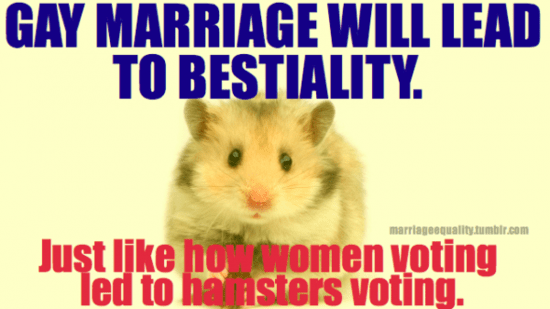
Hamsters

Eugene Volokh blesses Jon Rauch's "chill, gays" article – which is a little odd, as Jason Kuznicki points out. Volokh says he's for marriage equality but adds so many qualification and arguments from the far right, he sounds like Jeff Goldberg on Israeli West Bank settlements. Take Volokh's slippery slope argument from a year ago:

[P]eople who worry about slippery slopes generally — and who worry about slippery slopes in the field of sexual orientation and the law — can't be lightly dismissed. And it is reasonable for them to worry: If we have gotten this far partly through slippery slope effects, will we slip further, and to what? In particular, would this increase the likelihood of further broadening of antidiscrimination laws? Would it increase the likelihood that groups (such as the Boy Scouts) that discriminate based on sexual orientation will be excluded from tax exemptions, just as groups that discriminate based on race are often excluded from tax exemptions? Would it increase the likelihood that such groups will be excluded from generally available benefits?

Would it increase the likelihood of broader restrictions on anti-homosexuality speech — in government-run organizations, or in private organizations coerced by government pressure — by analogy to the broad support in many areas for restrictions on sexist speech? Would it increase the likelihood of restrictions on people's choosing roommates based partly on sexual orientation, or advertising such preferences in "roommates wanted" ads? Would it increase the likelihood of punishment of wedding photographers who refuse to photograph same-sex weddings (even if they have religious objections to participating this way in such ceremonies, and even if they feel that requiring them to photographing same-sex weddings compels them to create artistic works that they do not wish to create)? Would it increase the likelihood that legislatures will repeal religious institutions' partial exemptions from some bans on sexual orientation discrimination in employment?

But the slope stops slipping at some point. And when we slip too far we remain capable of walking back up the hill. A reader adds:

Whenever I hear the "churches will have to marry them" argument, I think of my straight cousin and his equally straight wife, both baptized and confirmed in the Catholic church. When they wanted to get married, they went to the church, the priest said the church wouldn't marry them because they hadn't been to mass or confession in years. Period. So they had to get married in a protestant church. If they couldn't force the church to marry them, how on earth could a same-sex couple force them to do so? 

This all relates to an old Ross Douthat post the Dish meant to respond to. A couple months ago, Douthat wrote a long second response to my criticism of his column . There are many points to disagree with. Here's his conclusion:

The benefits of gay marriage, to the couples involved and to their families, are front-loaded and obvious, whereas any harm to the overall culture of marriage and childrearing in America will be diffuse and difficult to measure. I suspect that the formal shift away from any legal association between marriage and fertility will eventually lead to further declines in the marriage rate and a further rise in the out-of-wedlock birth rate (though not necessarily the divorce rate, because if few enough people are getting married to begin with, the resulting unions will presumably be somewhat more stable). But these shifts will probably happen anyway, to some extent, because of what straights have already made of marriage. Or maybe the institution’s long decline is already basically complete, and the formal recognition of gay unions may just ratify a new reality, rather than pushing us further toward a post-marital society. Either way, there won’t come a moment when the conservative argument, with all its talk about institutional definitions and marginal effects and the mysteries of culture, will be able to claim vindication against those who read it (as I know many of my readers do) as a last-ditch defense of bigotry.

But this is what conservatism is, in the end: The belief that there’s more to a flourishing society than just the claims of autonomous individuals, the conviction that existing prohibitions and taboos may have a purpose that escapes the liberal mind, the sense that cultural ideals can be as important to human affairs as constitutional rights. Marriage is the kind of institution that the conservative mind is supposed to treasure and defend: Complicated and mysterious; legal and cultural; political and pre-political; ancient and modern; half-evolved and half-created. And given its steady decline across the last few decades, it would be a poor conservatism that did not worry at the blithe confidence with which we’re about to redefine it.

Like Volokh, Ross is engaging in a slippery slope argument, but Ross offers no concrete harms at the bottom of the hill. His argument is brilliant in its own way; you can't disprove invisible, immeasurable harms. It is a first principles argument that appeals to the genuinely conservative notion of preservation. But conservatism is not immune to change, it is not intent on cryogenically freezing the moral compromises of today and preserving them eternally. And conservatism must weigh unknowable potential pitfalls less heavily than known harms; what sort of perverse moral arithmetic would count the very tangible and painful consequences of denying marriage less than the immeasurable harms Ross fears?

Conservatism must have a vision for the future of marriage rather than a nostalgia for a time when marriage was primarily an economic institution. If heterosexual marriage is now about love and not necessarily about procreation (this is simply a social fact, as every recent court decision has been forced to acknowledge), and the love gays feel towards their spouses is equal to the love straights feel towards theirs, how can one logically deny marriage equality?

If love is created equal, then the institution that celebrates love ought to be open to all.

What Is Triangulation?

Bernstein's answer:

Triangulation is an advertising slogan coined by Dick Morris to advertise himself — to give him as large a share of the credit for Bill Clinton's 1996 re-election as possible. That's all. Trying to find any deeper meaning in it is like trying to find the deeper meaning in "Coke Adds Life" or "Tiger in Your Tank." Might be interesting to do it, but it's not going to tell you much about soft drinks, gasoline, or politics.

Why DADT Repeal Matters II

A reader writes:

What are the fundamentalists going to do when out GLBT service members begin earning commendations and awards for bravery?  Imagine the first gay soldier being awarded the Congressional Medal of Honor. It will forever destroy one of fundamentalism's most cherished and nurtured stereotypes, that GLBT folk are weak and craven. Military protocol requires that the entire chain of command, including Commander in Chief salutes anybody wearing that medal.  What a thrill.  I will rejoice when I someday see a President Gingrich or a President Huckabee humiliated into putting that medal around the neck of a towering, heroic, gay man.

That's precisely why so many Christianists resist this. Because it means that the most heroic American icon – the American soldier – would be revealed as gay. The Christianists cannot compute that (although many Christians, especially Catholics, can). For those who have no real interaction with real live gay people, there is an assumption that gay people are sick, perverted, miserable, and anti-American. They simply cannot bear this lie to be disproven in such an irrefutable way. So they struggle to sustain other people's closets to make their own white-knuckled and ignorant beliefs more plausible to themselves.

In the end, I believe, their heads will explode – but with the truth. Which is a good thing. God cannot be in conflict with truth. And maybe Christianity can be reborn in America through a series of such truth-eruptions.

Cannabis Closet Update

We just passed 420 sales.

You have until midnight PST for free shipping. They're only $5.95 for a quality 120 pages paperback. Buy a few and show your support for the Dish's experiment in reader-generated content and books, a deeper and more human debate on marijuana prohibition, and exposure of the publishing companies for the rip-offs they routinely get away with.

The Cannabis Closet: Reader Reactions

Ccloset

The books are flying from their virtual shelves. A reader writes:

I've been not-so-patiently awaiting the release of "The Cannabis Closet" for a while now, so I would have been a buyer no matter what. But when I found out it was selling for about the cost of a half gram of weed? Oh hell yeah. Seriously though, I love the series and I can't wait to check out my just-ordered book. Many thanks to you, Chris, Blurb, and the readers who shared their stories!

Remember: if you order before midnight tonight PST, shipping is free! You can browse the book here. (Use the coupon code FESTIVE for free shipping today; after that Dishheads get a $2.99 shipping discount, with the promo-code DISH. So the maximum anyone can pay is under $10. Buy yours here. I just bought ten for family and friends.) Another writes:

Just picked up a copy for a late Chanukah gift for my father. He's a charter member of the Cannabis Closet and a successful business owner. He loves the naj, so this will be the perfect gift. Thanks for making this so affordable, it was a no brainer.

Another:

Done and done! The VFYW book was great (it still resides on my coffee table) and at $5.95 I'll happily support the Dish.

Another:

Yay!!!! Since the T-shirts were a little expensive for us, I was happy to see that the book was so much more affordable! Thanks! I followed that thread religiously, so I'm sure that reading it as a whole will be a treat. Thanks again, and Merry Christmas and a Happy New Year to you, Aaron, your lovely dogs and all the editors at the Dish.

Once again, the book is here. And the View From Your Window book is here. (Why not make a double-gift of both for your favorite Dishhead friend or family member?)

Where Are America’s Corner Pubs? Seattle.

A reader writes:

I'm on board with Chicago, Wisconsin and Oregon, but let's not leave out Seattle. Like Portland, it is the home to numerous micro-breweries, and the corner pub is definitely a feature of every neighborhood, including Capitol Hill, Queen Anne, Belltown, and Fremont. Seattle is definitely a city where the pub crawl is alive and well. Many have amazing food – in the so called gastropubs – and many are very family-friendly. There are toys or a play area on one side and tables for the parents to spy on the kids while enjoying their pints. Please add my $0.02 for Seattle.

Another two cents:

They're on the corner of 15th Ave E and E Mercer St in Seattle, which has a number of pubs – many of which are on actual corners – dotting its neighborhoods. While my local neighborhood, the east side of 2197344320_4f0c154823_z Capitol Hill, has at least five watering holes that cater largely to neighborhood clientele, Canterbury Ale and Eats fits the definition of a corner pub. Not only is it on a corner, but it's not really good enough for people outside the neighborhood to bother with. They don't even have a website, but why bother? Anyone who would go there knows where it is because it's a fixture along 15th Ave E (the suit of armor in the entryway probably helps with that).

I came here with dozens of people for breakfast to watch Obama's inauguration. My wife and I have shared a number of Friday night dinners and drinks here that we've stumbled home from. We've run into old neighbors from our apartment building who have since moved into houses in the neighborhood. One night, ahem, resulted in our daughter nine months later. (Whoops.) And when those nine months passed, we even walked three blocks from the hospital on a pass to Canterbury while my wife was in pre-labor to watch the second half of last year's Apple Cup between the Huskies and Cougars (UW and WSU football to you non-NWers). If that's not a neigborhood pub, I don't know what is.

Another:

If you are ever in Seattle, go to Leny's Tavern (which has no website). It is a true American pub. (I am not an owner or employee or anything – just someone who appreciates a good sandwich, a cheap mug of beer, and a friendly, sarcastic bartender.)

Another:

Here's a Google Maps search for Seattle brew pubs.  We grow our own hops, grapes, and weed out here.

(Photo by Flickrite by and by)