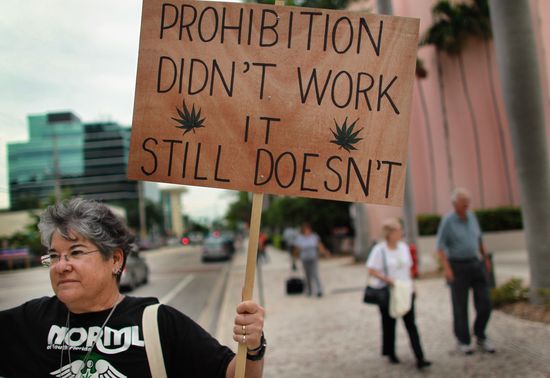
For The Pot Economy, Business As Usual

MarijuanaJoeRaedleGettyImages

Sasha Abramsky checks in on California's marijuana trade:

Following the demise of Prop 19, it's likely that the pot economy in California will settle back into the odd but familiar equilibrium of the gray market. Despite Richard Lee's optimism that a Prop 19–like initiative will pass in 2012—and despite a poll released immediately after the election that found that 31 percent of those who had voted no on Prop 19 favored some form of legalization or reduced penalties but didn't like specific language in the measure—the defeat suggests that, absent a change of heart at the federal level, full legalization may not be on the immediate horizon. Yet that doesn't mean the drug is being pushed back into the closet. In the wake of Prop 19, growers will return not to the darkness of the underground but to the dim lights of the shadows—still vulnerable, in theory at least, to federal raids but increasingly tolerated and even wooed by local and state politicians. The market is in place, and no one in California is talking seriously about tearing it down.

(Photo: Joe Raedle/Getty)
Palin Will Run

That's the impression of Jay Newton-Small, who just did a cover-story for Time on her:

She certainly is sounding more and more bullish on a run. From when I began talking with her about a story more than three months ago till two days ago when I last exchanged e-mails with her, she has sounded increasingly interested in running. And if she doesn't she's going to be awfully bored next year: her speaking engagements have tapered off (as with other potential candidates, like New Gingrich, the Washington Speakers Bureau warns clients that these speakers may not be able to fulfill their contracts if they decide to run); her book tour has ended; her TLC series is ending soon. Palin plans a foreign trip early next year, tentatively planned to England and Israel amongst other countries – a must for presidential wannabes. But after that, her schedule, thus far, is clear.

Where Are America’s Corner Pubs? Chicago, Ctd

A reader writes:

I got a chuckle out of seeing that you used the Brehon Pub to illustrate your post on "authentic" Chicago bars. Brehon (which means judge or lawyer in Gaelic) actually had the least authentic of origins. 

It was started in the '80s by federal and state authorities as a sham business (under the name "the Mirage"). Its sole purpose was to catch City of Chicago building and liquor inspectors soliciting bribes from taverns. Those friendly bartenders were all FBI agents and undercover cops. A bunch of people went to jail. When the scandal was over, the place remained a bar under a new name. Not exactly the beginning you'd expect for a cozy neighborhood Irish watering hole.

And one more thing about Chicago pubs. Historically the rule in Chicago was as long as you paid city officials their smallish brides, pretty much anyone could open a bar. That meant, unlike other cities, the early gay bar scene in Chicago was not dominated by the Mafia (Mayor Daley's men would never have let another organization horn in on the bribery income stream). The US's first gay leather bar (Gold Coast) was established in Chicago in the 1950s – a couple of decades before such things were tolerated in other cities. In the late '70s, when federal authorities raided a gay bar named Carol's, the owner (Richard Farnam aka "Mother Carol") led a protest march of 5,000 people on City Hall.

We may not be the most progressive of cities politically, but don't touch our bars.

When No Language Is Neutral

Howard Kurtz reports on a controversial Fox News Channel memo that directed news personnel on how they should refer to a provision of President Obama's health care bill. Jack Shafer – surprise! – defends the indefensible:

The call to refer to the program as the government option instead of the public option came from Republican pollster Frank Luntz, Media Matters and Kurtz report. But this shouldn't disqualify the new term from the Fox News stylebook. Government option is superior to public option in that it emphasizes that the government—and thus the taxpayers—will be footing the bill. As a modifier, public has many nongovernmental uses, as in public appearance, public figure, public display, public-key cryptography, public editor, public enemy, public storage, and public opinion.

But when government is used as an adjective, there is no such confusion. Does that make Fox News' semantic solution superior? I've always thought that Social Security should be renamed Government Ponzi Scheme. I'd also like the Export-Import Bank to be renamed the Government Subsidy Depot—but that's another column.

That Sammon issued a memo directing Fox News reporters to use a phrase he considers more accurate hardly constitutes "spin," as the headline to Kurtz's piece has it. If government option is spin, isn't public option spin, too?

Chait disagrees:

I suppose that might be a reasonable defense in a world where news organizations scrutinize every phrase for maximal accuracy. That, however, is not the practice at Fox News, or anywhere. Standard news practice is to simply keep using terms that have come into the public discourse and gained wide usage even if it is not the most technically accurate or neutral term. If you had a left-wing news network that decided it can no longer refer to military spending as "defense" because that presumes it is never used in an aggressive way, that would be an act of bias, regardless of the philosophical merits.

Where Are The Lab Coat Conservatives?

Daniel Sarewitz notes that 6% of scientists are Republicans while 55% are Democrats. Matt Steinglass wonders why:

I can think of three testable hypotheses they might look into. The first is that scientists are hostile towards Republicans, which scares young Republicans away from careers in science. The second is that Republicans are hostile towards science, and don't want to go into careers in science. The third is that young people who go into the sciences tend to end up becoming Democrats, due to factors inherent in the practice of science or to peer-group identification with other scientists. In the absence of data, I leave it to you to decide which you find most plausible. But by all means, social scientists should look into this.

Immigration: The Fundamental Question, Ctd

Reihan clarifies his position:

My sense is that many voters resent the notion that they are bigots because they are concerned about unauthorized immigration. Many of these voters are, I suspect, more sympathetic to the would-be migrants who take part in the formal immigration system, e.g., by participating in the diversity visa lottery. My sketch of a more humanitarian immigration policy would be modeled on the diversity visa lottery, only it would be restricted to the world’s poorest countries. Residents of all countries would be eligible to apply to work and settle in the U.S. through a points system that emphasizes skills, as we discussed above. Even if the total number of migrants under this system were somewhat lower than the current total when we combine authorized and unauthorized migrants, the impact of remittances and brain circulation would, I suggest, do far more for global welfare than the existing system. Remember that we’re talking about helping societies in which large numbers of people haven’t reached the two-dollar-a-day standard.

The DREAM Act, in my view, entrenches an immigration status quo that privileges a politically appealing and influential group over voiceless would-be workers.

Biking For Fun And Profit

BikeShareFredericBrownGetty

CityRyde's Jason Meinzer proposes that cities should try to monetize the benefit of riding a bike. He spoke with TreeHugger's A.K. Streeter:

One day I was reading the statistic how the Paris bike share program had reduced car trips by 8 percent in one year, and that's attributed to bike sharing, and then, it hit us – why shouldn't we be able to have revenue streams through carbon offset programs. Those bicycles trips are proven to displace carbon, there's a savings that can be quantified with precise precision, and then aggregated and certified and sold on on the open commodieties market place.

Felix Salmon runs the numbers.

(Photo: Frederic J Brown/AFP/Getty Images)

Calling The GOP’s Bluff

Howard Gleckman wants Obama to send the deficit commission's plan to Congress:

Republicans killed Democrats in November by selling voters on a wildly inconsistent platform of reducing taxes, opposing cuts in Medicare, and balancing the budget. This is absurd, but most voters didn’t know it. By demanding that GOP lawmakers vote on the fiscal panel’s plan—which trims deficits by both raising taxes and reducing future Medicare spending—Obama would issue a frontal challenge to the Republicans’ budget platform. They’d be forced to either oppose the only deficit reduction plan on the table or finally offer one of their own, thus ending their rhetorical free ride—and perhaps even opening the door to a serious deal. No matter how Republicans play it, Obama will have a chance to get back on offense on fiscal issues.

The Case Against Ethanol

It's open and shut, but that isn't stopping the Obama Administration and its EPA from continuing the anti-science approach to energy conservation:

…subsidizing blending ethanol into gasoline is fiscally indefensible. If the current subsidy is extended for five years, the Federal Treasury would pay oil companies at least $31 billion to use 69 billion gallons of corn ethanol that the Federal Renewable Fuels Standard already requires them to use. We cannot afford to pay industry for following the law. Even Al Gore has admitted he was wrong to support ethanol subsidies.

Unfortunately, the Obama administration seems bent on carving out a special niche for ethanol, with the Environmental Protection Agency moving forward with an initiative to increase the amount of ethanol blended in fuels from 10% to 15%. Coming from Illinois, a major corn-producing state, Obama's position is not surprising and is consistent with his position as a senator when he was one of five signers of a letter to President George W. Bush urging him not to repeal the tariff on foreign ethanol.

While ethanol subsidies and tariffs are supposed to lead to energy independence and reduce gas prices, numerous studies have demonstrated that the program does little for gas prices while raising corn prices and potentially harming the environment. In fact, ethanol is a story of rent-seeking that transcends party lines, providing $6 billion in benefits to an industry that has been created by the government.

To his credit, Hugh Hewitt is calling out Republicans for their support of ethanol. The linked interview is also notable for Fred Barnes' impeccable performance as a hack GOP apologist… and even he can't bring himself to stand up for ethanol!

The Daily Wrap

Today on the Dish, Andrew pondered whether Obama could finagle peace in the Middle East after starting over, and drafted a State of The Union address. James Franco's self-kiss left Andrew speechless, Peter Beinart measured the exodus of Israeli youth to other countries, and Andrew assessed the tuition tax hikes in Britain and what they've done to the Lib-Dem brand. We suffered another jolt in the DADT roller-coaster thanks to one man's bitter vendetta, and we tracked the full reax. Nate Silver decided DADT could be a nice slice of social reform pie to pair with economic reform, we kept an eye on Lieberman's tweets, and Serwer reminded us why DADT matters.

Will Wilkinson disparaged the left for its overblown reaction to the tax compromise and its silence on core liberties and Andrew agreed in principle. Hugh Hewitt hyperventilated about Tea Party opposition, Bush's economic wonk advised the right to take the deal, and Ed Kilgore considered a failed tax deal, with more analysis here. Larison nominated DeMint as the right's fiscal fraud, and Pelosi did to the tax cut deal what McCain (and Reid) were doing to DADT.

Babbage interviewed the Wikileaks Anonymous hackers, and Greenwald called it a war over control of the Internet. Andrew pointed out that the emperor still has clothes just not the power to keep them on, and Hemanshu Nigam confirmed the government probably won't ever be able to shut down the site completely. Contra Reihan, Serwer and Timothy Lee defended the DREAM Act, and Conor chalked it up to more than economics. Partisanship ruled whether attacks ads are considered fair, TSA may be categorizing airports as Fourth Amendment free zones, Google squared off with Amazon on e-books, and Matt Feeney marveled at the wave of Kelly Slater's skills.

Dissent of the day here, when Maggie met Sully here, FOTD here, VFYW here, chart of the day here, MHB here, and email of the day here.

–Z.P.