Obama is considering Bowles-Simpson tax reform as a key first step in addressing the long-term debt. The Dish rejoices.
Month: December 2010
Why DADT Repeal Matters
Adam Serwer puts the debate in perspective:
I once asked a service member who had been deployed to Iraq what she thought about DADT. She recounted how a member of her unit had asked my friend to inform her partner and child in the event that she did not make it home. For obvious reasons, this woman had to hide the existence of her family from the service. At this point she was choking back tears — both because of the thought of losing her friend, and the depth of the responsibility she had been asked to take on. Gay and lesbian soldiers will not stop fighting and dying on foreign battlefields all over the planet as a result of this vote. They will simply do so in secret.
Is Obama Making His Re-Election Less Likely?
A key paragraph from Mark Zandi's economic analysis:
It is … important to note that growth will be slower in 2012 than previously anticipated, as the fiscal drag expected in 2011 is pushed off another year. The deal will also encourage businesses to pull investment forward into 2011, to the detriment of investment in 2012. The economy will end up in about the same place—as measured by GDP, jobs and unemployment—by mid-2013.
Krugman cites Zandi and concludes that the tax deal will lower Obama's re-election chances:
[W]hat we know from lots of political economy research — Larry Bartels is my guru on this — is that presidential elections depend, not on the state of the economy, but on whether things are getting better or worse in the year or so before the election. The unemployment rate in October 1984 was almost the same as the rate in October 1980 — but Carter was thrown out by voters who saw things getting worse, while for Reagan it was morning in America.
Put these two observations together — and what you get is that the tax-cut deal makes Obama’s reelection less likely. Let me repeat: the tax cut deal makes Obama less likely to win in 2012.
Larison agrees. Drum doesn't. Nor does Ezra Klein:
The payroll-tax cuts look like the Bush tax cuts in reverse. By slapping an expiration date on the cuts, the Obama administration got twice as much as they otherwise would've (Making Work Pay, the tax cut being replaced, was only half size of the payroll-tax cut in 2011). And just as it was very difficult to let the Bush tax cuts expire, it'll be very difficult to let the payroll-tax cut expire. So the likely outcome here is that Democrats got $240 billion of payroll stimulus rather than $120 billion. That sounds good for Obama's reelection.
Republicans could, of course, try to let the payroll-tax cut expire. But then, as they've admitted, they'll be raising taxes in an election year. And nobody likes to do that.
Ryan Avent likewise believes Krugman is in the wrong:
Deceleration is not the same as "getting worse". And neither is decelerating growth the kiss of death. Take Mr Krugman's own example of the election of 1984, in which Ronald Reagan triumphed. Real GDP growth in that cycle actually peaked in the second quarter of 1983—more than a year before the election—after which it steadily slowed. From that 9.3% performance, growth tumbled to 3.3% by the fourth quarter of 1984, when voters actually went to the polls.
The second point to make is that according to Mr Bartels, it's income growth, rather than GDP growth, that really matters. And for income growth, the level of employment is clearly important; in a tighter labour market wages rise faster than in a slack market. On this score, the tax cut plan delivers. The level of employment is substantially higher with the deal than without it, and the unemployment rate is 8.4% in 2012 with the package compared to 8.7% with no package.
DADT: Third Time Is The Charm?
Bernstein takes another crack at DADT politicking:
[W]hether the new plan will work depends on whether Harry Reid and the Democrats (and House Democrats) are willing to stick around and do it. That, we don't yet know. It may depend, too, on how quickly the tax bill and any other business can be finished. And perhaps Republicans will be able to throw up enough roadblocks to run out the clock, after all.
Meanwhile, the original advantages of bundling repeal with the Defense Authorization bill turned out to have been a flop, or at least half a flop. The idea behind it was always that marginal Senators would be afraid to vote "against the troops" and would therefore vote for the larger bill even if they didn't want to vote for DADT repeal — and that other Senators who may have wanted DADT repeal but didn't want to vote for it would be spared a separate vote. Perhaps that's worked with some marginal Democrats (all Dems but Manchin voted yes today), but it certainly didn't work with Republicans.
Face Of The Day
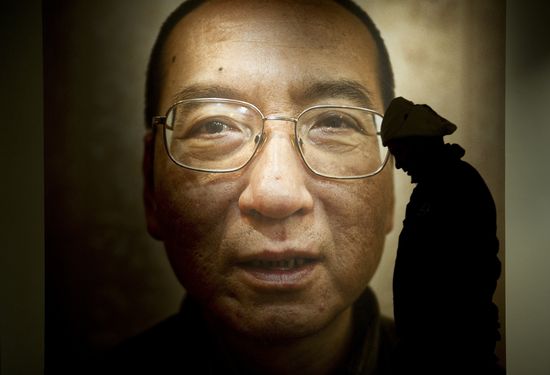
A man walks in front of a poster of Chinese dissident and peace prize laureate Liu Xiaobo at an exhibition at the Nobel Peace Center in Oslo, December 9, 2010. With the guest of honour stuck in a Chinese prison, this year's Nobel Peace Prize ceremony will center around an empty chair, as its celebration of dissident Liu Xiaobo continues to split the global community and infuriate Beijing. The Norwegian Nobel Committee head said he was surprised at the level of international support for jailed Chinese dissident and peace prize laureate Liu Xiaobo despite pressure from Beijing. By Odd Andersen/AFP/Getty Images.
Lieberman’s Tweets ON DADT
I guess at this point I'll grasp at anything:
# Senator Reid told me he will "Rule 14" the free-standing #DADT repeal so it skips cmte and can come directly to the Senate floor. about 1 hour ago via Twitter for iPhone
# We are working with our colleagues and are confident that there are at least 60 Senators who support repeal. about 1 hour ago via Twitter for iPhone
# @SenatorCollins and I and others are introducing a free standing bill to repeal #DADT today. about 1 hour ago via Twitter for iPhone
When Maggie Met Sully
Sarah Posner has an account of last night's family conversation about homosexuality at Georgetown. It was a packed house, and, although the debate did get somewhat hot at times, this was one of the calmest conversations on this topic I've been a part of. EJ Dionne was a wonderful moderator. Maggie was also sincere if somewhat, to my mind, obtuse about the real world effects of her campaign against gay couples having the legal security of civil marriage. Money quote:
Only with ice water running through one's veins could one have been unmoved by Sullivan's recounting of his Catholic boyhood, his sexual awakening as an adolescent, and, as he told it, what a lucky bloke he considered himself to be when he discovered sexual desire. As he has done in his writing, Sullivan celebrated his gayness, describing his sexuality as a divine gift, and that "the first person I came out to was God." Even the persistence of the teenage erection was depicted as a wondrous joy. That same-sex sexual desire — not just civil rights — is equally celebrated in God's eyes was both a divine (double entendre intended) and human argument to which Gallagher had no decent (again, double entendre intended) rebuttal.
The DADT Roller Coaster, Ctd
Jim Burroway pulls no punches:
Just like before, political gamesmanship trumps sound policy. But the problem wasn’t just in the Senate. Remember, it was President Obama who insisted that the Senate shouldn’t act before the Defense Department’s study was released — a report that wasn’t scheduled to be released until December 1, right in the middle of a lame duck session following what everyone knew would be a contentious mid-term election. This was his brilliant plan, and he owns the outcome as much as Reid and the GOP.
Jonathan Bernstein is befuddled:
I still don't understand Reid's thinking. Yes, Republicans could have dragged things out until January…but so what, if ultimately it gets done before the clock runs out? And what exactly is the downside if they try and just can't quite finish?
Meanwhile, Mark Udall just went to the Senate floor and said he'd like to see either another bite at this, or an attempt to bring back DADT as a standalone bill. Reid's office apparently believes that, too, could be blocked, but I'm not really sure why they believe that, if there are really 60 votes for it and, say, ten calendar days remain after the rest of their business gets done.
Ezra Klein uses the vote to attack the filibuster:
The diffusion of responsibility that comes from deciding law through complex parliamentary gamesmanship rather than simple majority-rules votes is the problem. What happened today is that a majority of the Senate voted for a bill that the majority of Americans support. The bill did not pass. Neither Harry Reid nor Susan Collins are ultimately responsible for that. The rules of the Senate are.
Sam Stein tweets:
On Manchin, aide says: “I would say that if he was somehow the 60th vote, I do not think he would have voted the way he did"
Email Of The Day
A reader writes:
A point that I keep coming back to over the past couple of days is something that Obama understands and lives out. Despite his own ideological bent, he knows he is the president of everyone and not just democrats. He seems to take that idea very seriously and I think it has and will continue to stand him in good stead.
I agree – which makes him the polar opposite to the current GOP, epitomized by Palin. They govern and will govern solely for those who voted for them. Because they regard everyone else as fake Americans. Obama? An altogether more serious and responsible figure.
Why Reid Spurned Collins
He thought four days' debate would stretch into much longer. Sargent:
I have now spoken to a senior Senate aide and put together what happened and why Reid did this.
Reid concluded that even if Collins was sincere in her promise to vote for repeal if given the four days of debate, there was no way to prevent the proceedings from taking longer, the aide says. Reid decided that the cloture vote, the 30 hours of required post-cloture debate, and procedural tricks mounted by conservative Senators who adamantly oppose repeal would have dragged the process on far longer.
"It would have been much more than four days," the aide says. "Her suggestions were flat out unworkable given how the Senate really operates. You can talk about four days until the cows come home. That has very little meaning for Coburn and DeMint and others who have become very skilled at grinding this place to a halt."
The bottom line: "Reid couldn't be certain conservative Senators wouldn't use the proceedings to foul up the Senate, with time running out on other major priorities." So, once again, the gays go to the back of line. Reid shares some of this blame – but the only real reason this hasn't gotten through is Republican opposition, in particular McCain.
 The Dish