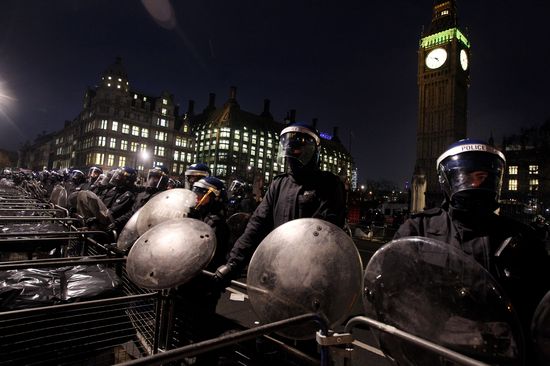
The Siege Of Westminster

RIOTBIGBENOliScarff:Getty

As student rioters ran through London's streets, attacking even a car containing the Prince of Wales and Camilla, the Coalition government got their rises in student tuition fees through Parliament. But the cost to the Liberal-Tory alliance has been considerable. The Liberals now have a staggeringly low 8 percent support in the country at large. Martin Kettle:

More than half of the Lib Dem backbenchers voted against the government. They were part of the largest revolt in the party's history. Collective governmental self-interest ensured that enough Tories went through the lobbies to win the vote. But the Lib Dems have exposed their divisions and wounds in the most public way. Things can never be quite the same. Tory attitudes to the Lib Dems have lost much of the warmth that was so striking in the summer. Tonight's Tory revolt got fewer headlines, but it was a sign and harbinger of more strained times. There is less talk about pacts or mergers now. The best of the Tory bloggers, Tim Montgomerie, claims fewer than one in five Tories want the coalition to go "on and on".

Meanwhile the Lib Dems have only their survival to cheer.

That's hardly unimportant. In other respects, though, they have had a bloody week. Lib Dem MPs have been like headless chickens, managing to split at least four ways tonight. The party sank to a new low of 8% in a poll today. The brand is particularly toxic in college towns. That's unfair in many ways, not least in the light of the Institute for Fiscal Studies finding this week that the Cable package is more progressive than both the current system and the one proposed a few weeks ago by Lord Browne. But it's a fact.
Pelosi’s Pique

The threat not to bring the tax cut deal to the floor of the House seems particularly dumb to me. Any deal that occurs in the new Congress will likely be less beneficial to the Dems or Obama. Which is why this is presumably a vent rather than a determined strategy for obstruction. At least I hope so. Between Pelosi and McCain, the sheer difficulty of getting anything done in this polarized climate, even stuff supported by hefty margins among the public, is beyond depressing.

The DADT Roller-Coaster

Rpkdg2rrcukkkgjlxy8baa

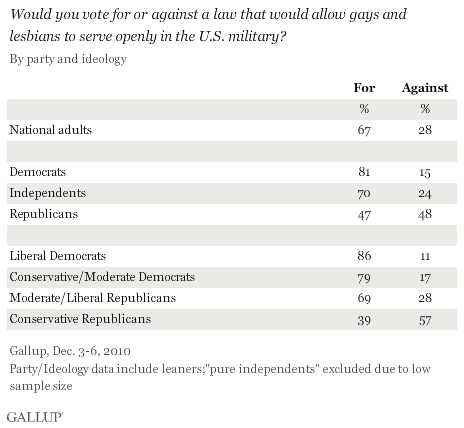
After what seemed like a reckless decision by Harry Reid to put DADT repeal to a vote before reaching an agreement with Collins to allow enough time for debate, it failed. Now, Collins and Lieberman say they will bring a DADT repeal vote to the floor as a stand-alone measure, which would require House action one more time. I have no idea whether this is viable as a way to save repeal. But one does note that repeal has passed the House, is supported by the military chiefs and defense secretary, has the backing of two-thirds of the American public, and has a 57 – 40 majority in the Senate.

This really means that John McCain's filibuster is what is killing repeal. Astonishing what one man's bitter soul can do to American democracy.

Mounting A Primary Challenge Against Obama, Ctd

Though he admits that it wouldn't be successful, Ambinder thinks it could prove annoying:

It conveys maximum anger and carries with it an implicit threat. Even if the left can't find someone who could beat Obama, they could make his reelection campaign much more challenging, and certainly create the type of distractions that a sitting president does not need. For liberals, this might not lead to disaster, especially if it looks like Republicans will nominate a candidate like former Alaska Gov. Sarah Palin, whom they believe is easily beatable.

The End Of National Security Journalism As We Know It, Ctd

A reader writes:

While you appear to approvingly quote Adam Serwer’s view on an expanded Espionage Act interpretation, this view ignores the paramount role of prosecutorial discretion in America’s legal system.  While pundits and fringe politicians will hyperbolize to gain attention, there’s absolutely no basis for believing that American news institutions are actually at risk of prosecution.  Law professor Steve Vladeck notes that “the principal restraint on the scope of the Espionage Act vis-à-vis the media has historically been prosecutorial discretion, not the Constitution.”  Reasonable people can disagree about the propriety of prosecuting Assange under the Espionage Act.  Claiming that such prosecution puts the sanctity of a free press at stake, however, is a red herring that deflects attention from a legitimate debate about a man who has shown no scruples about needlessly putting innocent people’s lives at stake.

Immigration: The Fundamental Question, Ctd

Conor begs Reihan to look beyond economics:

What I do think is that longtime residents of the United States brought here by illegal immigrant parents during childhood are in a unique position: through no fault of their own, they’ve long resided in a country where they don’t have a legal right to live or work (partly due to an incentive system set up by American citizens who are glad to employ illegal immigrants). It’s a tragedy for the affected kids. Economically they’re better off than lots of people in Third World countries who’d like to come here. But life is more than economics. Unlike would-be immigrants, potential Dream Act beneficiaries have developed friendships, formed romances, an invested themselves into communities in the United States. All that will be lost if they are forced to leave, and along with American complicity in their plight, those costs that factor into how I think about the legislation despite my not valuing people here already more than far away illegal immigrants. 

Are Negative Attacks Fair?

John G. Geer finds –surprise! – that partisanship greatly influences the answer:

[A]mong all Republicans, just 5% judged the negativity aimed the Tea Partiers to be “fair.”  Yet consider that 60 percent of “strong” Democrats did view the attacks on the Tea Party as fair.  

On the flip side:

The same story holds when judging negativity aimed at Democrats.   Among “strong” Republicans, 72% deemed such attacks [aimed at Democrats] as “fair” and only 1% as unfair.   Among “strong” Democrats, 50% deemed such as attacks as “unfair” and 6% as “fair.”  

His bottom line:

The gaps presented here underscore why it is so hard to forge a consensus in the news media or in the public on whether any attack is fair or unfair.  That judgment is so bounded up by partisanship that an objective, unbiased assessment is near impossible.    In many ways this reminder is an obvious one.  But in an increasingly partisan press, it is worth being reminded about the obvious.  And in anticipation of what will surely be a highly negative campaign in 2012, it may well pay to have additional reminders as the battle for the Republican nomination starts to heat up in just a few months and with the general election soon to follow. 

Wikileaks Can’t Be Shut Down

Larry Greenemeier interviews Hemanshu Nigam, "a former U.S. Department of Justice prosecutor of child and computer crimes who has also held high-level cybersecurity positions at Microsoft and News Corp":

You can shut down a Web site, but there's no question an individual intent on distributing that information will already have thought about keeping a copy of it in multiple other locations, either online or offline. When you run a Web site, if you're worried about an attack on that Web site, whether it's a distributed denial-of-service attack or some sort of virus attack, the best solution to those worries is to create backup plans. There could be a copy of that information sitting on a thumb drive that everyone buys at Costco for really cheap nowadays. It could be backed up on a CD. It could be stored with a cloud network storage company that can be accessed from anywhere. That's why this is a pretty significant challenge for the government to try to shut down a site—the task is, frankly, impossible.

Like the Dish, Bruce Schneier thinks that "the government is learning what the music and movie industries were forced to learn years ago: it's easy to copy and distribute digital files." What surprised him :

I'm not surprised that these cables were available to so many people. We know that access control is hard, and that it's impossible to know beforehand what information someone will need to do their job. What is surprising is that there wasn't any audit logs kept about who accessed all these cables. That seems like a no-brainer.


Groins And The Fourth Amendment

In an interview with Fallows and Goldberg, the TSA's John Pistole reacts to concerns that airports are becoming a "Fourth Amendment free" zone:

If people take an affirmative act of engaging in, in this case, aviation — they want to get on a plane — they're taking an affirmative act to do that. Then, yes, there is authority to do the administrative search for public safety purposes. As I've said a number of times, I think reasonable people could disagree as to the precise technique used on each person. So for you, it may be patting around the knees or the armpits. You might be sensitive there. For others, it is groins.

My solution. Do not fly if you can possibly help it. Conor is pissier:

Americans take affirmative action to do almost everything – to drive a private vehicle into a downtown area, to board a bus or a train or a ferry or a subway, to attend a concert or a baseball game or a political rally, to do their Christmas shopping at a mall rather than online, to crowd into a dance club on Saturday night, to buy their vegetables at a crowded outdoor market, etc. All these venues are plausible targets for a terrorist attack.

Suddenly air travel doesn’t seem so different – not to me, anyway.

Does Mr. Pistole believe that all the places I’ve described afford citizens less protection from the Fourth Amendment because everyone there made an affirmative decision to be present?