Dissent Of The Day

A reader writes:

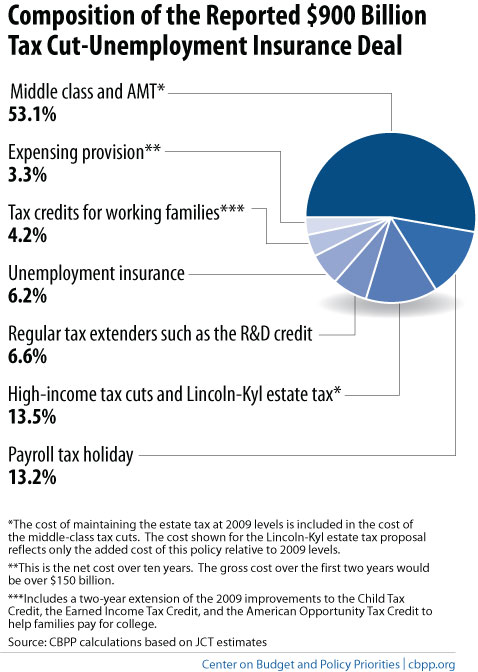
I think the question over whether the tax cut compromise is ultimately a win or a loss for Obama sort of misses the point about why liberals are angry over the whole thing. Two things he talked about in the press conference stand out for me. First, when he criticized the left for being sanctimonious and purist and seeing compromise as weakness, saying "if that's the standard by which we are measuring success or core principles, then let's face it, we will never get anything done."

The problem with that is, for the past two years liberals have watched as the right wing has been more sanctimonious and ideologically uncompromising than the left ever has been or could be, and still get everything they want and more thanks to Obama's particular way of compromising (namely, giving away the store as an opening to negotiation).

It's always the Democrats who have to be practical and pragmatic because they're the only ones who care even a little bit about actual governance, and because the other party doesn't, the Democrats always have to settle for less. Maybe it is the only way in this political climate, but it still sucks. And to be honest, I think you are being a bit unintentionally condescending here by telling liberals to basically get over it, given the fact that one reason you're not angry like we are is because the parts of the progressive agenda being sacrificed to compromise are all things you don't support in the first place. It's easy for you to take the long view; not so easy for people who've been fighting for this stuff for years. 

Also, there's the sense that Obama seems to be working from a false premise, buying into a weird Halperin-esque view of the world that somehow the country that elected Obama and the Democrats to historic majorities did so because they really wanted Mitch McConnell calling the shots. "This is a big, diverse country," he says. "Not everybody agrees with us. I know that shocks people." Thing is, they kinda do. I'm not saying the 2008 election was a huge national shift to the left ideologically, anymore than the recent midterms were a shift to the right, but on a lot of these issues he's giving away, stuff he campaigned on by the way, he actually had pretty broad public support. You often ask how the Democratic congress with it's huge majority, a president so sympathetic to the cause, and such favorable poll numbers can't seem to pass DADT, and I know you've framed that as not just a sign of political reality, but also a sign of political weakness on the part of Democrats. Well, the same can be said about the public option, extending unemployment insurance, and only extending the middle class tax cuts. Again, when you're particularly invested in something, it's a weakness when it's not done, but when you're less invested, as with all the stuff we liberals care about, that's just the way it is.

I take the point. We all tend to get more exercized over what we care about – and it's true, I have nothing like the interest in progressive taxation that most liberals do, and so don't share their outrage. What DADT and the tax deal represent, it seems to me, is the danger of procrastination. Both should have been tackled long before now (and the midterms) … and it isn't Obama's fault that Reid ducked for cover on taxes before an election (although it is Obama's fault that he waited so long on DADT – a study could have been set up very soon after his election to give everyone time to mull it over). Nonetheless, given the constraints, it seems to me that Obama's GOP-endorsed second stimulus is a rather impressive feat of jujitsu. And if he gets DADT repealed and START ratified in the same Congress, quite a coup.
Immigration: The Fundamental Question

Reihan isn't a fan of the DREAM Act:

As I understand it, the DREAM Act implicitly tells us that I should value the children of unauthorized immigrants more than the children of other people living in impoverished countries. If we assume that all human beings merit equal concern, this is obviously nonsensical. Indeed, all controls on migration are suspect under that assumption.

Timothy B Lee counters:

From my perspective, the fundamental question in the immigration debate is: do we recognize immigrants as fellow human beings who are entitled to the same kind of empathy we extend to other Americans, or do we treat them as opponents in a zero-sum world whose interests are fundamentally opposed to our own? Most recent immigration reform proposals, including the Founder’s Visa and the various guest worker proposals, are based on the latter premise: immigrants in general are yucky, but certain immigrants are so useful to the American economy that we’ll hold our collective noses and let them in under tightly control conditions.

The DREAM Act is different. The pro-DREAM argument appeals directly to Americans’ generosity and sense of fairness, not our self-interest. The hoops kids must go through to qualify for DREAM are focused on self-improvement for the kids themselves, not (like the Founders Visa) on maximizing benefits for American citizens. There’s no quota on the number of kids who are eligible, and at the end of the process the kids get to be full-fledged members of the American community.

Adam Serwer tweaks Lee's formula:

DREAM is politically feasible precisely because it appeals to Americans' generosity, sense of fairness, and self-interest. Those who would be eligible are poised to offer concrete, sustained benefits to the country as a whole. Sending them away is a waste of the resources we've already invested in them, not to mention the ones they're prepared to contribute. DREAM also shaves about $1.4 billion off the deficit in the next ten years. So while DREAMers are getting something very valuable, the rest of us are as well.

Can The World Recognize Palestine?

Hussein Ibish sees the logical next step toward a two-state solution:

With diplomacy in disarray, the importance and indispensability of state building, as the only real source of practical momentum at the moment, is increasingly obvious. On the diplomatic front, Palestinians were blocked from entrenching their position in the UN by the United States, but have succeeded in securing recognition from Brazil and Argentina, with Uruguay and several other states expected to follow. State building is practical and strategic, but increased international recognition for Palestine is important as well. Unilateralism is probably a dead end, but multilateralism isn't necessarily anything of the kind. Palestinians would be foolish not to understand that in the end Israeli opposition will make it practically impossible to establish and maintain a viable, sovereign and independent state of Palestine. But Israel would be foolish not to understand widespread international recognition of Palestine's legitimacy and existence has very significant consequences as well.

(Hat tip: Goldblog)

Take The Deal

Keith Hennessey, who worked on economic policy in George W. Bush's White House, supports the tax compromise:

Unlike many Congressional Republicans, I support extending extended unemployment insurance benefits when the unemployment rate is this high.  My back-of-the-envelope suggests that, at a 9.8% rate, between four and nine people who would like a job but cannot find one are getting more generous UI benefits for each person who is getting those same benefits and choosing not to take a job.  I’m OK with that ratio.

If I could make two changes to the bill, I’d pay for the increased spending on unemployment insurance with spending cuts in the outyears, and I’d drop the accounting gimmick that doesn’t lower future Social Security obligations to account for the lower payroll tax revenues.

If I could make a third change, I’d drop the business expensing.  This provision is a timing shift – it will cause firms to accelerate their medium-to-long-term investment spending into 2011.  That’s good for 2011 growth but bad for 2013 and 2014 growth.  Since I accept the consensus predictions that we’re in a multi-year slow recovery, that’s not a constructive change.  There are times when this makes sense.  I don’t think this is one of them, but I’m open to opposing arguments.


They Really Do Hate The Rich, Don’t They?

Will Wilkinson takes issue with the priorities of Democrats:

Even if it would be wise in the long run, raising taxes on top earners can wait until the economy's out of the woods. Conceding for now on taxes is a very small price to pay, especially if you think extending jobless benefits again is imperative. Is Mr Obama's willingness to kick this can down the road a couple years really worth getting in a twist about? I understand the frustration over the Democrats' failure to strike down this hated element of George W. Bush's legacy, but, but, but…

I guess wounded, wailing laments over the president's pathetic, weak-kneed capitulation wouldn't grate so much had I heard a peep yesterday about the administration's success in standing rock steady behind the president's legal right to unilaterally order the killing of American citizens. One would think this holdover of George W. Bush's reign would outrage liberals, but evidently one would be wrong. Perhaps liberals should take courage from the fact Mr Obama doesn't cave on everything. Besides, what's the power to raise taxes on the rich next to the power of discretionary assassination?

The "power of discretionary assassination" is a loaded term for killing an active al Qaeda member directly connected to ongoing efforts to kill innocent Americans, including a cartoonist now in hiding. But, yes, Will's core point rings true. The left's response to the deal really does highlight their redistributive passion, something the Dish does not share. Which is perhaps why it seems such a brilliant maneuver to me, and such a betrayal to them. I really don't hate the rich. The only reason to tax them more is the debt. And if we get a real deal to address the debt in the next two years, a little lee-way now to get a second stimulus seems to me to be political manna.

The Political Logic Of Repealing DADT

Nate Silver explains it:

[W]hen liberals are scoring Mr. Obama during 2012, his having achieved the goal of repealing DADT would help to reassure liberals that there had indeed been progress made. In some ways, it would represent a nice compliment to health care: one piece of economic reform, one piece of social reform. Both policies, also, proved problematic for Bill Clinton during the first two years of his term, and so achieving them would perhaps provide liberals with some sense of closure.

The BFD Of The Wikileaks Era

We have entered a new age in terms of government information and transparency. Governments are now attempting to scapegoat Asssange or pressure companies like Mastercard to squelch the new asymmetry. They remind me of those running the record industry a decade ago or the newspaper industry five years ago or the magazine industry now. Barret Brown observes the radicalism of the change:

There is no period in human history that matches the years between 1990 and 2010 in the degree to which the common terminology used at end would have been unrecognizable to those who lived at its beginning… [T]he central dynamic by which each of several billion people may now communicate and collaborate with any of those other several billion people has already been established, and all that remains now is for more of those people to realize the implications of this and then act upon those implications, as they have already begun to do, even if the media at large is still having trouble with the former.

The Emperor still has clothes. He just has no control over whether and when they are removed.

Quote For The Day

"Whatever you think of WikiLeaks, they have not been charged with a crime, let alone indicted or convicted. Yet look what has happened to them. They have been removed from Internet … their funds have been frozen … media figures and politicians have called for their assassination and to be labeled a terrorist organization. What is really going on here is a war over control of the Internet, and whether or not the Internet can actually serve its ultimate purpose—which is to allow citizens to band together and democratize the checks on the world’s most powerful factions," – Glenn Greenwald.

James Franco’s Self-Kiss

I have to say I don't know what to say. I suppose I should hereby retire from blogging. Maybe my amygdala is just completely side-swiped by the mustache or the smile to feel the revulsion at the narcissism others feel. Or maybe Franco is able to show us that he's mocking narcissism, while obviously seducing himself. Anyway, I can't stop myself watching it, in the same way a lot of people can't stop watching Franco wherever he appears.

The idea of a video-photo spread for the NYT magazine remains, however, an inspired piece of new media. Congrats.